
Your “Safe” Government Scheme Has a Stock Market Bet Built In
EPF and NPS both carry real equity exposure, while EPF-VPF tax thresholds are twice as generous for government…
 July 17, 2026by cyborg.vaibhav@gmail.com4 min read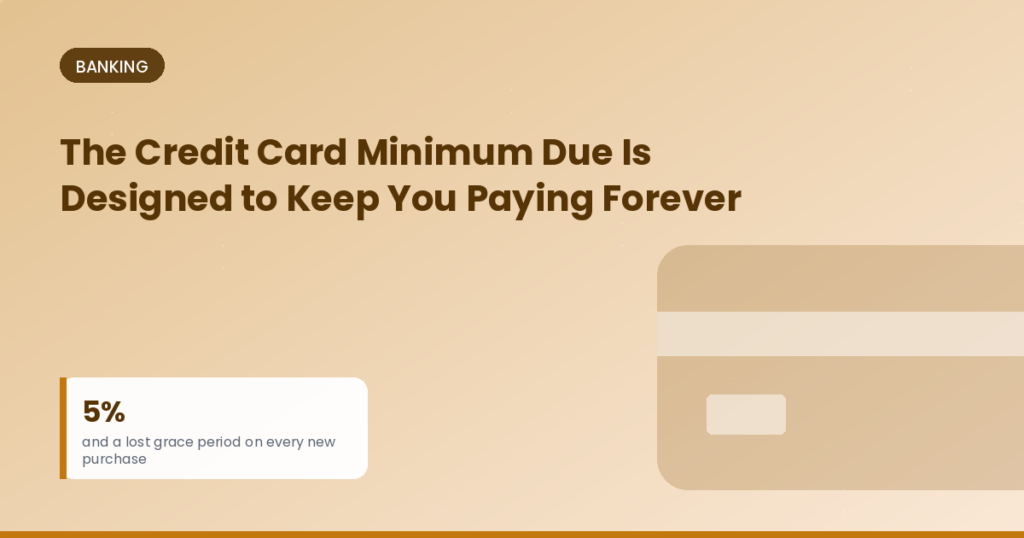
The credit card statement shows two numbers: the total amount due, and a much smaller “minimum amount due.” Paying just the minimum feels responsible — no late fee, account stays “current,” nothing gets reported as delinquent. It is also, by design, one of the most expensive ways to borrow money that looks completely normal on paper.
The minimum amount due is typically 5% of your outstanding balance (or a flat ₹200-500, whichever is higher). Paying it keeps your account in good standing and avoids a late payment fee and any credit score hit. What it does NOT do: stop interest from accruing on the remaining 95% of your balance, or — critically — preserve the interest-free grace period on new purchases. The moment you carry any revolving balance past the due date, every new purchase starts accruing interest from the day of purchase, with no grace period at all, until the full balance is cleared.
Indian credit card interest rates typically run 36-42% annualised (roughly 3-3.5% per month) on a revolving balance. GST at 18% applies on top of these interest charges and late payment fees, quietly adding to an already steep cost. Combined, a customer stuck in the minimum-due cycle can be paying an effective annualised cost well north of 40% — categorically worse than almost any other form of consumer credit, including most personal loans.
The minimum due is deliberately framed as the “safe” number to focus on — it’s the bold, prominent figure on the statement and the payment app’s default suggestion. Meanwhile, the true cost — the interest rate, the loss of the grace period, and the compounding effect of interest-on-interest as unpaid amounts roll forward — sits in the fine print. Psychologically, paying “something” every month feels like progress, which is exactly what makes it easy to keep doing for years without noticing the balance barely moves.
Pay the full statement balance every month if at all possible — this is the only way to avoid interest entirely and preserve the grace period on new purchases. If you’re already carrying a balance, prioritise paying it down aggressively rather than just the minimum, and consider a balance-transfer offer or a lower-cost personal loan specifically to pay off high-interest card debt — the arithmetic almost always favours moving the debt to a cheaper instrument over continuing to revolve it on the card.
It prevents a late-payment mark, which does help your score in that narrow sense — but a high credit utilisation ratio (carrying a large revolving balance relative to your limit) itself hurts your score, so the minimum-due strategy is only partially protective.
Yes — pay your statement balance in full for one full billing cycle. The interest-free grace period on new purchases typically resumes once you’ve cleared the entire outstanding balance, not just the minimum.
Source: Trade Brains: “The Credit Card ‘Minimum Due’ Trap — Why You Will Never Get Out of Debt”.
Disclaimer: This article is for general information only and is not financial advice. Interest rates, fees, and grace period rules vary by card issuer — check your specific card’s terms and conditions.
EPF and NPS both carry real equity exposure, while EPF-VPF tax thresholds are twice as generous for government…
Medical inflation runs 10-14% a year in India, nearly double the 5-6% general inflation most retirement calculators assume.
India has 967 SEBI-registered fiduciary advisers against over 1,33,000 commission-paid distributors.