

Your “Safe” Government Scheme Has a Stock Market Bet Built In
EPF and NPS both carry real equity exposure, while EPF-VPF tax thresholds are twice as generous for government…
 July 22, 2026by cyborg.vaibhav@gmail.com4 min read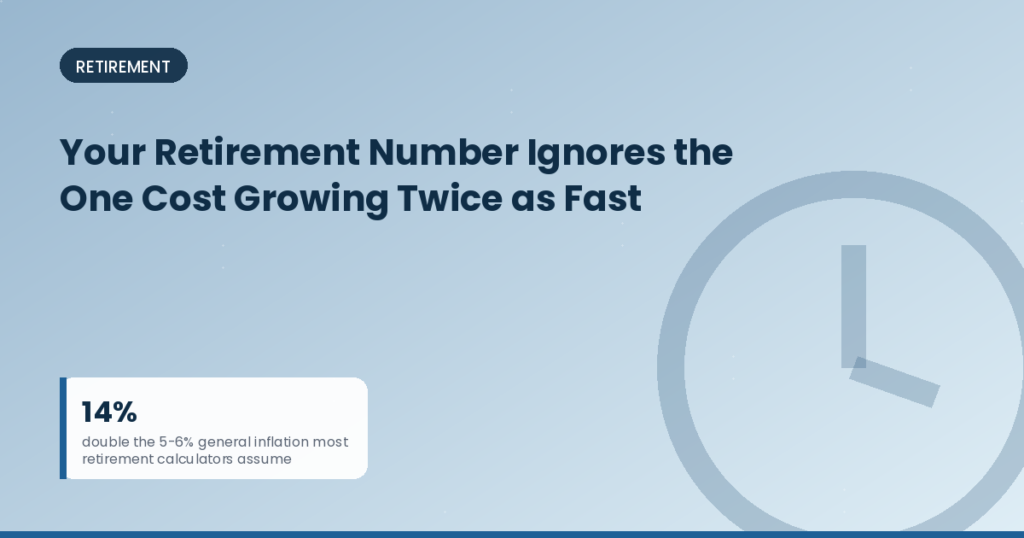
Run any standard retirement calculator and it will confidently tell you a number: 25-30 times your annual expenses, inflated at 5-6% a year, and you’re set for a comfortable retirement. What almost none of these calculators build in as a first-class assumption: your medical costs are very likely to rise at roughly double that rate, and a single serious health event late in retirement can blow through years of careful planning in one hospital stay.
General CPI inflation in India runs around 5-6% a year — the number every standard retirement calculator uses to project future expenses. Medical inflation runs at 10-14% annually, and India specifically has one of the highest medical inflation rates in Asia, well above the roughly 9.8% global average. A knee replacement that cost about ₹2.5 lakh in 2020 runs closer to ₹4.2 lakh today; a routine MRI has gone from roughly ₹3,500 to ₹7,200 over the same stretch. If your retirement corpus was built assuming healthcare costs grow at the same 5-6% as everything else, you are underestimating your single largest and least predictable retirement expense category.
Standard retirement corpus models assume a roughly flat, smooth annual withdrawal that grows with inflation — a reasonable simplification for groceries and utilities, a dangerous one for healthcare. Real retirements don’t spend on healthcare smoothly; they spend modestly for years and then face a lump-sum shock — a cardiac event, a cancer diagnosis, a hip fracture requiring surgery and rehabilitation — that can cost several years’ worth of the “smooth” healthcare budget in a single event. A corpus sized purely on average annual spending, with no separate buffer for a low-probability, high-severity event, can look perfectly adequate right up until the year it isn’t.
Beyond medical inflation itself, most retirement plans use a single life expectancy assumption (often the national average) rather than planning for the real possibility of living meaningfully longer — especially relevant for the healthier or better-off retirees this kind of planning most applies to. Combine an underestimated healthcare cost curve with an underestimated lifespan, and the standard “25-30x expenses” rule can leave a genuine multi-year gap late in retirement, exactly when the ability to earn additional income has disappeared entirely.
Financial planners increasingly suggest earmarking a dedicated health fund equal to roughly 20-25% of total retirement corpus, sized and inflated separately from routine living expenses, specifically to absorb this lumpier, faster-growing cost category. Separately, adequate health insurance (increasingly recommended in the ₹25-50 lakh range depending on age and city, given how fast treatment costs are rising) reduces — though doesn’t eliminate — the risk of a single event draining the core retirement corpus meant for everyday living.
No — insurance typically has sub-limits, co-pays, waiting periods for pre-existing conditions, and caps that can leave a real gap during a major illness, especially for older policyholders. It meaningfully reduces the risk but shouldn’t be treated as a full substitute for a dedicated health buffer within the retirement corpus itself.
It’s a reasonable starting benchmark, but the right figure depends on your age, existing health conditions, family medical history, and how comprehensive your health insurance already is — treat it as a floor to stress-test against your own situation, not a one-size figure.
Source: WealthEase, on medical inflation trends in India and their retirement planning impact.
Disclaimer: This article is for general information only and is not financial or medical advice. Inflation rates and healthcare cost estimates vary by region and individual circumstances — consult a qualified planner for your specific situation.
EPF and NPS both carry real equity exposure, while EPF-VPF tax thresholds are twice as generous for government…
India has 967 SEBI-registered fiduciary advisers against over 1,33,000 commission-paid distributors.
5% minimum due, 36-42% annual interest, and a lost grace period on every new purchase.