
Your Retirement Number Ignores the One Cost Growing Twice as Fast
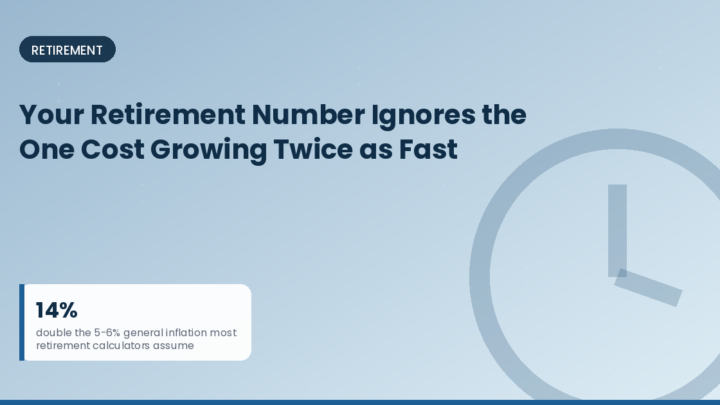
Medical inflation runs 10-14% a year in India, nearly double the 5-6% general inflation most retirement calculators assume.
 July 24, 2026by cyborg.vaibhav@gmail.com6 min read
The pitch every Indian saver has heard a thousand times: government schemes are “safe,” market-linked products are “risky.” Put your money in EPF, NPS, small savings schemes — sarkar ki guarantee hai. Here is the uncomfortable part almost nobody spells out plainly: a real and growing slice of the money you hand over to “safe” government-run retirement schemes is itself sitting in the stock market, the tax rules around it keep tightening on the ordinary saver specifically, and the same government collecting that money sets its own terms on when and how much you get back.
In a written reply to the Lok Sabha on 2 December 2024, the government confirmed that EPFO has invested in equity ETFs tracking the Nifty and Sensex since August 2015. As of March 2024, roughly ₹2.34 lakh crore of the EPF corpus sat in these ETFs, up from ₹22,766 crore in 2017-18 — growing every single year. What Parliament was also told, plainly: there is no government guarantee on this equity portion. The scheme sold to salaried India as a fixed-interest, risk-free provident fund has a real and growing exposure to the same stock market volatility that “safe” savers were told to avoid.
Budget 2021 made interest on EPF and Voluntary Provident Fund (VPF) contributions taxable once your own annual contribution crosses ₹2.5 lakh — a rule squarely aimed at disciplined savers who used VPF as a safe, high-interest place to build a large retirement corpus. The same rule sets the threshold at ₹5 lakh — double — for government employees. The single most reliable way ordinary private-sector savers had of compounding tax-free, guaranteed-feeling money got a lower ceiling than the one applied to the people writing the rule.
The National Pension System, actively promoted by the government as the modern retirement solution, is not a fixed-return product at all — it’s a market-linked scheme with an equity allocation (scheme E) that can run as high as 75% for younger subscribers under the auto-choice option, tapering only as you approach retirement. This isn’t hidden in fine print, but it directly contradicts the “government scheme equals safe fixed return” mental model that gets sold to a saver walking in the door. You are choosing your own equity exposure, inside a government-branded product, with the government setting the rules for withdrawal, annuitisation, and taxation on the way out.
A debt mutual fund is not run by the government and is not obligated to follow government fiscal priorities — its manager answers to unit holders and SEBI regulation, not to a finance ministry balancing a budget. That’s a genuine structural difference worth taking seriously. But it is not automatically safer in every sense: debt funds carry their own real history of failure — the 2019 DHFL default that forced side-pocketing across 165 schemes, and Franklin Templeton’s 2020 wind-up of six schemes holding ₹25,215 crore, freezing investor access for months. The honest comparison isn’t “government schemes bad, debt funds good” — it’s that BOTH carry risks that get undersold to retail savers who were told one word — “safe” — and left to discover the fine print themselves.
EPF money in equities with no guarantee. NPS built around a market-linked, government-set equity dial. A tax threshold on your own provident fund savings that’s twice as generous for the people who wrote the rule as for the people the rule applies to. A gold bond scheme (SGB) quietly discontinued once it became fiscally inconvenient, leaving early holders with restricted exit options. A pension scheme (PMVVY) with a locked-in rate that simply stopped being sold. None of these individually proves bad faith. Together, they show a consistent pattern: the government designs its own schemes’ terms, changes them when convenient, and applies different rules to itself than to the people it’s collecting money from — and “safe” was never a promise that those terms would stay generous, only that your capital was nominally protected.
Don’t panic-move retirement savings out of EPF or NPS — they still carry real advantages (employer matching, tax deductions, in EPF’s case a strong historical floor rate). Do stop assuming “government scheme” is a synonym for “no risk” or “rules that won’t change.” Diversify across both government-backed and independently-managed instruments, read the actual terms on equity exposure and tax thresholds rather than the marketing description, and treat every promise of “safety” — government or private — as a claim to verify, not a fact to assume.
Not directly comparable — EPF’s equity slice is a modest, diversified portion of a much larger debt-heavy corpus, and EPF has never defaulted on its declared interest rate. The point isn’t that EPF is unsafe; it’s that “guaranteed, zero market exposure” is not an accurate description of what EPF actually is today.
No — debt funds carry their own credit and liquidity risks, as the Franklin Templeton and DHFL episodes show. The better approach is understanding what each option — EPF, NPS, debt funds, FDs — actually is and isn’t, and diversifying deliberately rather than switching entirely based on a single narrative in either direction.
Sources: Outlook Money, citing the government’s Lok Sabha reply on EPFO’s equity ETF holdings; ReLakhs, on the differential Rs 2.5 lakh / Rs 5 lakh EPF-VPF interest taxation thresholds.
Disclaimer: This article presents a critical retail-investor perspective on government-run savings scheme design, grounded in the cited facts and figures. It is for general information only, not financial or investment advice, and does not allege illegality or bad faith on the part of any institution — readers should verify current scheme rules before making decisions and consider both the risks and genuine benefits (employer matching, tax deductions, historical stability) of EPF and NPS alongside independently-managed alternatives.
Medical inflation runs 10-14% a year in India, nearly double the 5-6% general inflation most retirement calculators assume.
India has 967 SEBI-registered fiduciary advisers against over 1,33,000 commission-paid distributors.
5% minimum due, 36-42% annual interest, and a lost grace period on every new purchase.