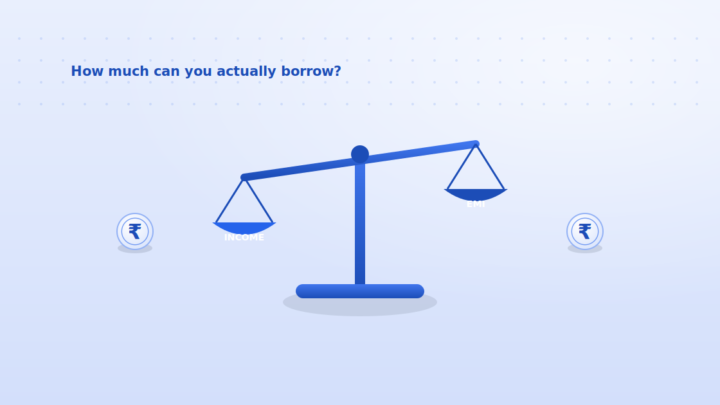
Loan Eligibility Calculator: How Much Can You Borrow?
Before applying, find out roughly how large a loan your income can support. This calculator estimates your eligibility.
 September 25, 2025by cyborg.vaibhav@gmail.com7 min read
A personal loan is fast, requires no collateral, and can land in your account within a day or two — which is exactly why it’s also one of the most expensive ways to borrow. There’s no asset backing the loan, so the lender prices in that risk with a rate that’s often double or more what a home loan charges. It’s a genuinely useful tool for the right situation and a costly habit for the wrong one.
EMI = P × i × (1+i)ⁿ ÷ [(1+i)ⁿ − 1], where P is the loan amount, i is the monthly interest rate, and n is the number of months — the same formula behind every amortizing loan, home or personal. What changes with personal loans is the rate: typically 10-24%, against 8-9% or so for a home loan, purely because there’s no property or asset the lender can fall back on if you stop paying.
A ₹3 lakh personal loan at 14% over 3 years works out to an EMI a little above ₹10,000 a month, with total interest paid over the tenure landing somewhere in the ₹65,000-70,000 range — meaning you’ll hand back roughly ₹3.7 lakh in total for a ₹3 lakh loan. That’s the real cost of the convenience, and it’s worth sitting with that number before signing.
A personal loan is a reasonable tool for a genuine, time-bound need — a medical emergency, an urgent home repair, consolidating several higher-rate debts (like credit card balances, which often run even hotter than personal loan rates) into one cleaner EMI. It’s a poor tool for discretionary spending — a vacation, a phone upgrade, a wedding expense that could instead be saved for — because you’re paying a steep rate for something that didn’t need to happen on borrowed time in the first place.
The most expensive mistake is comparing lenders only on the headline interest rate and ignoring the processing fee, which can run 1-3% of the loan amount upfront and meaningfully changes the real cost — always look at the APR (annual percentage rate), which folds fees in, rather than the advertised rate alone. The second is rolling one personal loan into another to “manage” payments, which usually just resets the clock and adds fresh fees without solving the underlying cash flow problem. The third is borrowing the maximum amount a lender offers rather than the amount actually needed — lenders often pre-approve more than is sensible to borrow.
Why is the interest rate so much higher than a home loan? Because it’s unsecured — there’s no property or asset backing the loan, so the lender charges more to compensate for the higher risk of default.
Can I prepay or foreclose the loan early? Usually yes, though many lenders charge a small foreclosure fee, typically a percentage of the outstanding principal — check this before signing, since it affects whether early repayment actually saves you money.
That congratulatory SMS — ‘You are pre-approved for ₹5 lakh!’ — is not underwriting; it is marketing with your data. Personal loans are the branch’s highest-margin retail product, so the machinery runs hot: 18–24% rates framed as ‘just ₹11,000/mo’, flat-rate quotes from app lenders, processing fees plus GST clipped upfront, and insurance packed into disbursal. The ‘instant’ in instant loan describes the bank’s profit recognition, not your convenience.
A personal loan has exactly two honest uses: genuine emergencies cheaper than card debt, and consolidating costlier debt downward. Funding lifestyle, vacations or ‘investment opportunities’ at 18% is arithmetic self-harm — the EMI feels small precisely because the tenure was stretched until it did.
Farooq Ansari, a composite mobile repair shop owner in Nanded built from a pattern common among app-loan borrowers, took a ₹1.5 lakh working-capital loan through a lending app to restock parts before Ramzan season. The app’s landing screen advertised “interest from 10.99%,” and the loan disbursed to his account within the hour — but the processing fee, a mandatory insurance add-on, and a platform fee weren’t shown until several screens deep, by which point he’d already accepted the loan.
What Farooq’s experience runs into is RBI’s 2022 Digital Lending Guidelines, introduced specifically to stop this pattern. The rules require the regulated entity actually funding the loan (a bank or NBFC, not just the app or “Lending Service Provider” facing the customer) to disclose the full, all-inclusive Annual Percentage Rate — every fee folded into one number — directly to the borrower, upfront, in a standardised Key Fact Statement, before the loan is accepted. The guidelines also restrict “first loss default guarantee” structures that previously let apps quietly absorb early defaults off their own books, obscuring the real credit risk from the regulated lender actually carrying the loan.
YOU ENTER the loan amount and let every fee flow into one number, and the calculator settles what Farooq’s actual cost of credit looked like once the processing fee and insurance were annualised alongside the headline 10.99% — a real APR closer to 24%, more than double what the landing screen implied. Under the 2022 rules, that full APR is supposed to appear in the Key Fact Statement before acceptance, not buried in a fee schedule three screens deep.
The practical takeaway: before accepting any app-based loan, ask specifically for the Key Fact Statement and check whether the regulated lender’s name (not just the app’s brand) appears on it. If an app can’t or won’t produce one, that alone is a signal to look elsewhere.
It’s also worth checking who actually owns the default risk. Before the 2022 guidelines, some apps quietly guaranteed a lender’s early losses through informal arrangements, which meant the app had every incentive to disburse aggressively since it wasn’t fully exposed to the downside of bad loans. Restricting those structures pushes the real credit risk back onto the regulated entity whose name should be on your Key Fact Statement — which is exactly why that document, not the app’s marketing screen, is the one worth reading closely.
Farooq’s second loan, taken a year later from a different app after he’d learned this lesson, took him three extra minutes to check the Key Fact Statement against the landing-page rate before accepting — and that small habit alone caught a similar gap in a competing app’s disclosure before he’d committed to anything.
‘From’ is doing the work — that rate belongs to a borrower profile that isn’t you (or anyone). Your offer letter’s annualised reducing rate, including fees, is the only number that exists.
Genuinely yes — 14% retiring 42% is a two-thirds pay cut for your creditor. The trap is refilling the card afterwards; consolidation without a spending stop is a debt escalator.
Disclaimer: Farooq Ansari is a composite character built from a pattern common among app-loan borrowers, not a real person. This article is for general information only and is not financial or tax advice. Consult a qualified advisor before making investment or tax decisions.
Before applying, find out roughly how large a loan your income can support. This calculator estimates your eligibility.
A loan against property unlocks cash from real estate at lower rates than a personal loan. This calculator…
Buying a home is a big decision. This calculator shows your home-loan EMI, total interest, and the savings…
Knowing your EMI matters, but the real savings hide in prepayment. This calculator shows how much interest and…
Before buying a car, know exactly what the loan will cost each month. This calculator shows the EMI…
If your loan rate is high, transferring to a cheaper lender can save lakhs. This calculator shows the…