
Whole Life Insurance: Sold as an Investment, It Is Neither
A year of premiums in commission explains the pitch. Term plus index investing ends $929,000 ahead -- same…
 December 5, 2025by cyborg.vaibhav@gmail.com8 min read
Todd Bergstrom, a sales engineer in Des Moines, did the two things every windfall guide tells you to do in the same November. In October he sold a losing tech-stock position to harvest the loss against his taxes, the way any decent tax-planning article recommends. In November his year-end bonus landed, and he did what this very article is about to tell you the data supports: he put it to work right away, in a fund tracking the same index his losing position had tracked. Both moves were individually correct. Done in the same month, they cancelled each other out. (Todd is a composite character based on common windfall-investing situations, not a real person — more on that at the end.)
A bonus hits. An inheritance arrives, or a house sale closes, and suddenly you’re holding more cash than you’ve ever invested at once. The instinct — and a lot of well-meaning advice — is to ease it in slowly so you don’t buy at the top. The data has been quietly disagreeing for decades.
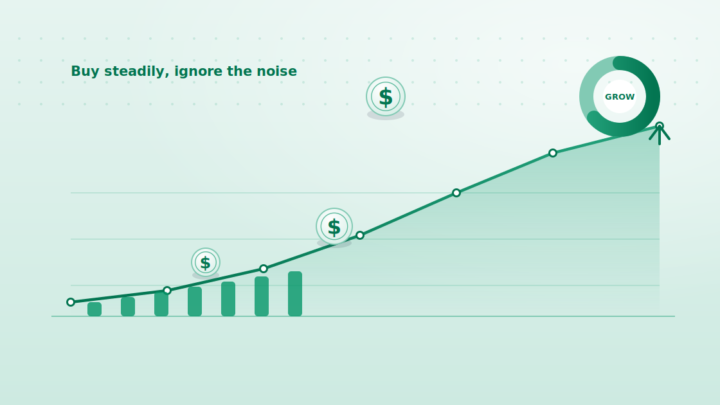
Because markets rise more often than they fall, putting a lump sum to work now has historically beaten spreading it out, most of the time, across most historical periods studied. Money invested earlier simply has longer to compound. The comparison below shows what one sum, left alone, can become over time.
Example: invest a $50,000 windfall today at 7% average annual growth and in 20 years it’s roughly $193,500. Spread that same $50,000 into the market gradually over the next 12 months instead, and — on average, across most historical stretches — you end up with somewhat less at the 20-year mark, simply because a portion of the money sat in cash during the exact months it could have already been compounding.
That said, comfort isn’t worthless. If dropping the whole amount in on Monday and watching it fall 10% by Friday would make you panic-sell everything, easing it in over a few months is the right move for you — not because the math favors it, but because it keeps you from doing something far more expensive in a moment of fear.
Two things worth holding firm on regardless of which approach you pick. Match the money to the timeline — a windfall you’ll need in two years has no business in the stock market. And don’t let it rot in checking for six months while you “decide” what to do; idle cash is a real, quiet loss to inflation.
Who this matters for most: anyone who’s just received or is about to receive a windfall and feels frozen by the size of the decision. Stocks for the far-off goals, safe cash for the near ones, deployed reasonably promptly.
Money that arrives visibly — inheritance, severance, home sale, settlement — triggers a coordinated welcome party. The bank flags the deposit for its brokerage arm’s call list; annuity sellers arrive with ‘guaranteed lifetime income’ illustrations; whole-life agents discover you; and a cousin has a business idea. Every pitch shares one feature: urgency, because deliberation is the predator’s enemy.
The defense is a waiting period with rules: park it in T-bills/high-yield savings (4%+ while you think), tell callers you have a 90-day policy, pay off high-interest debt first (a guaranteed 20%+ ‘return’), then deploy boring — index funds, lump or averaged over months. Nothing about a windfall changes investing math; it only changes who calls you.
Here is Todd’s actual problem, and the reason it belongs in this specific article rather than a generic tax page: the same instinct to “deploy the windfall promptly” is exactly what walks people into it. The IRS wash sale rule, codified at Internal Revenue Code Section 1091, disallows a capital loss deduction if you buy a “substantially identical” security within 30 days before or 30 days after the sale that generated the loss — a 61-day window in total, counting the sale date itself.
Todd’s October sale locked in an $8,000 loss he planned to use — up to $3,000 against ordinary income this year, the rest carried forward. When his November bonus went into a fund tracking the same index as the stock he sold, the IRS treated that purchase as happening inside the wash-sale window. The rule does not require buying back the identical ticker; “substantially identical” can include an index fund tracking the same benchmark closely enough. Result: his $8,000 loss was disallowed for this year’s taxes and instead added to the cost basis of his new shares, deferring the benefit rather than destroying it — but deferring it to a sale that might be years away.
What nobody tells you: the wash sale rule follows you across account types, not just within one brokerage. Buying the substantially identical security in an IRA, a spouse’s account, or even a different brokerage entirely still triggers it — and if the repurchase happens inside a tax-advantaged account like an IRA, the IRS position is that the disallowed loss is gone permanently, not just deferred, because there is no future taxable sale in that account to add the basis to. A windfall that gets routed into “the safe account” can be the exact mechanism that makes a harvested loss disappear for good.
The fix is not complicated once you know it exists. Wait 31 days after harvesting a loss before redeploying new money into the same or a closely tracking fund, or redirect the windfall into a similar-but-not-identical index (a different provider, a slightly different benchmark) so the money stays invested without tripping the rule. What the calculator settles for Todd: enter the amount you want to deploy today and the date of any recent loss-harvesting sale, and it tells you whether today is inside or outside the 61-day window that decides whether your loss survives.
It does not mean tax-loss harvesting is a bad idea, or that windfalls should sit in cash out of fear of the rule. Both practices are sound on their own; the problem is purely a timing collision between two good ideas, and it is entirely avoidable once you know the 61-day window exists.
It also does not mean every repurchase of anything related is a violation. Buying a different company’s stock, or a fund tracking a meaningfully different index, is not “substantially identical” under the rule — the ambiguity exists mainly around near-identical index funds and options on the same security, not across genuinely different investments.
And it does not mean the deduction is lost forever in the ordinary case. Outside an IRA, a disallowed wash-sale loss is deferred into your new shares’ cost basis, not destroyed — you get the benefit eventually, just not on the schedule you planned.
You trade market risk for issuer risk, surrender schedules and 2–3% annual costs. ‘Can’t lose’ products lose slowly, by design, in fees and inflation.
After debts and the emergency fund: within 6–12 months for most, lump-sum if your stomach allows. The only wrong speeds are ‘today, into what a caller sold’ and ‘never’. If you recently harvested a loss, check the 61-day window before picking a fund, not after.
The IRS has never issued a precise definition, deliberately, so it is judged on the facts. Two different companies’ stock is not substantially identical even in the same sector. The grey zone is index funds tracking the same benchmark from different providers — treat those as risky to swap within 30 days of a loss sale.
Regulatory source: the IRS defines the wash sale rule under Internal Revenue Code Section 1091 and discusses it in Publication 550. The application to a same-month tax-loss-harvest-then-windfall scenario, and Todd’s specific numbers, are this article’s own.
General information, not financial advice. “Todd Bergstrom” is a composite character based on common windfall-investing situations, not a real person.
A year of premiums in commission explains the pitch. Term plus index investing ends $929,000 ahead -- same…
A coworker once spent his lunch breaks picking stocks, glued to his phone, riding the high of a…
Everyone wants to "buy the dip" and sell the top. Almost nobody actually does it, because nobody knows…
Two friends, same age, same paycheck. One starts investing $300 a month at 25. The other keeps meaning…
A $500/mo habit over 20 years grows to far more than most people expect. See exactly how much…
The HSA shoebox strategy, 457(b) stacking, asset location, 0% capital gains harvesting, NUA and the mega-backdoor Roth, plus…