Rent in the City, Buy Farmland, Pay No Tax: The Advice That Raises Your Tax Bill
Agricultural income is exempt, but partial integration uses it to pick a higher rate for your salary. The…
 January 16, 2026by cyborg.vaibhav@gmail.com7 min read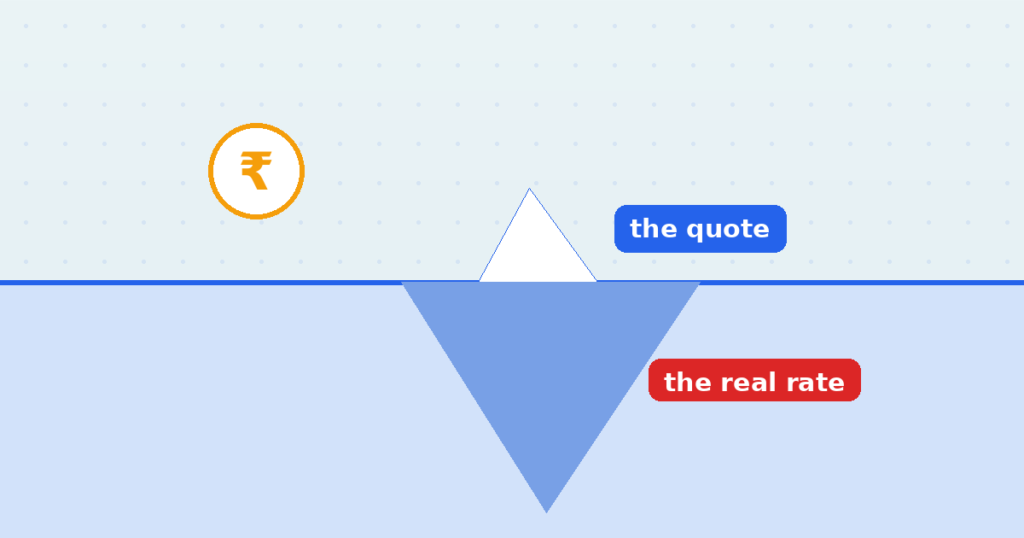
Ravi Deshmukh, 32, a supply-chain analyst in Pune, watched the showroom manager slide the paper across: “Sir, only 8% interest.” Ravi can do math — 8% of ₹6 lakh is ₹48,000 a year, seems fair for a car loan. What the paper did not say: this was a flat rate, charged on the full ₹6 lakh for all five years — including the lakhs he would have already repaid. The real rate on Ravi’s loan is 14.13%. He negotiated the car’s price for an hour and the loan’s price not at all, and the dealership counted on exactly that — even though a regulation that should have stopped this exact pitch had already been in force for over a year by the time he sat down at that desk.
A reducing-balance loan — every bank home loan works this way — charges interest each month only on what you still owe. A flat-rate loan charges interest on the original amount till the last EMI, as if you had repaid nothing. By the final year, Ravi owes barely a lakh but pays interest on six. The flat number is engineered to be small and quotable; the arithmetic conversion is roughly flat × 1.8 ≈ real, and it is never printed on the brochure.
Since October 1, 2024, the RBI requires every bank and NBFC to hand borrowers a Key Facts Statement (KFS) for new retail and MSME term loans — a standardized, one-page summary that must state the Annual Percentage Rate (APR), the true all-in cost of borrowing including fees, insurance add-ons, and processing charges, not just a headline interest number. A car loan is exactly the kind of retail term loan this rule covers. Any charge not disclosed in the KFS cannot be added later without the borrower’s explicit consent. If Ravi’s financing came through after that date and he was handed only a flat-rate figure with no KFS showing the APR, the dealership wasn’t just being unhelpful — it was skipping a specific, dated disclosure requirement that exists precisely to stop a flat number from being compared against a reducing-rate quote as if they were the same thing.
RBI’s fair-practice guidance requires lenders to disclose the effective annualised, reducing-balance rate. Car dealers, consumer-durable counters and many NBFCs quote the flat number anyway, because the fine print technically exists somewhere and nobody at a showroom on a Sunday reads annexures. The grey practice is not the flat rate itself — it is quoting it naked, next to a bank’s reducing rate, knowing you will compare the two as if they were the same species. The KFS mandate closes some of that gap on paper; whether a specific showroom actually hands one over on a Sunday afternoon is a separate, ongoing enforcement question.
Enforcement of the KFS rule works through the regulated lender’s own compliance function and RBI supervisory inspections, not through a showroom clerk’s goodwill — which is exactly why a rule that took effect in October 2024 could still fail to reach a customer standing at a sales desk in 2026. The paperwork obligation sits with the bank or NBFC underwriting the loan; the sales conversation happens with a dealership employee whose incentive runs the opposite direction. Nothing stops a borrower from insisting the two connect before signing — it just takes asking for the document by its actual name, out loud, before any paperwork gets signed, and well before any free seat cover gets offered as a distraction from it.
YOU ENTER the flat rate, loan amount, and tenure from any showroom quote. IT TELLS YOU the true reducing-balance rate and EMI — the exact number Ravi’s KFS, had one been handed over, would have been legally required to show him upfront.
A flat rate charges interest on the full original principal for the entire tenure, even though you're paying that principal down every month: EMI = (P + P×R×years) ÷ (years×12). A reducing (or "diminishing") balance rate, the standard for home and most personal loans, charges interest only on what's still outstanding, which is why its EMI on the same headline rate comes out noticeably lower. Used-car loans, gold loans, and many personal/consumer loans are quoted flat — always ask the lender directly whether a quoted rate is flat or reducing before comparing offers.
The "true effective rate" above is the reducing-balance rate that would produce the exact same EMI as your flat-rate loan — a same-basis number you can actually compare against a bank's reducing-rate offer.
One question, asked while looking them in the eye: “Is that flat or reducing, and can I see the Key Facts Statement with the APR?” If the answer is flat, or there’s no KFS forthcoming — or a sudden interest in offering you a free seat cover instead — multiply the rate by 1.8 in your head and compare that against a bank’s quote. Better: run the calculator above in the showroom; it solves the true reducing-equivalent rate from any flat quote in seconds. The EMI being “affordable” is not the test. The rate is the test, and since October 2024, asking for the KFS by name is a legitimate, specific request rather than an awkward one.
Commission from the financier, often 1-3% of the loan — sometimes more than the margin on the car. The discount they “give” you on the car frequently comes back to them through the loan.
If the flat quote × 1.8 still beats every reducing-balance offer you can get — rare, but possible — then the structure does not matter, only the true cost does. Compute first, sign second.
Ask in writing and keep the request on record — the RBI’s mandate applies to the regulated entity (the bank or NBFC actually extending the loan), not just the showroom staff relaying its terms, so escalating past the sales desk to the lender directly is the more effective route if a KFS isn’t produced.
No — the KFS requirement specifically covers new retail and MSME term loans, which includes car loans, personal loans, and most consumer-durable financing, but credit card receivables are explicitly carved out of this particular mandate. That distinction matters if a salesperson tries to wave off a KFS request by treating all forms of consumer credit as equivalent; a car loan is squarely inside the rule’s scope even if a credit card wouldn’t be.
The gap between what the rule requires and what actually happens at a Sunday-afternoon showroom desk is exactly where Ravi’s ₹48,000-a-year mistake lived. The KFS mandate didn’t fail as a policy — it simply wasn’t invoked, because nobody in the room said the three words that trigger it. That’s the part worth internalizing more than any specific percentage: a flat-rate quote isn’t illegal by itself, and a KFS isn’t automatically volunteered by a lender who’d rather you didn’t ask. The protection exists on paper the moment a retail term loan is signed; it exists in practice only once a borrower actually asks for the page that spells out the APR in writing, before agreeing to anything.
Source: Reserve Bank of India, Key Facts Statement (KFS) for Loans and Advances, effective October 1, 2024, at rbi.org.in.
Disclaimer: This article is for general information only and is not financial advice. “Ravi Deshmukh” is a composite character with invented finances, not a real person. Consult a qualified advisor before signing any loan agreement.
Agricultural income is exempt, but partial integration uses it to pick a higher rate for your salary. The…
Deferring tax is an interest-free loan from the government. Growth vs IDCW, employer NPS, gain harvesting, CGAS, section…
EPF and NPS both carry real equity exposure, while EPF-VPF tax thresholds are twice as generous for government…
Medical inflation runs 10-14% a year in India, nearly double the 5-6% general inflation most retirement calculators assume.
India has 967 SEBI-registered fiduciary advisers against over 1,33,000 commission-paid distributors.
5% minimum due, 36-42% annual interest, and a lost grace period on every new purchase.