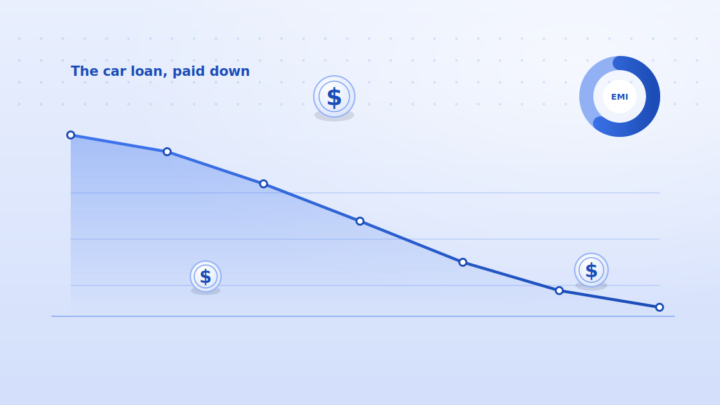
Financing a Car: Interest on Something That’s Shrinking
Here's the part the dealership would rather you didn't dwell on: the moment you drive a new car…
 April 14, 2026by cyborg.vaibhav@gmail.com7 min read
Brian financed his car through the dealership two years ago at 7.9% APR, the number the finance manager pulled up on a screen and presented as simply “the rate.” Last month, refinancing through his credit union, the loan officer asked an offhand question that changed how Brian understood that entire transaction: “did you know the dealer marks that number up?” He hadn’t. The 7.9% he signed for wasn’t the lender’s actual assessment of his creditworthiness — it was a lower number the lender had approved, with the dealership adding roughly two percentage points on top and keeping the difference, legally, as compensation for arranging the loan.
Brian is a composite character — a stand-in for a pattern that shows up constantly among buyers who finance directly through a dealership, not a real loan record. His numbers are invented. The dealer-markup mechanism that raised his rate is not.
How this article was checked. The description of dealer reserve and indirect auto lending below is drawn directly from the CFPB’s own published guidance as reviewed in July 2026. Specific enforcement actions and industry practices can change — check consumerfinance.gov for current guidance before relying on a specific detail.
When you finance through a dealership rather than bringing your own bank loan, you’re almost always using what the industry calls indirect financing: the dealer submits your application to one or more third-party lenders, who each respond with a “buy rate” — the interest rate that specific lender is actually willing to accept based on your credit profile. The CFPB’s own guidance describes what happens next plainly: many indirect lenders then allow the dealer to charge you a higher rate than the buy rate, called a dealer markup, and share some or all of that extra interest revenue back to the dealer as compensation for originating the loan.
Dealer reserve is a long-standing, legal method of compensating dealers for the value of arranging financing, and it’s disclosed in the fine print of the retail installment contract industry-wide rather than announced at the negotiating table as its own number. The CFPB’s specific fair-lending concern — the focus of a coordinated CFPB and Department of Justice action against a major indirect auto lender — isn’t that markup exists, but that giving dealers open discretion over how much to mark up a given loan creates room for the same buy rate to turn into very different final rates for similarly qualified borrowers, without any credit-based justification for the difference.
Brian’s actual creditworthiness, in the lender’s own assessment, supported a 5.9% rate. The two-point markup the dealership added meant every month of his loan carried meaningfully more interest than his credit profile alone would have produced. Over the full term of a multi-year auto loan, a two-point rate difference on a normal-sized loan balance adds up to real money — often more than most buyers would accept if the markup were presented to them as a separate, negotiable fee rather than folded invisibly into “the rate.”
Get pre-approved by a bank or credit union before you go car shopping, so you walk in already knowing a real rate you qualify for and can compare any dealer-arranged offer against it directly. If you do finance through the dealer, ask the finance manager directly whether the rate includes a markup over the lender’s buy rate — you may not get a precise answer, but the question itself signals you’re comparison-shopping the rate, not just the payment. And treat the interest rate as its own negotiable line item, separate from the vehicle price and the monthly payment, the same way you’d negotiate any other cost on the deal.
This is not a claim that dealer financing is always a bad deal — manufacturer-subsidized promotional rates arranged through a dealership can genuinely beat anything a bank or credit union will offer, and dealer reserve by itself isn’t illegal. The CFPB’s enforcement focus has specifically been on discretionary markup applied in a way that produces different rates for similarly qualified borrowers without a credit-based reason, not on the existence of dealer compensation itself. The point is narrower: the rate presented at the finance desk is not necessarily the lender’s own assessment of your credit, and walking in with an outside pre-approval is the simplest way to know the difference.
Not by itself — it’s a long-standing, legal way to compensate dealers for arranging financing. The CFPB’s concern has been specifically about markup applied in a discriminatory or unjustified pattern across similarly qualified borrowers, not the practice of markup existing at all.
It’s difficult to know for certain after the fact, since the buy rate isn’t typically disclosed to the buyer. The more reliable approach is getting pre-approved before you shop, so you have your own confirmed rate to compare against whatever the dealer offers.
Not automatically — compare both. Manufacturer promotional financing can sometimes beat any outside rate, and having a pre-approval in hand doesn’t stop you from taking the dealer’s offer if it’s genuinely better; it just means you’ll know if it isn’t.
Often, yes — refinancing an existing auto loan through a bank or credit union at a lower confirmed rate, once your credit history includes on-time payments, is a common and effective way to correct an initial markup after the fact.
Nothing in federal law requires it, and the markup is the dealership’s compensation for arranging the financing in the first place — disclosing the buy rate would functionally reveal exactly how much of that compensation exists on a given deal, which no seller is required to volunteer about its own margin on any part of a transaction, not just financing.
Yes — the same rate difference compounds over more months on a longer-term loan, so a markup that might be a modest total cost on a 36-month loan becomes considerably larger on a 72-month term, on top of the “underwater” risk a longer term already carries from depreciation alone.
Statutory sources, all official: CFPB, Bulletin on Indirect Auto Lending and Compliance with ECOA; CFPB and DOJ, Ally Financial Auto Loan Pricing Enforcement Action. The framing of dealer markup as a specific, quantifiable cost for an individual buyer is Linqz’s own analysis, not stated as such by the CFPB.
Disclaimer: General information, not financial advice, and Linqz is not a lender or a registered investment adviser. “Brian” is a composite character with invented finances, not a real person. Indirect lending practices and regulatory guidance can change — verify current details at consumerfinance.gov before acting, and consult a qualified professional about your own loan.
Here's the part the dealership would rather you didn't dwell on: the moment you drive a new car…
Claiming at 62 vs 70 can change your monthly benefit by more than 50%. See your own numbers…
Same contribution, two tax treatments, very different after-tax outcomes depending on one bet: your future tax bracket.
Skip the scary generic headline number. Work backward from your own real spending to find what you actually…
Salary isn't take-home pay. See what federal tax, payroll taxes, and deductions actually leave you with.
Income doesn't measure progress - assets minus liabilities does. Add up your own numbers and track the trend…