
The Scary Number, and Why You Shouldn’t Look Away
At some point a calculator tells you you'll need "$2 million to retire" and your stomach drops. The…
 May 19, 2026by cyborg.vaibhav@gmail.com7 min read
Karen hit her retirement number at 62 — $1.2 million, calculated the standard way, $4,000 a month in spending divided by a 4% withdrawal rate. She retired feeling genuinely secure. At 84, her Medicare premium jumped by several hundred dollars a month with no change in her spending, no new diagnosis, nothing she could point to. What actually happened is that the IRS doesn’t let a retirement account owner keep withdrawing at 4% forever — a legally required percentage rises every year she’s alive, and by her mid-eighties it had pulled well past what her “number” was ever built to produce.
Karen is a composite character — a stand-in for a pattern that shows up across retirees who saved diligently in traditional accounts, not a real account record. Her numbers are invented. The rising withdrawal schedule that caught up with her is not.
How this article was checked. The required minimum distribution figures below come directly from the IRS Uniform Lifetime Table in Publication 590-B. The Medicare IRMAA mechanism is described from the Social Security Administration’s own published process. Both the RMD divisor table and the IRMAA income thresholds are reviewed and can be updated by their respective agencies — check irs.gov and ssa.gov for the current-year figures before relying on any specific number here.
The standard retirement-number calculation — monthly spending divided by a withdrawal rate, usually 4% — assumes you’ll keep withdrawing at roughly that same rate for the rest of your life. That’s a reasonable planning assumption for your own spending. It is not, however, what federal law actually requires once you own a traditional IRA or 401(k). The IRS’s Uniform Lifetime Table sets a required minimum distribution for every year past a set starting age, expressed as a percentage of your account balance that climbs every single year you’re alive, whether or not you need or want the money.
At 73, the IRS table requires a withdrawal of roughly 3.7% of the prior year-end balance — close enough to her planned 4% that nothing felt unusual. By 80, the required percentage rises to roughly 5%. By 90, it’s roughly 8%. Karen’s account, boosted by market growth she hadn’t spent down, was still substantial by her mid-eighties, and an 8% required withdrawal on that balance produced far more taxable income in a single year than her actual $4,000-a-month spending needed. The extra income didn’t sit quietly — it pushed her modified adjusted gross income high enough to cross a Medicare income threshold two years later, triggering an income-related surcharge on her Part B and Part D premiums that had nothing to do with how she was actually living.
A 4%-based number is a solvency check — will the money last — not a forecast of the tax and Medicare consequences of what you’ll eventually be forced to withdraw. Required minimum distributions are calculated purely from the prior year-end account balance and the IRS’s own divisor table; they don’t know or care what your monthly budget says you need. Someone who saved diligently and let a large traditional balance grow can hit a stretch in their eighties or nineties where the required withdrawal is genuinely double their spending, and nothing in the original “$4,000 divided by 4%” calculation ever surfaces that.
If a large share of retirement savings sits in traditional, pre-tax accounts, model the IRS’s required minimum distribution percentages against expected spending at several future ages — not just the withdrawal rate used to size the original number. Converting some traditional balances to a Roth IRA during lower-income years before required distributions start shrinks the pre-tax balance those future percentages apply to, at the cost of paying tax on the conversion now. And because Medicare’s income-related surcharge looks at income from two years earlier, a large one-time RMD or Roth conversion is worth timing deliberately rather than triggering by accident in a year that happens to push you over a threshold.
The years between retiring and the age required distributions begin are the ones that actually matter most for this planning, precisely because they’re the only years where you control the timing of withdrawals rather than the IRS’s table controlling it for you. Someone who retires at 62 and doesn’t start required distributions until 73 has roughly a decade where converting traditional balances to Roth, ideally while still in a lower bracket than during working years, can be done gradually and deliberately rather than all at once. Spreading conversions across several of those years, rather than doing one large conversion, also avoids pushing a single year’s income high enough to trigger its own Medicare surcharge two years later — the same mechanism that eventually caught up with Karen, just self-inflicted instead of forced.
This is not an argument against saving in traditional retirement accounts, and having “too much” in savings is a genuinely good problem compared with the alternative. It also doesn’t mean Roth conversions are automatically right for everyone — they trigger tax now in exchange for smaller forced withdrawals later, and whether that trade makes sense depends on your current bracket versus your expected bracket in your eighties and nineties. The point is narrower: a retirement “number” built purely from a target withdrawal rate describes whether your money lasts, not what the IRS will eventually force you to withdraw, and those two things can diverge substantially late in retirement.
Current law sets the starting age at 73, moving to 75 for people born in 1960 or later under rules phased in by the SECURE 2.0 Act — confirm your specific starting age against current IRS guidance, since this has changed more than once in recent years.
Roth IRAs owned by the original account holder are not subject to required minimum distributions during their lifetime, which is exactly why shifting some balance from traditional to Roth before RMDs begin reduces the future forced-withdrawal amount.
No — only those whose modified adjusted gross income, including the RMD, crosses the income thresholds Social Security uses to determine the surcharge, which start at a level well above typical middle-income spending. Larger traditional account balances make crossing that line more likely as required percentages rise with age.
Not necessarily — withdrawing faster than you need also creates taxable income now. The more targeted approach is modeling the specific years where required withdrawals are likely to exceed spending, and addressing those years directly through conversions or timing, rather than changing behavior across the board.
Statutory sources, all official: IRS Publication 590-B, for the Uniform Lifetime Table and required minimum distribution rules; Social Security Administration, Income-Related Monthly Adjustment Amount, for how Medicare’s income-related surcharge is determined. The framing of a rising RMD percentage as a gap against a flat “4% number” is Linqz’s own analysis, not stated as such by either agency.
Disclaimer: General information, not tax or financial advice, and Linqz is not a CPA firm or a registered investment adviser. “Karen” is a composite character with invented finances, not a real person. RMD starting ages, divisor tables and Medicare income thresholds are set by federal law and agency guidance and are updated periodically — verify current-year figures on irs.gov and ssa.gov before acting, and consult a qualified professional about your own accounts.
At some point a calculator tells you you'll need "$2 million to retire" and your stomach drops. The…
Claiming at 62 vs 70 can change your monthly benefit by more than 50%. See your own numbers…
Same contribution, two tax treatments, very different after-tax outcomes depending on one bet: your future tax bracket.
Salary isn't take-home pay. See what federal tax, payroll taxes, and deductions actually leave you with.
Income doesn't measure progress - assets minus liabilities does. Add up your own numbers and track the trend…
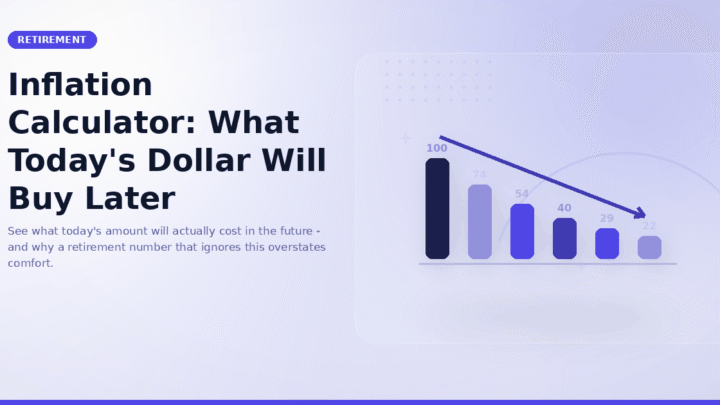
See what today's amount will actually cost in the future - and why a retirement number that ignores…