GST Calculator: Add or Remove GST Instantly
Need to add GST to a price or strip it out of one? This calculator does both in…
 March 2, 2026by cyborg.vaibhav@gmail.com7 min read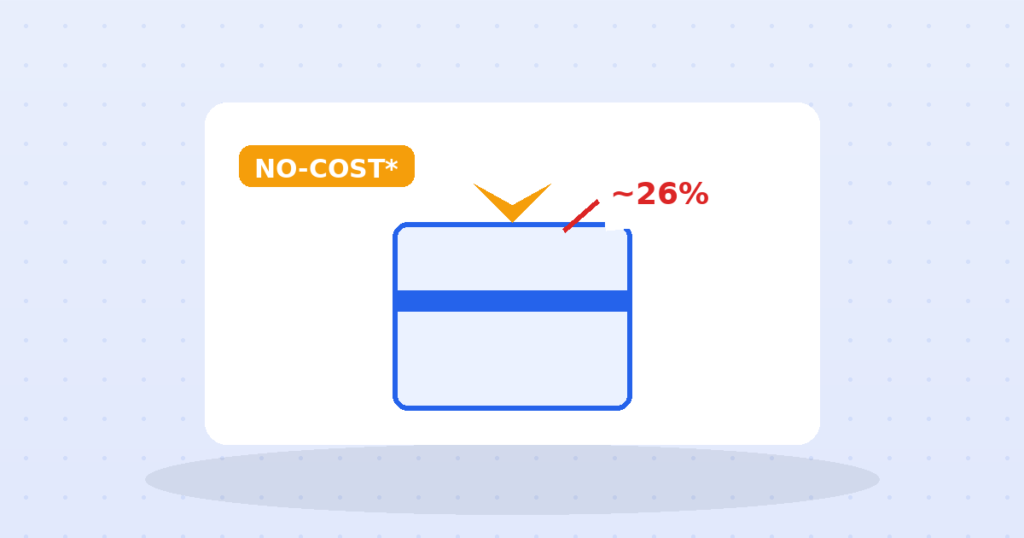
The phone cost ₹30,000, and the checkout page smiled: “No-Cost EMI — pay ₹5,000 × 6. Total: ₹30,000.” Zubin Screwvala, a retail sales associate in Vadodara — a composite character based on common consumer-finance patterns, not a real person — took it, because free financing is free money. Except: the cash buyer next to him paid ₹28,500 after an “instant discount” Zubin’s EMI made him ineligible for. Plus a ₹199 processing fee. Plus GST on an interest component that legally exists inside the deal even though the brochure says it doesn’t. “No-cost” cost him about ₹1,938 — an effective ~26% annualised on the money he actually borrowed. The name is not a description. It is a sedative.
RBI does not permit truly zero-interest lending games, so the industry built a costume: the lender charges interest (typically 12–15%), and the “no-cost” illusion is created by the merchant funding an equivalent discount — a discount that, note carefully, the cash buyer often receives directly instead. Your EMI schedule genuinely sums to the sticker price; what vanished is the cheaper price that existed beside it. Add the processing fee, and add GST at 18% — charged on the interest component the structure pretends not to have. The tax office, at least, is not fooled about what this is.
Here is the fact almost no article on this topic quotes directly, because it predates most of them. In September 2013, RBI wrote to banks about exactly this category of scheme and made a finding that has never been walked back: the very idea of a “zero percent interest” retail finance scheme is fictitious, because the interest cost is simply relocated into a higher product price, a processing fee, or a foregone discount, rather than eliminated. RBI’s direction to banks was to stop offering finance under a “zero percent” or “no-cost” label at all, and instead disclose a genuine, uniform interest rate and processing charge on every such scheme — so a customer compares like with like instead of comparing a real price against a marketing phrase.
That single finding is the reason every “no-cost EMI” screen today is, strictly, describing a structure the regulator already told banks not to name that way. The label survived in shopping-cart copy anyway, because the rule was addressed to the lending side of the transaction, not to how a merchant’s checkout page is worded — a gap the industry has lived in for over a decade.
Notice what the finding does and does not settle. It does not say a merchant may never advertise EMI options, and it does not fix a number you can quote as “the cost”. What it settles is the premise: there is no such thing as truly costless short-term retail finance manufactured out of nowhere. Somebody — the lender, the merchant, or you — pays for the time value of the money you are borrowing, every time, without exception. The only open question at any given counter is which of the three it is, and by how much. Once that premise is accepted, the checkout screen stops being a source of information and starts being a claim you have to test, the same way you would test “up to 70% off” at a clearance sale.
Nobody runs an IRR on a phone. The absolute rupees are small enough to be waved off — ₹1,900 on ₹30,000 — but the rate is card-debt territory, and the mechanism trains a habit: converting purchases into monthly obligations by default. Consumer-durable finance desks sit inside stores because the point of sale is the point of least arithmetic. The whole model monetises the distance between “sounds free” and “is 26%”.
Shows both directions at once: what the total becomes if GST is added to this amount, and what the base price and tax portion are if this amount already includes GST. Common slabs are 5%, 12%, 18%, and 28% — set the rate that applies to your item or service.
Always ask one question at the counter: “What is the cash / upfront price with all discounts?” — then compare totals, including fees and GST lines, not instalment counts. If the cash price equals the EMI total to the rupee and there is no fee, the financing is genuinely free — it happens, occasionally, when brands subsidise launches. Otherwise you are borrowing at a rate nobody printed. And if you would not put the phone on a credit card revolving at 26%, do not put it on a scheme that is the same thing wearing a bow.
It does not mean every no-cost EMI offer is a scam — when a brand genuinely absorbs the entire interest cost as a launch subsidy and the cash price and EMI total truly match, the label is accurate and the financing really is free. It does not mean RBI’s 2013 finding banned the practice outright — it addressed how banks price and disclose such schemes, not the marketing language a retailer’s checkout page uses, which is why the phrase never disappeared. And it does not mean EMI itself is the villain; spreading a large, planned purchase over months at a genuinely disclosed rate can be a reasonable choice. The problem is a specific one: a name that implies zero cost attached to a structure that, examined honestly, rarely is.
Zubin’s own habit made this concrete: a phone this year, a laptop next year, a set of appliances the year after — each one individually easy to shrug off at under two thousand rupees, and each one quietly recruiting him back into the same 26% structure. The trap is not any single purchase. It is that the checkout screen never shows the running total across a year of “free” financing, only ever the one transaction in front of you.
In the discount you became ineligible for, the processing fee, and the GST on interest — all sitting outside the tidy multiplication they showed you. The comparison is never EMI-total versus sticker; it is EMI-total-plus-everything versus the best cash price.
Often — the card version can additionally burn your interest-free period on other purchases and count against your limit. Read the card’s terms for “EMI conversion”; the word “interest” appears more times than the advertisement suggested.
RBI’s September 2013 communication to banks found that the underlying idea of a zero-percent-interest retail finance scheme is fictitious, since the cost is always relocated rather than removed, and directed banks toward uniform, disclosed interest and processing charges instead of a “zero percent” label. The finding was aimed at the lending side of the transaction; verify RBI’s current stance directly at rbi.org.in, since guidance in this area has been refined since 2013.
Disclaimer: This article is for general information only and is not financial or tax advice. Zubin Screwvala is a composite character based on common consumer-finance patterns, not a real person. Regulatory guidance and GST rates change — verify the current position directly on rbi.org.in before relying on this. Consult a qualified advisor before making investment or tax decisions.
Need to add GST to a price or strip it out of one? This calculator does both in…
Agricultural income is exempt, but partial integration uses it to pick a higher rate for your salary. The…
Deferring tax is an interest-free loan from the government. Growth vs IDCW, employer NPS, gain harvesting, CGAS, section…
EPF and NPS both carry real equity exposure, while EPF-VPF tax thresholds are twice as generous for government…
Medical inflation runs 10-14% a year in India, nearly double the 5-6% general inflation most retirement calculators assume.
India has 967 SEBI-registered fiduciary advisers against over 1,33,000 commission-paid distributors.