
No-Cost EMI Costs Exactly What It Says It Doesn’t
The discount you lost, the fee you paid, the GST on interest that 'doesn't exist' -- about 26%…
 August 27, 2025by cyborg.vaibhav@gmail.com9 min read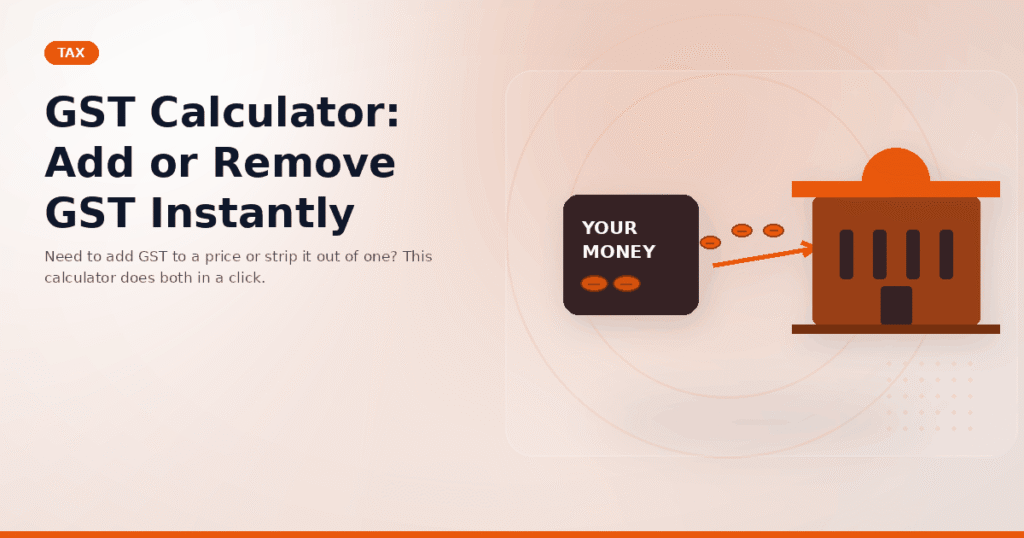
Ketan Vyas has run a kirana store off Station Road in Bharuch for eleven years, stacking branded biscuits, detergents and packaged atta on shelves priced at whatever’s printed on the wrapper. His turnover sits comfortably under ₹1.5 crore, which makes him eligible for the GST Composition Scheme — a flat 1% of turnover instead of collecting tax slab by slab. A tax consultant selling annual return filing services told him switching would “cut his GST to almost nothing.” Ketan nearly signed up. He didn’t, because when he actually modelled it against what he was paying net — not gross — the flat rate came out more expensive, not less. That calculation is the part every other explainer of the Composition Scheme skips.
Before the Composition Scheme decision makes sense, the basic add/remove math has to be automatic. To add GST to a base price: GST amount = price × rate ÷ 100, and total = price + GST. To strip GST out of a price that already includes tax: base price = total × 100 ÷ (100 + rate). These are inverses of each other, and the common error is subtracting a straight percentage from a tax-inclusive total instead of dividing it out.
Say a service costs ₹10,000 before tax at 18%: GST = ₹10,000 × 18 ÷ 100 = ₹1,800, total ₹11,800 — shown on an in-state invoice as CGST ₹900 plus SGST ₹900. Flip it: an invoice showing ₹11,800 as the final price has a pre-tax base of ₹11,800 × 100 ÷ 118 = ₹10,000 exactly, not ₹11,800 minus 18%, which would be wrong.
In-state sale — across state lines this same ₹1,800 would show as one IGST line instead of split CGST/SGST.
Under GST’s normal (“regular”) scheme, Ketan charges GST on what he sells and separately claims Input Tax Credit (ITC) for the GST he already paid his distributors on that same stock. He remits only the gap between the two to the government — not the full amount he collected. Under the Composition Scheme, that netting disappears entirely. He pays a flat percentage of turnover — currently 1% of turnover for goods traders and manufacturers, with different flat rates for restaurants and for services, subject to a turnover ceiling that has been revised over the years — and cannot claim ITC on anything he buys, ever, while enrolled. He also cannot charge GST separately on his invoice; it must be issued as a Bill of Supply, tax-inclusive by law, not itemised.
Ketan’s shop turns over roughly ₹90 lakh a year, almost entirely branded, MRP-fixed goods bought from GST-registered distributors at a blended rate of around 8% across his mix of 5%, 12% and 18% items. On that stock he pays his distributors roughly ₹6,24,000 a year in GST on purchases. Under the regular scheme, he claims that entire amount back as ITC against the roughly ₹7,20,000 of GST embedded in what he sells, and remits only the difference — about ₹96,000 a year, which is tax on the value he actually adds, not on his full turnover.
Under the Composition Scheme, the flat 1% on ₹90 lakh comes to ₹90,000 — on its own, slightly less than ₹96,000. That is the number the consultant quoted him, and on that comparison alone the switch looks like a win. But the ₹6,24,000 of GST he pays his distributors every year does not disappear just because he stops claiming it. Under composition, he still pays it at the point of purchase — he simply loses the ability to net it off. Because his goods are MRP-fixed and set by the manufacturer, he cannot raise his selling price to recover that lost credit either. The realistic total cost of switching, for a shop with his purchase mix, is closer to ₹90,000 in flat tax plus the ₹6,24,000 he can no longer reclaim — a jump from roughly ₹96,000 a year to over ₹7 lakh.
The Composition Scheme genuinely helps some businesses — a small restaurant with few registered suppliers, a service provider whose main cost is his own labour rather than taxed inputs, or a trader who buys mostly from unregistered small suppliers with little GST embedded in the purchase price in the first place. For those businesses, there is little ITC to give up, so the flat, low rate is close to pure saving. What almost nobody explains is that the scheme is worst for exactly the kind of shop that looks, on the surface, most eligible for it: a retailer of branded, GST-heavy, MRP-fixed goods bought from registered distributors, where the input credit being forfeited is large relative to turnover and the retailer has no pricing freedom to claw it back. Eligibility for the scheme and benefit from the scheme are two different questions, and the paperwork only checks the first one.
What to actually do before enrolling: pull last year’s purchase invoices and add up the GST you actually paid your suppliers — not the slab rate, the rupee figure. Compare that against what you currently remit net, after ITC, under the regular scheme. If the forfeited credit is small relative to your turnover, the flat rate is likely a genuine saving. If it is large — which tends to happen exactly when your stock is branded, GST-heavy and bought from registered distributors — the flat rate can cost you more, not less. YOU ENTER your own turnover and purchase mix, and IT TELLS YOU which side of that line your shop actually sits on, instead of trusting a consultant’s single-line pitch.
The applicable rate on any single item — commonly 5%, 12%, 18%, or 28% under the regular scheme — depends entirely on the category of goods or service, not on who’s buying or selling. Getting the rate wrong is usually a bigger risk than getting the arithmetic wrong, so when in doubt, confirm the correct slab for your specific item on the GST portal rather than assuming a standard rate.
None of this means the Composition Scheme is a bad scheme, or that the consultant who pitched it to Ketan was trying to mislead him — for a different kind of business, the same pitch would have been sound advice. It does not mean every branded-goods retailer should avoid composition either; a shop with thinner distributor GST exposure, or one willing to absorb a small margin hit, might still find it worthwhile for the compliance simplicity alone — far fewer returns to file each year. It also does not mean the numbers here are Ketan’s exact figures forever: turnover thresholds, flat rates by category and the scheme’s other conditions have been revised before and can be revised again, so confirm the current thresholds and rates directly on the GST portal or with CBIC before deciding, rather than relying on last year’s numbers.
GST itself is arithmetic; the games are in presentation. Retail classics: quotes given ex-GST so the bill grows 18% at signing (‘sir, tax extra’); ‘GST discount’ theatre where the ‘discount’ merely absorbs tax the seller owed anyway. In finance specifically: GST on insurance premiums, card interest, processing fees and brokerage — costs quoted to you net, charged to you gross.
CGST and SGST apply to sales within the same state and split the tax equally between central and state governments; IGST applies to sales across state lines and is collected as a single tax.
No — a registered person under the Composition Scheme is generally restricted to intra-state supply of goods and cannot make inter-state outward supplies, which is a separate limitation from the ITC trade-off and worth checking against your customer base before switching.
Yes — 18% on interest and most fees, which is partly why revolving debt compounds faster than its APR suggests. One more reason the minimum-due lifestyle is so expensive.
Divide the total by (100 + rate) and multiply by 100 — not a straight percentage subtraction from the total.
Regulatory source: the GST Composition Scheme, its turnover thresholds and flat rates by category of business, and the restriction on input tax credit and inter-state supply for enrolled dealers, are set out on gst.gov.in and by the Central Board of Indirect Taxes and Customs (cbic.gov.in); verify current thresholds and rates there before deciding. The reconstruction of Ketan’s purchase-versus-sale arithmetic and the comparison between net regular-scheme liability and forfeited credit is this article’s own analysis.
Disclaimer: This article is for general information only and is not financial or tax advice. “Ketan Vyas” is a composite character, not a real individual. Consult a qualified advisor before making investment or tax decisions, and verify current GST thresholds, rates and scheme conditions directly on gst.gov.in or cbic.gov.in before relying on them.
The discount you lost, the fee you paid, the GST on interest that 'doesn't exist' -- about 26%…
Want a regular income from your investments without draining them too fast? This SWP calculator helps you plan.
SSY is one of the best schemes for a girl child's future -- safe, high interest and tax-free.…
Your income rises every year -- your SIP can too. This calculator shows how a yearly step-up supercharges…
Investing a small amount every month can build a large corpus over time thanks to compounding. This SIP…
For short-term loans and quick estimates, simple interest is all you need. This calculator gives the interest and…