
Sukanya Samriddhi Yojana Calculator: Save for Your Daughter
SSY is one of the best schemes for a girl child's future -- safe, high interest and tax-free.…
 March 12, 2026by cyborg.vaibhav@gmail.com7 min read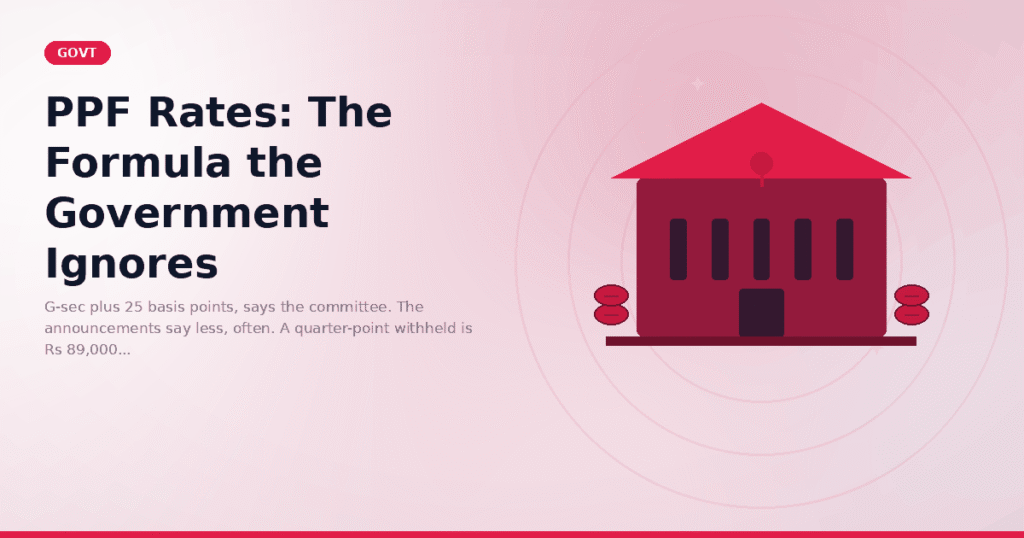
Yamini Deshbhratar retired from the railways in Bilaspur three years ago, and her pension gap is filled by the interest her PPF and SCSS accounts throw off every quarter. Every quarter, a committee inside the finance ministry runs a formula the government itself adopted, armed with government bond yields and a small bonus — for PPF, the 10-year G-sec yield plus 25 basis points. Every quarter, savers like Yamini find out what the committee decided to do with the answer. And for stretches at a time, the announced rate has sat below what the formula prescribes — rounded down, frozen, “held steady” — while the same government’s own borrowing costs set the benchmark. The formula exists. Following it is optional. Guess in which direction the option gets exercised.
The Shyamala Gopinath committee framework (2011) was meant to end politics in small-savings rates. The Reserve Bank of India constituted the committee in 2010 specifically to depoliticise this, and its recommendation was precise: peg each small-savings instrument to the yield of a government security of comparable maturity, plus a fixed spread — 25 basis points for most instruments, 50 basis points for the 10-year-linked schemes, and a full 100 basis points for schemes meant to protect senior citizens. In practice, rates are “reviewed” every quarter by the Department of Economic Affairs and frequently left unchanged even when the formula points up, because every 0.25% on the small-savings pool costs the exchequer real money across an enormous base, and savers do not march over a rounding decision. When yields fall, cuts have historically arrived with more punctuality than increases. The asymmetry will feel familiar to anyone who has watched banks pass on rate hikes faster than rate cuts: the same physics, operated this time by the referee who also borrows in the same market.
Small numbers, long horizons: ₹1.5 lakh a year into PPF for 15 years at 7.1% builds about ₹40.7 lakh; at 7.35%, the rate a formula-faithful regime might have paid in a quarter where G-sec yields justified it, the same contributions build about ₹41.6 lakh. The ₹89,000 difference is one family’s withheld bonus — multiply it by the tens of millions of PPF, SSY, SCSS and NSC accounts in the country and the “rounding” becomes one of the quieter fiscal instruments available to any government: a tax on patience, collected from its most disciplined citizens, that never has to be voted on because it is never technically a tax.
What makes this a genuinely checkable claim, rather than a grumble, is that the government publishes both halves of the comparison itself. The Department of Economic Affairs notifies small-savings rates every quarter through a public office memorandum, and the 10-year G-sec yield that the formula is meant to track is published continuously by the Reserve Bank of India and reported in every RBI Monetary Policy Committee resolution. Anyone can hold the two documents side by side. Yamini cannot move bond markets, but she can, with two public numbers and a calculator, work out whether her own government paid her the spread it promised itself it would pay her.
The direction of the gap matters as much as its size. In quarters when G-sec yields have risen quickly, the announced small-savings rate has typically lagged the formula’s prescription by more than a rounding error would explain. In quarters when yields have fallen, announced rates have tended to catch down with less delay. Neither direction is a scandal on its own — discretion is written into the framework, which never removed the government’s final say — but a discretion that only ever gets exercised in the exchequer’s favour is not really discretion. It is a one-way ratchet wearing a formula’s clothes.
None of this makes PPF bad — EEE tax treatment (exempt on contribution, growth and withdrawal) is nearly unique, the sovereign guarantee is real, and even a shaved 7.1% tax-free beats a 7% FD taxed at slab by a wide margin. The point is subtler and more useful: treat the rate as a policy output, not a law of nature. It can drift down through your accumulation years, and your plan should not assume otherwise.
Assumes the full annual amount is deposited at the start of each financial year (the best case for interest) and compounded annually at a constant rate for the whole tenure. PPF's actual rate is set by the government every quarter and can change year to year — update the rate slider whenever it does.
Tax: PPF is one of the very few EEE instruments left: the deposit qualifies for 80C (old regime, up to ₹1.5L/yr), the interest accrues completely tax-free, and the entire maturity is tax-free too — no TDS, and it doesn't even need to be offered to tax. Under the new regime you lose the 80C deduction on the way in, but the interest and maturity stay tax-free either way. That makes PPF's effective pre-tax-equivalent yield for a 30%-slab investor roughly 1.45× the headline rate when comparing against an FD.
Max the PPF in April, not March — a full year’s interest on the full amount, every year, compounds into lakhs across the account’s life. Track the quarterly announcements (two minutes, four times a year) so rate drift enters your planning early rather than as a surprise at 55. Ladder across small-savings products — SSY for daughters and SCSS at 60 carry their own, usually better, spreads over the formula. And hold the system to its own paper: the formula and the underlying G-sec yield are both public, and quoting them in consultation windows and to elected representatives is how frozen quarters have, historically, eventually thawed.
This does not mean the government is quietly stealing from savers, or that the committee’s formula was a sham from day one. The framework did genuinely reduce arbitrary rate-setting compared to the pre-2011 era, and discretion to deviate was always part of the design, not a loophole discovered later. It also does not mean you should abandon PPF for a marginally higher-yielding, uninsured alternative — the sovereign guarantee and EEE status are worth more than a few basis points most years. What it means is narrower: a saver who assumes the announced rate always equals the formula’s answer is trusting an intermediate step she can actually check for herself, in ten minutes, with two publicly available numbers. Yamini is a composite drawn from the common experience of small-savings-dependent retirees; the specific figures above are illustrative arithmetic, not one person’s real account statement.
Structurally, small-savings rates tend to follow G-sec yields downward as an economy matures and market rates ease. Plan conservatively: model your PPF at a rate slightly below today’s and be pleasantly surprised if it holds.
Both, for different jobs: PPF is the guaranteed, tax-free floor of a portfolio; equity is its growth engine. The mistake is asking either to do the other’s work.
You can, with two numbers: the average 10-year G-sec yield for the preceding three months (published by RBI), and the announced small-savings rate for the same quarter (notified by the Department of Economic Affairs). Subtract, and compare the gap to the 25-to-100 basis-point spread the committee recommended for that instrument. It takes longer to find the two documents than to do the subtraction.
Regulatory source: the Reserve Bank of India-constituted Shyamala Gopinath Committee (2011) set out the G-sec-linked formula for small-savings rates; the Department of Economic Affairs publishes the quarterly small-savings rate notifications, and the Reserve Bank of India (rbi.org.in) publishes the underlying G-sec yield data used to check the formula. The comparison between formula-implied and announced rates, the arithmetic, and the character of Yamini are this article’s own analysis.
Disclaimer: This article is for general information only and is not financial or tax advice. “Yamini Deshbhratar” is a composite character based on common patterns among small-savings-dependent retirees, not a real person. Interest rates, spreads and G-sec yields move every quarter — verify the current rate notification before making a decision, and consult a qualified advisor before making investment or tax decisions.
SSY is one of the best schemes for a girl child's future -- safe, high interest and tax-free.…
PPF is excellent for long-term, safe, tax-free saving. This calculator shows the amount after 15 years.
Agricultural income is exempt, but partial integration uses it to pick a higher rate for your salary. The…
Deferring tax is an interest-free loan from the government. Growth vs IDCW, employer NPS, gain harvesting, CGAS, section…
EPF and NPS both carry real equity exposure, while EPF-VPF tax thresholds are twice as generous for government…
Medical inflation runs 10-14% a year in India, nearly double the 5-6% general inflation most retirement calculators assume.