
Your “Guaranteed” EPF Has Rs 2.34 Lakh Crore Sitting in the Stock Market
The government confirmed it in Parliament: a real slice of your provident fund is in equity ETFs, with…
 July 22, 2026by cyborg.vaibhav@gmail.com12 min read
Ashwin Gokhale keeps two folders in the steel almirah in his Wardha house. One holds a small-savings passbook from the post office on the Arvi road. The other holds a statement for a gilt fund his nephew set up on a phone. Both folders contain claims on exactly the same borrower — the Government of India. Only one of them has ever shown him a loss.
That is not because one is safe and the other is not. It is because they carry different risks that arrive at different times through different doors, and only one of the two is required to print the bad news on a screen every evening.
Ashwin is 64, retired in 2022 as a sub-divisional officer with the Public Works Department after thirty-four years of road and building contracts across Vidarbha, and is a composite — assembled from the sort of retired government engineer who is very good at reading a tender document and has never once been shown a term sheet, not a real individual. He is precisely the kind of saver for whom “government-backed” is supposed to be the end of the conversation.
On 7 June 2021, SEBI issued circular SEBI/HO/IMD/IMD-II DOF3/P/CIR/2021/573, and it did something quietly radical. It required every debt mutual fund scheme to place itself in one cell of a three-by-three grid called the Potential Risk Class matrix, effective 1 December 2021.
The grid has two axes, and that is the whole point. Down one side is the maximum interest rate risk the fund manager is permitted to take, measured by Macaulay Duration: Class I is one year or less, Class II is three years or less, Class III is any duration at all. Across the top is the maximum credit risk, measured by something called Credit Risk Value: Class A is a CRV of 12 or more, Class B is 10 or more, Class C is under 10.
SEBI publishes the CRV table itself. Central and state government securities, repo on government securities, TREPS and cash score 13 — the top of the scale. A AAA-rated corporate bond scores 12. AA scores 10. A scores 7. Unrated paper scores 2, and below-investment-grade scores 1.
Take the single most government-backed thing you can buy inside a mutual fund: a gilt fund holding nothing but sovereign paper. Its Credit Risk Value is 13, so it sits in Class A — relatively low credit risk, the best column on the board. Its holdings are long-dated, so its Macaulay Duration is well past three years, which puts it in Class III — relatively high interest rate risk, the worst row.
The cell it lands in reads, in SEBI’s own words: Relatively High interest rate risk and Relatively Low Credit Risk. The safest possible credit and the most exposed possible duration, in one box, on the front page of the Scheme Information Document, in bold, because the circular requires it to be prominently visible there and on the application form.
There is a detail buried in paragraph 19 of the circular that makes the separation explicit. Funds in Class I and Class II face a cap on the residual maturity of each instrument they hold — three years and seven years respectively. That cap does not apply to securities issued by the central and state governments. The regulator carved sovereign paper out of the maturity restriction while leaving it fully exposed on the duration axis, which is only coherent if you accept that credit risk and interest-rate risk are two different things that need two different controls.
Now put ₹30 lakh of Ashwin’s commuted pension into each folder and move interest rates by 1.5 percentage points. Same money, same government, same event, opposite outcomes.
Rates fall. The gilt fund holds long bonds; its price rises by roughly its duration multiplied by the rate move. On a fund with a Macaulay Duration around seven years, that is somewhere near a tenth of the value — call it ₹3 lakh, printed in green. The post office passbook does nothing at all. Ashwin’s quarterly credit is unchanged, because his rate was fixed on the day of deposit. Then his five-year term ends, he walks back to the Arvi road branch, and the notified rate for that quarter is 1.5 points lower. On ₹30 lakh, his income drops by about ₹45,000 a year, in one step, permanently, and no product he holds ever showed him it was coming.
Rates rise. Exactly reversed. The gilt fund’s NAV falls by roughly ₹3 lakh, in red, on his nephew’s phone, and Ashwin phones the nephew at nine in the evening. The passbook again does nothing, and at maturity he reinvests at a higher rate and is better off. The saver who felt nothing was, on this occasion, the one who won.
That last box is the part worth carrying out of this article. The loss you can see is usually temporary. The loss you cannot see is usually permanent. A gilt fund investor who does not sell during the drawdown recovers as the underlying bonds approach maturity. A small-savings investor who reinvests at a lower notified rate has locked that lower rate in for the whole of the next term. One of those is a scare. The other is a pay cut.
The same logic applies to the largest sovereign-adjacent pot most Indians own. The provident fund rate is declared periodically rather than marked to a price, so an EPF balance behaves like Ashwin’s passbook and not like his gilt fund: no visible volatility, full exposure to the rate that gets declared next. Public Provident Fund goes further still, because its rate is reset quarterly on the entire balance, which makes a thirty-year PPF account a floating-rate instrument with no printed price anywhere.
Two figures decide almost everything here, and both are printed on documents you already have. The first is the Potential Risk Class cell on the front page of any debt fund’s Scheme Information Document. The second is the date your fixed-rate deposit matures, because that is the day your reinvestment risk becomes real.
Match the instrument to when you need the money, not to how safe it sounds. If the money is needed on a known date, a fixed-rate instrument maturing on or before that date carries almost no risk that matters to you. If the money is needed at an unknown date, a long-duration fund can be forced to sell into a drawdown, which is the mechanism that turns a paper loss into a real one.
Stagger maturities rather than stacking them. Ashwin’s entire exposure resolves on one afternoon in one quarter. Splitting the same corpus across deposits maturing in different years converts a single bet on one quarter’s notified rate into an average of several — the same idea as averaging into a market, applied to the side of the ledger nobody averages.
Read the cell, not the category name. “Debt fund” describes nothing. The two-letter cell on the front page of the document tells you exactly how much credit risk and how much duration risk the manager is permitted to take, and it is there because SEBI made it compulsory.
It does not mean small-savings schemes are secretly risky. Their credit risk really is the lowest available in the country, they really do avoid mark-to-market volatility, and for a retiree whose priority is a stable quarterly credit and no evening phone calls, that combination is genuinely valuable and not a trick.
It does not mean a gilt fund is equivalent to them either. Duration risk is real, it can be large, and a retiree who needs to withdraw during a drawdown crystallises it. A daily NAV is information, not danger, but only for someone who can afford to ignore it.
And it does not mean the Potential Risk Class cell captures everything. It caps credit and duration. It says nothing about liquidity, which is a third and separate thing, and 2020 taught Indian investors that a portfolio can be investment-grade on paper and still impossible to sell.
The narrow, usable version: there is no single scale on which one of these is safer than the other. There are at least two axes, the regulator has already drawn them, and the instrument that protects you on one is exposed on the other. Ashwin does not need to choose the safe folder. He needs to know which risk each folder is carrying on his behalf, and whether he can live with the way it arrives.
On credit risk, no — both are claims on the same government, and government securities sit at the top of the regulator’s own Credit Risk Value scale, above the best-rated corporate bond. On interest-rate risk, yes, substantially, because a gilt fund holds long-dated paper priced every day while a fixed-rate deposit is not priced at all. The honest answer is that they are not more or less risky than each other, they are risky in different directions, and which one suits you depends on whether you would be forced to sell at a bad moment.
It is the risk that when your deposit matures you cannot get the same rate again. It is invisible because it produces no statement, no red number and no notification — it simply arrives as a smaller quarterly credit after you renew. It is also usually permanent for the length of the new term, which is what makes it more consequential than a mark-to-market fall that reverses. Nobody mentions it because there is nothing to display.
On the front page of the Scheme Information Document and the Key Information Memorandum, and on the application form, where SEBI requires the matrix to be placed near the scheme name, prominently visible and in bold. The fund must also notify unitholders by SMS if the cell changes, and moving to a cell with higher credit or duration risk than the one originally chosen counts as a fundamental attribute change of the scheme.
Only for money that will not be needed during a plausible drawdown. The usual structure is to hold near-term spending in short-duration or fixed-rate instruments whose maturity is matched to when the money is required, and to accept duration risk only on the portion with a genuinely long horizon. The failure mode is not owning a long-duration fund; it is being forced to sell one.
Regulatory source: SEBI circular SEBI/HO/IMD/IMD-II DOF3/P/CIR/2021/573 dated 7 June 2021 sets out the Potential Risk Class matrix, the Credit Risk Value table, the duration classes and the disclosure requirements quoted above. Interest rates on small savings schemes are notified quarterly by the Ministry of Finance, and the provident fund rate is declared periodically. The two-folder framing, the mirrored rate-shock arithmetic and the character of Ashwin are this article’s own.
Disclaimer: General information, not financial or investment advice. Linqz is not a SEBI-registered investment adviser. “Ashwin Gokhale” is a composite character, not a real individual, and every figure here is illustrative. Scheme rates, risk classifications and duration positioning change — check the current Scheme Information Document and the current notified rate before acting.
The government confirmed it in Parliament: a real slice of your provident fund is in equity ETFs, with…
Declared in March, credited whenever. Late interest misses its own compounding: Rs 2 lakh across a career of…
EPF quietly builds a large retirement corpus from your salary. This calculator projects its value over your career.
Agricultural income is exempt, but partial integration uses it to pick a higher rate for your salary. The…
Deferring tax is an interest-free loan from the government. Growth vs IDCW, employer NPS, gain harvesting, CGAS, section…
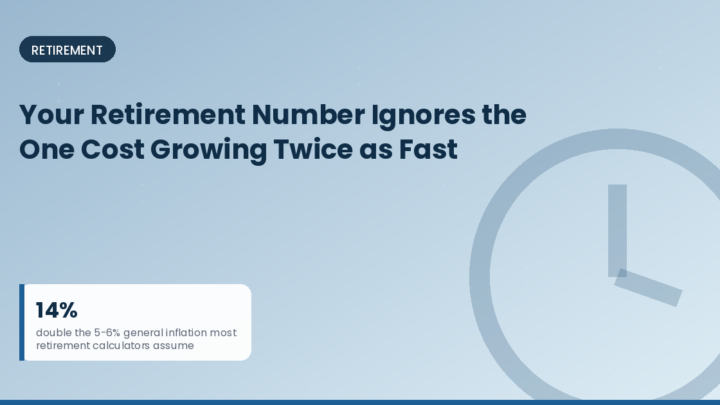
Medical inflation runs 10-14% a year in India, nearly double the 5-6% general inflation most retirement calculators assume.