
Your “Safe” Government Scheme Has a Stock Market Bet Built In
EPF and NPS both carry real equity exposure, while EPF-VPF tax thresholds are twice as generous for government…
 March 14, 2026by cyborg.vaibhav@gmail.com7 min read
Ritu Chawla‘s EPF passbook, watched from her desk as a garment export coordinator in Ludhiana, is a study in patience. The financial year ends in March; the interest rate is declared with ceremony; and the actual credit into her account arrives… whenever it arrives — routinely months later, sometimes with the next year knocking. The press release is punctual. The money is not. And in compounding, when is money: interest that lands late is interest that missed months of earning interest on itself. (Ritu is a composite character reflecting a pattern that shows up across EPF passbooks nationwide, not one office’s problem — more on that below.)
EPF interest is computed on monthly running balances but credited as a lump annually — after the rate is ratified through a committee-and-ministry relay that treats the calendar as advisory. In several recent years, tens of crores of accounts saw interest credited two, three, even eight months after year-end (software upgrades and tax-rule changes have all taken turns as the reason). EPFO’s standard reassurance — “no loss, interest is calculated from the due date” — is true for the year in question and quietly false across time: until credited, the amount is not in your balance earning the next cycle’s interest, and for anyone who withdraws or transfers in the gap, the absence is very real.
Take a ₹10 lakh balance earning 8.25%: the year’s interest is ₹82,500. Credited 8 months late, that sum sat out roughly ₹4,500 of its own earning time. Small — once. Repeat the pattern across a 20-year career of growing balances and the cumulative drag compounds toward ₹2 lakh+ for a diligent saver who did everything right except control a back office.
The delay is symptomatic of a monopoly’s relationship with its members: you cannot switch providers, so punctuality is a courtesy, not a competitive necessity. The same institution charges employers penalties for late deposits — the standard it applies inward is gentler. None of this is scandal; all of it is drag, and drag is the tax nobody legislates.
Ritu once raised the delay with a colleague in her HR department, who repeated the standard reassurance almost word for word: “no loss, interest is calculated from the due date.” That line comes from a real rule, and it is worth knowing precisely, because it is both true and incomplete in exactly the way that matters to her.
So the reassurance is legally accurate on the exact rupee Ritu is owed for the year in question, and silent on the compounding cost of the wait — which is the calculation earlier in this article, not something EPFO’s talking point addresses at all. The two things are not in conflict; they are simply answering different questions, and only one of them is the question most members are actually asking.
What EPFO does offer, and rarely advertises loudly, is a formal channel for exactly this class of complaint: the EPF interactive Grievance Management System (EPFiGMS), a portal built to log and track member grievances — including delayed interest crediting, missing employer deposits and transfer holdups — against a service timeline, rather than leaving members to guess whether anyone is looking at it. Ritu filed her first EPFiGMS ticket the year her cycle ran eight months late; it didn’t move the credit date, but it created a dated, trackable record that her later transfer application could point to, instead of her word against a passbook screenshot.
What the calculator settles for Ritu: enter her running EPF balance and the number of months a credit is delayed, and it tells you the rupee cost of that specific gap — not a national average, her own account, her own delay.
Simplified: assumes 12% employee + 3.67% employer contribution on Basic + DA every month (the employer's other 8.33% funds the separate EPS pension, not this corpus), interest compounded monthly at the rate you set, and Basic + DA stepping up once a year by your increment. Real EPF also credits interest on the actual monthly running balance per year-end rules and is subject to the wage ceiling for the EPS split on higher salaries — treat this as a close estimate, not a statement.
Tax: EPF is EEE for most people — contributions get 80C (old regime), and both interest and the retirement withdrawal are tax-free after 5 years of continuous service. Two exceptions worth knowing: (1) if your own contribution exceeds ₹2.5L in a financial year, the interest earned on the amount above that limit is taxable at your slab every year (the banner above tracks this from your inputs); (2) withdrawing before 5 years of service makes the corpus taxable and attracts 10% TDS if it exceeds ₹50,000 — submit Form 15G/15H if eligible. Employer contributions above ₹7.5L/yr across EPF+NPS+superannuation are also taxable as a perquisite.
Check your passbook every quarter (the EPFO portal and UMANG app both show it) — not to fix EPFO, but to catch your side’s failures early: employer deposits missing or late are far more damaging and fully actionable. Reconcile the annual interest line when it lands; raise a grievance on the EPFiGMS portal if a cycle looks skipped, and keep the ticket number — it is the paper trail Ritu wishes she had filed sooner. Before any withdrawal or transfer, time it after the credit hits, not before. And diversify your retirement plumbing — NPS and your own SIPs answer to market hours, not committee calendars.
It does not mean EPFO is failing to pay what it owes, or that the delay is theft. Paragraph 60 is real, the interest is computed correctly on the monthly running balance, and every rupee for the year in question does eventually land. It also does not mean filing an EPFiGMS grievance will speed up a systemic annual crediting cycle that runs late for tens of millions of accounts at once — it will not, and expecting it to is the wrong ask.
What it does mean is narrower: the cost that matters is not the year EPFO is late crediting everyone; it is the specific gap a withdrawal or transfer creates for one account, mid-cycle, and that gap is both real and something a member can plan around — which is exactly what the reassurance line was never designed to tell anyone.
Ritu now does one small thing differently: before applying for any partial withdrawal or job-change transfer, she checks whether the annual credit for the outgoing year has already posted. If it hasn’t, she waits a few weeks where her plans allow it. It costs her nothing and it closes the one gap that was ever actually hers to close.
No — 8%+ tax-free with sovereign character remains excellent. The lesson is narrower: institutional promises have operational lags, and your plan should carry a margin for them.
Worse — that is your money missing its earning window monthly, and it is enforceable. The passbook shows deposit dates; a pattern of lateness is a formal grievance, and EPFO does pursue employers on it.
For the annual crediting cycle itself, usually not — it is a systemic, sector-wide lag rather than something specific to one account. It becomes worth it the moment the delay is paired with something else: a stuck transfer, a missing employer contribution, or a withdrawal request that seems to have vanished. That is where a dated ticket earns its keep.
Regulatory source: Paragraph 60 of the Employees’ Provident Fund Scheme, 1952, which governs how EPF interest is computed on the monthly running balance, and EPFO’s EPFiGMS grievance portal for member complaints including delayed crediting and stuck transfers. The rupee-cost reconstruction of a delayed credit and Ritu’s story are this article’s own.
Disclaimer: This article is for general information only and is not financial or tax advice. Consult a qualified advisor before making investment or tax decisions. Ritu Chawla is a composite character based on common EPF passbook and crediting-delay patterns, not a real person.
EPF and NPS both carry real equity exposure, while EPF-VPF tax thresholds are twice as generous for government…
The government confirmed it in Parliament: a real slice of your provident fund is in equity ETFs, with…
EPF quietly builds a large retirement corpus from your salary. This calculator projects its value over your career.
Agricultural income is exempt, but partial integration uses it to pick a higher rate for your salary. The…
Deferring tax is an interest-free loan from the government. Growth vs IDCW, employer NPS, gain harvesting, CGAS, section…
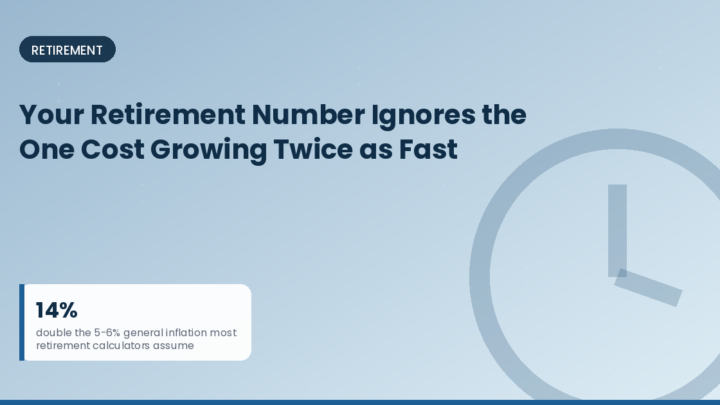
Medical inflation runs 10-14% a year in India, nearly double the 5-6% general inflation most retirement calculators assume.