The 1% Exit Load That’s Really Designed to Keep You From Ever Leaving
Exit loads and ELSS lock-ins protect the AMC's assets under management first. What to check before committing money…
 January 14, 2026by cyborg.vaibhav@gmail.com8 min read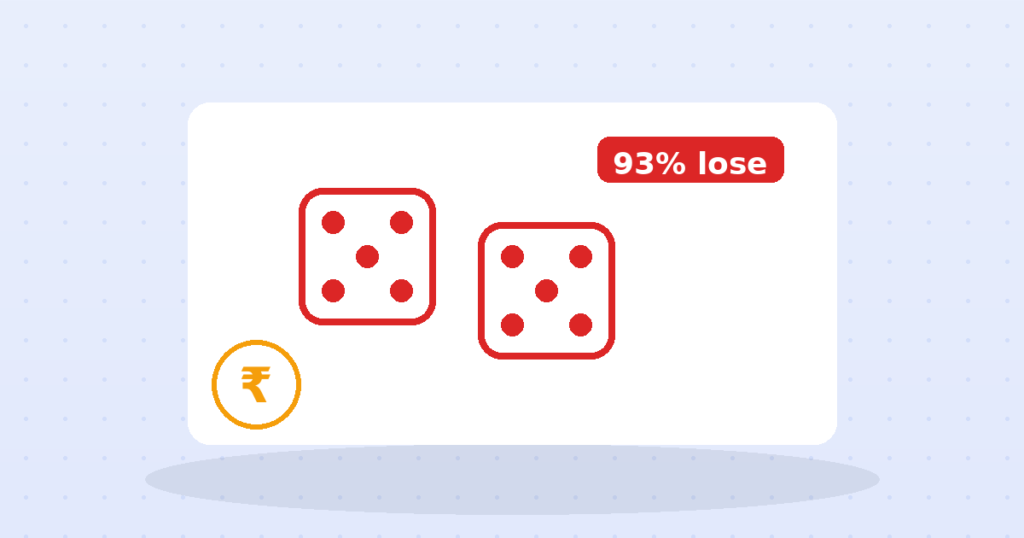
Prakash Solanki checks his F&O positions from the staff toilet at the delivery hub he manages on the outskirts of Ahmedabad, because that is the only place on his shift nobody asks what he is looking at. Eleven lakh people like Prakash lost money in derivatives over three years — and he genuinely believes he is one trade away from getting it back. He is not fighting the market. He is fighting a business model. (Prakash is a composite character built from common salaried-employee F&O trading patterns, not a real individual — more on that at the end.)
This is not a moralising uncle’s opinion. SEBI counted every trader: between FY22 and FY24, 93% of individual F&O traders lost money. The average loser dropped about ₹2 lakh including costs. The total: over ₹1.8 lakh crore transferred out of retail pockets in three years. Only about 1% earned more than ₹1 lakh after costs. A casino with these odds would at least give you a free drink.
Your losses are not vaporised — they are revenue. Proprietary desks and algorithmic traders on the other side of your trades take the spread. Your broker takes brokerage on every leg, win or lose — which is why the app celebrates your order with confetti, not your returns. The exchange takes transaction charges. The government takes STT and GST. Every layer of the pyramid is paid by turnover, and you are the turnover. The “free education” webinars, the Telegram tips channels, the influencers with rented luxury cars — all of it is a funnel built to keep the 93% refilling the pool.
The average loss is not just money gone; it is a future confiscated. ₹2 lakh left alone in a boring index fund for 20 years at 12% becomes about ₹19.3 lakh. Prakash did not lose two lakh. He lost nineteen.
SEBI’s most damning line was not the 93%. It was that three-quarters of the losers kept trading after two straight years of losses. Options are engineered to feel like skill: near-misses, occasional jackpots, a round-the-clock scoreboard. That is not an investment product’s psychology. That is a slot machine’s.
Here is the part almost nobody writing about F&O losses mentions, because most of that coverage was written before it happened. SEBI did not just study the carnage — in October 2024 it moved to shrink the table itself, through a circular titled “Measures to Strengthen Equity Index Derivatives Framework for Increased Investor Protection and Market Stability.” Three changes matter for someone like Prakash specifically.
First, weekly expiries were rationed to a single benchmark index per exchange. NSE kept Nifty 50, BSE kept Sensex; the weekly expiries on Bank Nifty, Nifty Financial Services, Nifty Midcap Select and Nifty Next 50 were withdrawn. For years, a trader could find some index expiring almost every day of the week — a permanent, rolling lottery draw. That rhythm is now compressed to one expiry per exchange, which is precisely why it was done: SEBI’s own study had linked the concentration of short-tenor options activity around expiry days to sharp, artificial price swings that retail traders were on the losing side of.
Second — and this is the one that changes Prakash’s arithmetic directly — the minimum contract value for index derivatives was raised from roughly ₹5 lakh to a ₹15–20 lakh band, effective from the same date. Exchanges recalculated lot sizes to hit that new floor: illustratively, the Nifty 50 lot moved from 25 to 75 units and the Bank Nifty lot from 15 to 30. A third safeguard, an extra 2% Extreme Loss Margin on short options positions specifically on expiry day, was layered on top from the same date, and calendar-spread margin benefits on expiry day were withdrawn from February 2025.
What nobody selling the “SEBI cracked down, it’s safer now” headline tells you: none of this touches the 93% figure. It was never designed to. The tightening raises the entry price of a bad habit; it does not change the odds of the habit itself. Prakash cannot slice his risk into as many small, forgettable weekly tickets as he used to — each remaining bet is now roughly three times the notional it was — but the spread, the brokerage on every leg, the STT, and the structural 93%-lose-money reality documented above are completely untouched by a contract-size rule. If anything, a trader who keeps trading at the same rupee-risk-per-week now does it through fewer, larger positions, which concentrates the same expected loss into fewer, sharper events rather than removing it.
Illustration only. Equity returns are not guaranteed and do not arrive in a straight line. Tax: the post-tax line in the results treats this as an equity fund — units held over 12 months pay 12.5% LTCG on gains beyond ₹1.25L per financial year (units sold within 12 months, e.g. your most recent instalments, pay 20% STCG instead, so the true bill on a one-shot redemption is slightly higher than shown; spreading redemption across years uses the ₹1.25L exemption more than once and lowers it). Debt funds have no LTCG rate at all — their entire gain is taxed at your slab. Start a SIP →
If you trade derivatives with money you cannot lose, stop reading and close the position. If you must scratch the itch, ring-fence it: a fixed small pot, never topped up, never funded by loans or credit cards. And run the SIP calculator above with whatever you lost last year — not to feel bad, but because seeing what it becomes by 60 is the only cure that works. What the calculator settles for Prakash: enter last year’s F&O loss and the years left until 60, and it tells you the exact rupee figure that habit is quietly costing his retirement, not just his month.
It does not mean every person who trades index options is reckless, or that SEBI’s 2024 tightening was theatre. The contract-size increase and the expiry rationalisation are real, verifiable changes that made the retail F&O table smaller and more expensive to sit at, and that is a defensible public-interest goal on its own terms — fewer people impulse-trading a Bank Nifty expiry on their lunch break is a genuine improvement.
It also does not mean the 7% who are not losing money are doing something you can copy from a Telegram channel. SEBI’s own data ties that group overwhelmingly to proprietary desks and algorithmic participants with cost and speed advantages a salaried employee trading from a shared office toilet simply does not have.
And it does not mean a bigger minimum lot size is a safety net. It is a bigger swing on the same broken odds — which is exactly why the arithmetic above matters more after the 2024 rules than before them, not less.
So does SEBI — about 1 in 100, mostly professionals with speed, data and hedges you do not have. You are not competing against the market; you are competing against them.
No. Owning businesses for years has positive expected returns; leveraged bets on Tuesday’s expiry do not. The industry blurs the two on purpose — “equity market participation” sounds better than what weekly options actually are.
It made it more expensive to enter, not safer to hold. The minimum notional per lot roughly tripled and weekly expiries were rationed to one benchmark index per exchange, which reduces how often a trader can gamble small and often. The 93% loss rate that the arithmetic above is built on comes from spread, brokerage and structural costs the contract-size rule does not touch at all.
Regulatory source: SEBI published both the FY22–24 individual F&O trader loss study and the October 2024 “Measures to Strengthen Equity Index Derivatives Framework” circular that rationed weekly expiries and raised the minimum contract value. Lot sizes and effective dates are cited illustratively as of their 2024–25 rollout and should be checked on the current NSE/BSE circular before trading. The reconstruction of Prakash’s arithmetic and the compounding comparison are this article’s own.
Disclaimer: This article is for general information only and is not financial or tax advice. Consult a qualified advisor before making investment or tax decisions. “Prakash Solanki” is a composite character based on common F&O trading patterns among salaried employees, not a real person.
Exit loads and ELSS lock-ins protect the AMC's assets under management first. What to check before committing money…
AMFI's own data shows SIP stoppage ratios spiking past 100%. The far bigger, invisible problem: SIPs nobody ever…
Your income rises every year -- your SIP can too. This calculator shows how a yearly step-up supercharges…
Investing a small amount every month can build a large corpus over time thanks to compounding. This SIP…
ELSS is the only mutual fund that also cuts your tax. This calculator shows both your returns and…
The price difference isn't your only cost when you trade. This calculator reveals every charge and your true…