SWP Calculator: Plan a Steady Withdrawal Income
Want a regular income from your investments without draining them too fast? This SWP calculator helps you plan.
 January 9, 2026by cyborg.vaibhav@gmail.com8 min read
Shanta Iyengar, a retired homemaker in Tiruchirappalli, gets ₹6,000 every quarter from a mutual fund, and every quarter she tells her daughter the fund is “paying well”. Her daughter finally sat down with the statement instead of the phone call. The fund was not paying anything. It was handing Shanta her own money back, deducting it from her units’ value, and calling it income. The industry had a word for this trick — “dividend” — until the regulator confiscated the word. Then, in 2020, the tax department found a second way to make the same trick expensive for her, this time through the deduction column.
When a mutual fund declares a payout, the NAV drops by exactly the payout amount the same day. Nothing was earned; something was released. It is your own capital doing a lap of honour through the banking system. SEBI found the word “dividend” so misleading that in April 2021 it forced the industry to rename these plans IDCW — Income Distribution cum Capital Withdrawal. Read that expansion slowly: capital withdrawal. The regulator put the confession into the product’s own name, and the products still sell, because almost nobody reads a plan-type expansion before signing the form.
Because “monthly income from mutual funds” is the easiest pitch in finance, especially to retirees who grew up trusting a fixed deposit’s interest cheque. The payout feels like a pension. Meanwhile the money that left stopped compounding, and it is precisely the money Shanta is least equipped to do without, since she is drawing it down at the exact age when time can no longer repair the gap.
Take ₹10 lakh for 15 years at 12%. Left alone in a growth plan, it becomes about ₹54.7 lakh. In a payout plan distributing 4% a year — with the payouts sitting in savings, as they usually do — corpus plus payouts total about ₹41.8 lakh. The bow tie cost Shanta ₹12.9 lakh, before a single rupee of tax is even discussed.
Here is the piece that turns a bad structure into a genuinely expensive one. Before the Finance Act, 2020, dividends from mutual funds were tax-free in the investor’s hands, because the fund itself paid a Dividend Distribution Tax before handing out the payout. That law changed. Every IDCW payout you receive since April 2020 is added to your income and taxed at your slab rate — the same slab that applies to your pension, your rent, your interest income. And the Income-tax Act now requires the fund house to deduct tax at source on it under Section 194K, once your IDCW receipts from that fund house cross a threshold in the financial year, currently ₹10,000 per AMC per year (raised from ₹5,000 with effect from April 1, 2025 — a figure that moves, so check the current threshold on the Income Tax Department’s site rather than trusting a number printed here).
Sit with what that actually means for Shanta. Her ₹6,000-a-quarter payout is, mechanically, her own capital being returned to her. Under Section 194K, if her total IDCW receipts from that fund house cross the threshold in a year, tax is withheld from what is already her own money, and whatever is not withheld at source still has to be declared and taxed at her slab when she files. She is not paying tax on a gain. She is paying tax on a withdrawal, dressed as income, precisely because the label on the plan says it is income.
Compare that to what happens if the same ₹10 lakh sits in a growth plan and she takes a Systematic Withdrawal Plan instead. Under an SWP, each withdrawal is treated as a partial redemption of units, and only the gains portion of that redemption is taxed as capital gains — not the whole withdrawal at slab rate. Same retiree, same need for monthly cash, and one route taxes the full withdrawal at slab while the other taxes only the profit embedded in it. The IDCW route is not simply an inferior product design; it is a design that routes the same rupee through a costlier tax gate on the way out.
If you need monthly money from a corpus, a Systematic Withdrawal Plan does the same job with the dignity of honesty: you choose the amount and the timing, and only the gains portion of each withdrawal is taxed. The fund does not decide for you, the amount does not depend on whether the fund manager felt generous that quarter, and nothing is dressed up as a gift.
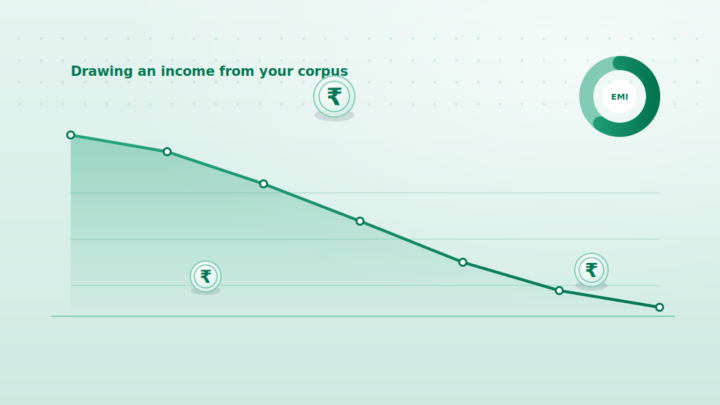
Simulates a Systematic Withdrawal Plan month by month: the corpus grows at your assumed return, and the withdrawal is taken out every month, so it shows whether the corpus actually lasts the period you set or runs out earlier. Real returns vary year to year (a bad sequence of returns early on can exhaust a corpus much faster than a flat average return suggests) — treat this as an illustrative case, not a guarantee.
Tax: this is exactly why SWP beats an FD-interest income for many retirees — each withdrawal is mostly your own capital coming back (not taxed) plus a slice of gain. The tax card assumes an equity fund: gain slices are long-term (12.5%) with the first ₹1.25L of gains exempt each financial year, tracked on an average-cost basis. Early in the plan the gain slice is tiny, so tax is far below what the same monthly income from FD interest would attract at slab rates. In a debt fund the gain slices are instead taxed at your slab. Withdrawals in the first year of holding would be short-term (20% for equity) — buy at least a year before starting the SWP to avoid that.
Open your statement and look for the letters IDCW. If they are there and you do not specifically need the payouts, switch to the growth option of the same fund — this is usually a same-day, no-load switch within the same scheme. If you do need income, size an SWP at about 4–6% of corpus a year and let the rest compound. Check your Form 26AS or AIS each year for TDS entries under Section 194K against your PAN — that entry is the tax department’s own confirmation that what you received was treated as taxable income, not a tax-free return of capital. And when anyone offers you “dividend income” from a mutual fund, ask them to say the full name of the plan type out loud.
This does not mean every payout is a mistake. A retiree who wants a fixed monthly habit and finds an SWP’s flexibility unsettling may rationally prefer the automatic payout, even at the tax cost, for the behavioural discipline it enforces. It also does not mean the fund house did anything improper — the mechanics are disclosed in the scheme document, and the 2021 renaming to IDCW was the regulator forcing exactly this disclosure. What it does mean is narrower: calling a capital withdrawal “income” changes how a saver thinks about her own money, and since 2020 it also changes how much tax she pays on thinking about it that way. Shanta is a composite drawn from a very common pattern among retired IDCW-plan investors — the specific numbers are illustrative, not a real person’s statement.
It is unpredictable — funds can cut or skip payouts, and the amount is not yours to set. An SWP gives the same cash flow, on your terms, and routes the tax through gains rather than the whole withdrawal.
No — a company’s dividend comes from profits it generated. A fund’s IDCW comes from your own pocket, and since 2020 is taxed at your slab exactly like a real dividend would be. Same word, opposite origin, identical tax bill; that is exactly why the pitch still works.
No — Section 194K TDS applies to income distributed by a mutual fund, which in practice means IDCW payouts. A growth-plan unit that you redeem is taxed as capital gains, not under Section 194K, which is one more reason the growth-plus-SWP route and the IDCW route are not tax-equivalent twins.
Regulatory source: the Income Tax Department administers Section 194K TDS on mutual fund income distributions and the slab-rate treatment introduced by the Finance Act, 2020; SEBI mandated the IDCW renaming in 2021. The reconstruction of the tax gap between IDCW and SWP, the arithmetic, and the character of Shanta are this article’s own analysis.
Disclaimer: This article is for general information only and is not financial or tax advice. “Shanta Iyengar” is a composite character based on common patterns among retired IDCW-plan investors, not a real person. Tax thresholds and TDS rates under Section 194K change — verify the current figures on the Income Tax Department’s website before acting, and consult a qualified advisor before making investment or tax decisions.
Want a regular income from your investments without draining them too fast? This SWP calculator helps you plan.
Agricultural income is exempt, but partial integration uses it to pick a higher rate for your salary. The…
Deferring tax is an interest-free loan from the government. Growth vs IDCW, employer NPS, gain harvesting, CGAS, section…
EPF and NPS both carry real equity exposure, while EPF-VPF tax thresholds are twice as generous for government…
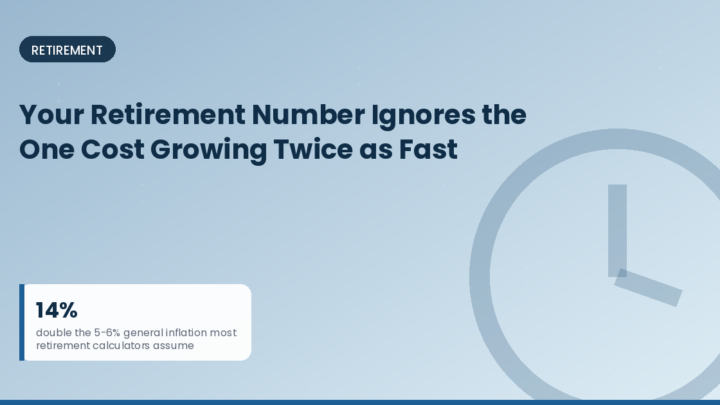
Medical inflation runs 10-14% a year in India, nearly double the 5-6% general inflation most retirement calculators assume.
India has 967 SEBI-registered fiduciary advisers against over 1,33,000 commission-paid distributors.