Rent in the City, Buy Farmland, Pay No Tax: The Advice That Raises Your Tax Bill
Agricultural income is exempt, but partial integration uses it to pick a higher rate for your salary. The…
 March 4, 2026by cyborg.vaibhav@gmail.com7 min read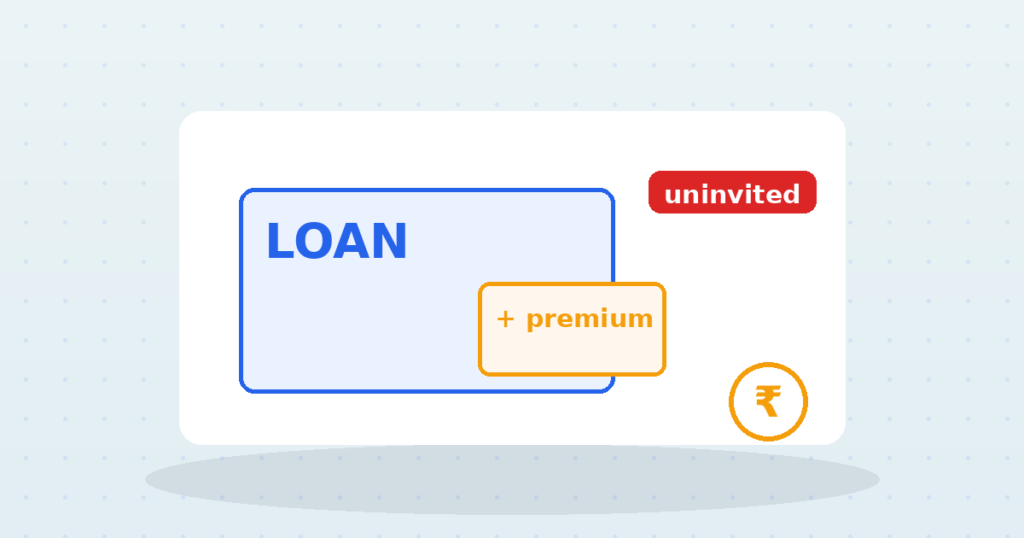
Somewhere on page three of his car-loan sanction letter, a passenger had boarded: “Credit Shield Premium — ₹25,000, financed.” Nobody asked Farhan Sheikh, 34, a store manager in Nashik buying his first sedan. The premium was added to his loan principal, which means for five years he pays interest on his own insurance — a policy that protects the bank’s loan, chosen by the bank, from an insurer that pays the bank a commission for the introduction. Three parties at the table, and the man paying for lunch wasn’t consulted on the menu. What Farhan also never learned: he had a legal window to cancel that exact policy and get almost all of it back, and it had already started ticking the day he signed.
Loan-linked insurance — “credit shield”, “loan protector” — is sold at disbursal, when your signature hand is already warm and your attention is on the car keys. The trick is not the insurance (loan cover can be sensible); it is the packing: a single premium for the full tenure, financed into the principal so it feels free, at group-policy pricing you never compared, generating a commission the bank keeps. Farhan’s ₹25,000, financed at 9.5% over five years, actually costs about ₹31,500 — and if he forecloses the loan early, the “refund” of unused premium has a way of becoming a customer-service archaeology project.
The honest comparison was never offered: a plain term insurance top-up covering the loan amount costs a fraction of packaged credit-shield pricing, pays your family (not just the bank), survives a balance transfer, and is bought at rates you compared yourself. RBI has repeatedly reminded lenders that insurance with a loan cannot be mandatory and the customer’s choice of insurer must be respected — a reminder that exists, tellingly, because branches keep needing it.
Here is the part almost no borrower ever hears: the credit-shield policy Farhan was sold is still, legally, an ordinary life or health insurance policy, and every such policy sold in India carries a mandatory free-look period — 30 days from the date the policy documents are received, under IRDAI’s own consumer-protection rules. During that window a policyholder can cancel for any reason and receive a near-full refund, minus only specific deductions such as stamp duty and a pro-rated risk premium for days already covered. The catch is timing: the premium was financed into the loan the moment Farhan signed, so by the time the first EMI statement arrives showing the extra amount, the free-look window is often already closing or closed, and nobody at the branch is going to remind a customer of a deadline that benefits the customer and costs the bank a commission.
YOU ENTER the premium amount, the loan’s interest rate and the remaining tenure; IT TELLS YOU exactly what that “free-feeling” premium costs once interest is added on top, the same way it costs on the car itself. What the calculator settles is the one question a sanction letter never answers directly: is this insurance actually cheap, or does financing it quietly double as a second loan you never agreed to take out.
Standard reducing-balance EMI, the method every Indian bank and NBFC uses for car loans. The "value at loan end" card depreciates the loan amount (a proxy for the car's price) at the rate you set — it exists to show the gap between what you repay and what the car is worth by the time it's yours outright.
Tax: a car loan for personal use gives you no tax benefit — no deduction on interest or principal, in either regime. The exceptions: if the car is used for business or professional purposes, the interest and depreciation are deductible as business expenses; and the old §80EEB electric-vehicle interest deduction (up to ₹1.5L) applied only to EV loans sanctioned between April 2019 and March 2023, so it's unavailable for new loans. Compare against the US version of this calculator for how differently the two markets price money.
If Farhan does nothing beyond the day he signed, the ₹25,000 premium quietly becomes ₹31,503 by the time the loan closes — a ₹6,500 markup for financing a decision he never actually made. Multiply that pattern across every car, personal and home loan sold with a packed premium in a single bank’s branch network in a year, and the free-look period stops looking like a minor consumer-protection footnote and starts looking like the one lever ordinary borrowers already have and almost never pull.
Read the sanction letter’s fee table before signing — every line, out loud if needed. Ask directly: is any insurance included, is it mandatory (the answer must be no), and what is the loan without it? If a premium was already packed by the time you notice, check the date on your policy document immediately — the free-look period is typically 30 days from receipt, and cancelling inside it gets almost the whole premium back even though it was financed into the loan. If you want cover, buy term insurance separately the same week. If the window has closed or a premium was packed without consent at any point, write to the lender citing mis-sale and copy the banking ombudsman portal. The car is negotiated in lakhs; don’t donate thousands on page three, and don’t let a 30-day clock you were never told about run out in silence.
None of this means loan-linked insurance is always a scam or that every borrower should cancel on principle. Some group policies are priced fairly and some borrowers genuinely want the convenience of one combined payment rather than managing a separate policy and a separate due date. The point is narrower: the choice to bundle, finance and keep the premium should be the borrower’s, made with the free-look window and the true financed cost both visible up front — not a default nobody flags until the EMI schedule already reflects it. A borrower who reads the fee table, asks the two direct questions, and still prefers the packaged option with full knowledge of what it costs has made an informed choice, not a mistake. The problem this article is about is the version where none of that happens — where the premium simply appears, financed, unread and unquestioned, and the only chance to undo it quietly expires while the new car is still being driven around to show family and friends.
Cover is a good idea; this packaging of it is expensive and bank-first. A term top-up equal to your total debts, bought independently, does the same job better and cheaper.
It does not, and saying so is a compliance violation. Ask for that requirement in writing and watch it evaporate — few sentences dissolve faster at a bank desk.
IRDAI’s free-look period is 30 days from the date you receive the policy document. Cancelling inside that window gets you a near-full refund, minus deductions like stamp duty and the risk premium for days already covered — even though the premium itself was financed into your loan.
The refund guarantee is gone, but the underlying mis-sale complaint is not — if the insurance was made to look mandatory or was added without clear consent, that is still grounds for a written complaint to the lender and, if unresolved, the banking ombudsman.
Disclaimer: Farhan Sheikh is a composite character based on common loan-linked insurance mis-sale patterns, not a real person. This article is for general information only and is not financial or tax advice. Consult a qualified advisor before making investment or tax decisions.
Agricultural income is exempt, but partial integration uses it to pick a higher rate for your salary. The…
Deferring tax is an interest-free loan from the government. Growth vs IDCW, employer NPS, gain harvesting, CGAS, section…
EPF and NPS both carry real equity exposure, while EPF-VPF tax thresholds are twice as generous for government…
Medical inflation runs 10-14% a year in India, nearly double the 5-6% general inflation most retirement calculators assume.
India has 967 SEBI-registered fiduciary advisers against over 1,33,000 commission-paid distributors.
5% minimum due, 36-42% annual interest, and a lost grace period on every new purchase.