The Doubling-Time Test: One Question That Unmasks Every Scheme
KVP doubles in 9.6 years -- that's what sovereign-guaranteed money does. 'Double in 3 years' is a guaranteed…
 September 8, 2025by cyborg.vaibhav@gmail.com7 min read
Kisan Vikas Patra has one job and does it with almost no complexity: it doubles your money over a fixed, government-declared period, guaranteed. There’s no market risk, no fund manager, nothing to track — just a certificate that turns into twice its face value if you wait long enough. That simplicity is exactly why it appeals to a certain kind of saver and is completely wrong for another.
KVP is a savings certificate sold at post offices (and some banks) as part of India’s small savings schemes. You hand over a lump sum, and the government commits to doubling it by a specific date, based on the interest rate in force when you buy it. At the current rate of roughly 7.5%, that doubling period works out to about 9 years and 7 months (around 115 months) — the exact tenure is published whenever the rate changes, since it’s simply back-calculated from the rate.
So ₹1 lakh invested today becomes ₹2 lakh at maturity, around 115 months later — no more, no less, since the whole design is compounding at a fixed rate toward a known multiple. The rate applicable to your certificate is locked in at purchase, so a future rate cut doesn’t affect KVP you’ve already bought, only the schemes launched after the cut.
KVP works best for savers who want zero ambiguity and don’t need the tax break — someone who has already used up their 80C limit through PPF, ELSS, or insurance, and simply wants a safe place to park an additional lump sum without thinking about it for years. It’s also common among people planning for a specific, date-certain need — a known event nearly a decade out — where “guaranteed doubling by this date” is more valuable than a possibly-higher but uncertain market return.
It’s a poor fit if you’re trying to save tax, since KVP offers no 80C deduction at all, and a poor fit if you might need the money in the first two and a half years, since that’s the lock-in period before any premature encashment is allowed (and even then, only in specific circumstances like the holder’s death or a court order).
People sometimes assume KVP is tax-free because it’s a small savings scheme — it isn’t. The interest is fully taxable at your income slab, though nothing is deducted at source, so you’re responsible for declaring it yourself each year (or at maturity, depending on how you’ve chosen to report it). Confusing KVP with NSC or PPF, which do carry 80C benefits, is the most frequent slip-up.
Does KVP save me tax? No — there’s no 80C deduction, and the interest earned is taxable at your slab rate each year (or on maturity, depending on how you report it).
Can I transfer a KVP certificate? Yes, in limited situations — from one person to another, or from one post office to another — subject to the scheme’s specific rules.
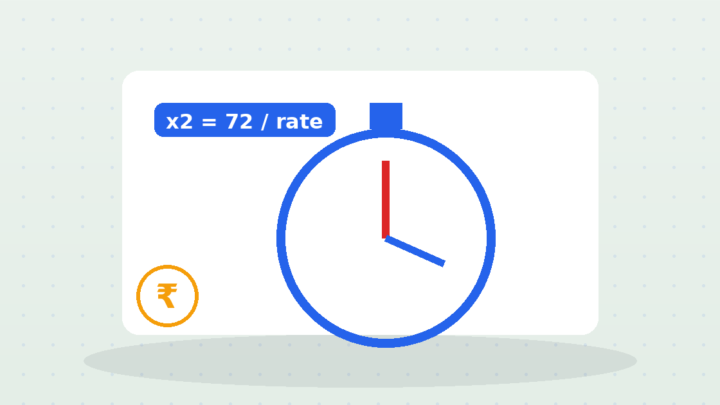
KVP’s superpower is not its rate — it is that it publishes the honest price of doubling: about 9.6 years at sovereign safety. Hold that number against every “double in 3 years” scheme at the community hall: doubling in 3 requires a guaranteed 26% a year, which exists nowhere legitimate. The post office quietly gave every villager a ponzi-detector; few know they own it.
KVP’s own fine print worth reading: interest is fully taxable at slab (unlike PPF), there is no 80C benefit, and premature exit rules are rigid. It is a trust instrument for people who value certificate-in-hand certainty — respectable, but for long horizons the taxable 7.5% trails PPF’s tax-free rate for anyone in a real tax bracket.
PPF wins on tax (EEE) for long money; NSC’s 5-year term with 80C suits old-regime taxpayers; KVP is the simple doubling certificate for those who want neither lock-in logic nor accounts — just note its interest is taxed.
Basavaraj Hiremath, a composite retired agricultural extension officer in Belagavi built from a pattern common among small-savings buyers, put ₹3 lakh of his retirement gratuity into KVP at his local post office, on a neighbour’s recommendation that “it’s a government scheme, just like NSC, so it’s safe and it saves tax.” He’d used NSC for years and knew that scheme carried a Section 80C deduction, so he assumed KVP worked the same way and didn’t budget for any tax consequence.
What Basavaraj didn’t know is that KVP carries no Section 80C deduction whatsoever — unlike NSC, which qualifies both the initial deposit and, in most years, the reinvested annual interest for the 80C limit. KVP’s interest instead accrues and is taxable every single year at the holder’s income-tax slab rate, on an accrual basis, even though the post office deducts no TDS on it. That means the responsibility to report and pay tax on interest he never actually received in cash sat entirely with Basavaraj, year after year, with no automatic reminder from the scheme itself.
What the calculator makes clear is the accrued-interest curve underneath KVP’s advertised “doubling” — and it’s precisely that accrued amount, not just the final payout, that Basavaraj owed slab-rate tax on annually. On ₹3 lakh at roughly 7.5%, the first year’s accrued interest alone runs into the tens of thousands of rupees, fully taxable, with zero TDS cushion and zero 80C offset to soften it — a genuinely different tax profile from the NSC he’d used for decades.
The fix for Basavaraj wasn’t to avoid KVP altogether — it’s still a legitimate, sovereign-guaranteed doubling instrument for someone who has already used up their 80C limit elsewhere. It was simply to set aside a slice of expected accrued interest each year for tax, and to stop assuming every post-office scheme behaves like the one he already understood.
He also learned to separate two things people routinely conflate: a scheme being government-backed and a scheme being tax-advantaged. Sovereign guarantee protects the principal and the promised return; it says nothing about how that return is taxed. PPF is both sovereign-backed and tax-exempt at every stage; NSC is sovereign-backed with a partial 80C benefit; KVP is sovereign-backed with no tax benefit at all. Reading the safety label and the tax label as two separate questions would have saved Basavaraj the surprise entirely.
He now keeps a simple habit before buying any new post-office instrument: ask the counter clerk two separate questions — is the principal protected, and is the interest taxed — rather than one combined question about whether the scheme is “safe,” since the counter staff’s idea of safe rarely extends to the tax treatment.
KVP needs no agent and pays no extra benefits. Anything bolted on is the agent’s margin, not the product’s.
Disclaimer: Basavaraj Hiremath is a composite character built from a pattern common among small-savings buyers, not a real person. This article is for general information only and is not financial or tax advice. Consult a qualified advisor before making investment or tax decisions.
KVP doubles in 9.6 years -- that's what sovereign-guaranteed money does. 'Double in 3 years' is a guaranteed…
Want a regular income from your investments without draining them too fast? This SWP calculator helps you plan.
SSY is one of the best schemes for a girl child's future -- safe, high interest and tax-free.…
Your income rises every year -- your SIP can too. This calculator shows how a yearly step-up supercharges…
Investing a small amount every month can build a large corpus over time thanks to compounding. This SIP…
For short-term loans and quick estimates, simple interest is all you need. This calculator gives the interest and…