
Social Security Estimator: Why Claiming Age Changes Everything
Claiming at 62 vs 70 can change your monthly benefit by more than 50%. See your own numbers…
 April 9, 2026by cyborg.vaibhav@gmail.com8 min read
Marcus got a $5,000 bonus for finishing his master’s degree and did the responsible thing: he sent all of it straight at his federal student loan balance. Two years later, his loan servicer’s letter about his income-driven repayment plan made him feel sick. That $5,000 hadn’t saved him a cent of interest in any way that mattered — because Marcus is on track for Public Service Loan Forgiveness in six more years, and every extra dollar he ever sent the servicer simply lowered the balance that was already going to be wiped out for him. He had prepaid a debt that was never going to cost him the full amount in the first place.
Marcus is a composite character — a stand-in for a pattern that shows up constantly among teachers, nurses and government employees on income-driven federal loan plans, not a real payroll or loan record. His numbers are invented. The mechanism that swallowed his bonus is not.
How this article was checked. The income-driven repayment and forgiveness mechanics below reflect Federal Student Aid’s own published guidance at studentaid.gov as reviewed in July 2026. IDR plan terms, forgiveness timelines and qualifying-payment rules have changed multiple times in recent years and can change again — verify your specific plan’s current rules on your servicer’s studentaid.gov portal before making a prepayment decision.
The standard advice on extra cash is to compare your loan’s interest rate against your realistic expected investment return. If the loan rate is higher, paying it down wins — a guaranteed “return” equal to the interest you stop paying. If your expected investment return is meaningfully higher, investing usually wins over the long run, with more volatility along the way. An extra $300 a month toward a 20-year loan at 6.5% can save roughly $9,800 in interest and cut a couple of years off the payoff; the same $300 invested at 7% can grow to roughly $156,000 over 20 years. That comparison is correct as far as it goes, and it is also missing an entire category of federal borrower for whom the interest rate on the loan is close to irrelevant.
Federal Student Aid runs several income-driven repayment plans where your required monthly payment is set by your income, not by how much you owe, and where any remaining balance is forgiven after a set number of years of qualifying payments — or sooner, in ten years, if you work in public service under Public Service Loan Forgiveness. On these plans, studentaid.gov is explicit that if you’re on track to have a balance forgiven, extra payments simply reduce that future forgiven amount rather than buying you anything, because those extra dollars don’t count as additional qualifying payments toward the forgiveness clock — the clock runs on time and required payments, not on how much principal is left.
Marcus’s federal loan carries a 6% rate, which looks like a clear “pay it down” case under the standard comparison. But he is six years from Public Service Loan Forgiveness, and his income-driven required payment is capped well below what a normal amortization schedule would demand. His projected balance at year ten, based on his required payments alone, was already going to be forgiven in full. The $5,000 bonus he sent the servicer reduced that future forgiven balance dollar for dollar — it did not shorten his six years, did not lower his monthly required payment, and did not buy him anything he wasn’t already going to get for free. The 6% “guaranteed return” the standard framework promised him was, for those specific dollars, closer to a 0% return with extra steps.
Loan servicers process a prepayment the same way regardless of whether you’re on an IDR plan headed for forgiveness — the payment posts, the balance drops, and nothing in that transaction warns you that the balance you just reduced was money you were never going to have to pay back anyway. The information that would have stopped Marcus exists on studentaid.gov, but nothing prompts you to go read it at the exact moment you’re deciding what to do with a bonus.
Before treating “pay off debt” as the safe default, check four things in order: whether an employer retirement match is being left on the table, since that’s an immediate, uncapped return no investment or payoff can match; whether an emergency fund exists, since a guaranteed payoff you can’t reverse is a poor substitute for cash when the car breaks down; whether the debt in question is a federal student loan on an income-driven plan or headed toward forgiveness, in which case extra payments may be close to worthless; and only then, the ordinary rate-versus-return comparison for whatever debt is left. For debt that isn’t on a forgiveness track, the standard comparison from the top of this article still applies, and it’s the right tool for a car loan, a private student loan, or a credit card balance.
One bonus misapplied is a bad year. Someone who repeats Marcus’s mistake every time a windfall arrives — a tax refund, a bonus, a side-gig payment — for the entire stretch of an IDR plan gives up not one $5,000 mistake but potentially tens of thousands of dollars in money that could have compounded in a retirement account instead of quietly vanishing into a balance that was headed for zero regardless.
This is not an argument against paying down debt in general, and it does not apply to private student loans, car loans, mortgages or credit cards, where paying extra genuinely does reduce what you owe and what you’ll pay in interest. It applies narrowly to federal loans where the borrower is realistically on track for income-driven forgiveness. If you’re not sure whether that describes you, that uncertainty is itself the reason to check studentaid.gov before your next windfall, not after.
Your studentaid.gov account tracks your qualifying payment count under your current IDR plan and shows your projected forgiveness date. If that date is realistic and your income isn’t about to change dramatically, extra payments are the ones worth reconsidering.
No — a standard fixed repayment plan amortizes the same way any other loan does, and extra payments reduce both the balance and the total interest exactly as the standard rate-versus-return comparison describes.
Then the forgiveness path is less certain, and treating the loan as if it will be paid off in full — using the ordinary comparison — is the more conservative assumption until your career plans firm up.
If your income is likely to rise enough that you’ll pay off the balance before the forgiveness date arrives anyway, or if you’re not confident you’ll stay on the qualifying path, the standard rate-versus-return math becomes relevant again, since forgiveness is no longer the more likely outcome.
Statutory sources, all official: Federal Student Aid, Income-Driven Repayment Plans; Federal Student Aid, Top FAQs About IDR Plans, on how extra payments interact with a forgiven balance; IRS federal income tax rates and brackets, for the tax context on investment returns. The framing of this as a “guaranteed return that isn’t” for forgiveness-track borrowers is Linqz’s own analysis, not stated as such by Federal Student Aid.
Disclaimer: General information, not tax or financial advice, and Linqz is not a loan servicer or a registered investment adviser. “Marcus” is a composite character with invented finances, not a real person. Income-driven repayment terms, forgiveness timelines and qualifying-payment rules are set by federal regulation and have changed multiple times in recent years — verify your specific plan’s current terms on studentaid.gov before acting, and consult a qualified professional about your own situation.
Claiming at 62 vs 70 can change your monthly benefit by more than 50%. See your own numbers…
Same contribution, two tax treatments, very different after-tax outcomes depending on one bet: your future tax bracket.
Skip the scary generic headline number. Work backward from your own real spending to find what you actually…
Salary isn't take-home pay. See what federal tax, payroll taxes, and deductions actually leave you with.
Income doesn't measure progress - assets minus liabilities does. Add up your own numbers and track the trend…
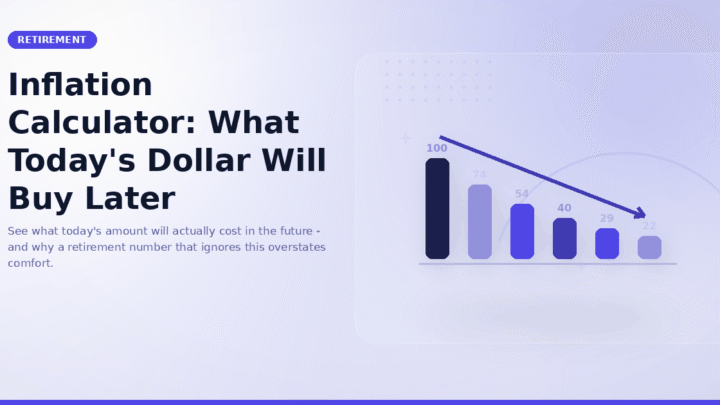
See what today's amount will actually cost in the future - and why a retirement number that ignores…