SCSS Calculator: Senior Citizen Savings Scheme Returns
SCSS offers seniors a safe, high, regular income. This calculator shows the quarterly interest and maturity.
 July 3, 2026by cyborg.vaibhav@gmail.com8 min read
Meenakshi Pillai retired from a government college in Thiruvananthapuram in early 2023 with a spreadsheet already built: half her ₹30 lakh retirement corpus into the Senior Citizens Savings Scheme (SCSS), half into the Pradhan Mantri Vaya Vandana Yojana (PMVVY), both paying a fixed, predictable monthly income for a decade. By the time she actually walked into the post office that April, one half of that spreadsheet was no longer a product anyone could sell her.
PMVVY, run through LIC, stopped accepting new subscriptions after 31 March 2023. Anyone who bought a policy before that date locked in a 7.4% annual return, payable monthly, guaranteed for the full 10-year term — a genuinely useful product for a retiree wanting fixed monthly income that never moves regardless of what happens to interest rates elsewhere. Anyone retiring after that date has no PMVVY option at all. It isn’t being sold anymore, and no replacement product offering the same locked-for-a-decade structure has been announced.
Alongside PMVVY’s closure, the government raised the SCSS maximum deposit limit from ₹15 lakh to ₹30 lakh per individual, effective April 2023 — a change that, not coincidentally, lets a retiree like Meenakshi now put an entire ₹30 lakh corpus into SCSS alone, exactly the amount PMVVY’s closure left unaccommodated. But SCSS works on a different mechanism entirely: its interest rate is not locked for the tenure the way PMVVY’s was. It is reviewed every quarter by government notification, so a retiree’s income can rise or fall through the life of the account depending on the rate at each reset — the opposite of the fixed, predictable number PMVVY offered.
Her spreadsheet had assumed two locked rates for a decade. What she got instead was one scheme whose rate moves. Put ₹30 lakh entirely into SCSS at a quarterly-reviewed rate, and her monthly income is only ever as reliable as the next government notification. If the rate is reviewed downward at some future reset, her monthly cheque falls with it, through no decision of her own — something a PMVVY policyholder locked in before April 2023 will simply never experience on that portion of her money.
This is not a reason to avoid SCSS — the doubled limit is a real improvement for anyone who has more than ₹15 lakh to place in a government-backed scheme — but it does mean the “fixed income” a retiree tells their family to expect is now, for the full corpus, a number that can change every three months, not a number frozen the day the account was opened.
Two rule changes from the same November 2023 notification round matter more than the headline rate does, and almost nobody budgets around either one. First, SCSS accounts can now be extended in blocks of three years, indefinitely, rather than the single three-year extension previously allowed after the initial five-year term — useful if Meenakshi is still in good health at 75 and wants the account to keep running. Second, the premature-closure penalty is tiered in a way that punishes an early exit unevenly: close the account within the first year and a 1% penalty is deducted from the deposit; close it between one and two years and the penalty rises to 1.5%; close it after two years and it falls back to 1%. A retiree who needs to break the account exactly in year one-and-a-half pays the steepest penalty of the entire tenure, which is precisely the point in a five-year plan where an unexpected medical expense is most likely to force the issue.
Confirm PMVVY genuinely isn’t available before budgeting around it — some older financial plans and advisor templates still reference it as if it were current, and a retiree relying on one could be planning around a product that no longer exists. For SCSS, check the current quarterly rate directly rather than assuming it matches whatever figure you last heard, since it is reviewed afresh every quarter and the number that was accurate in January may not hold by July. Build in a buffer for the possibility that a future reset comes in lower than the one you opened the account at, and if there is any real chance you might need to break the account early, know in advance which side of the one-to-two-year window that would fall on.
What the calculator settles for Meenakshi: enter her SCSS deposit and the current quarterly rate, and it tells her the actual monthly income at today’s number — not the number she remembers from when PMVVY was still being sold.
It does not mean SCSS is a worse scheme than PMVVY was, or that the government has left retirees worse off overall. A ₹30 lakh limit accommodates far more of a typical retirement corpus than the old ₹15 lakh cap did, and SCSS still carries a sovereign guarantee that most private fixed-income products cannot match. It does not mean every retiree needs to panic about rate resets either — small savings rates move gradually, not violently, and the scheme remains one of the safer places to hold retirement capital in India.
What it does mean is narrower: a plan built assuming a locked, decade-long rate on half a corpus needs to be rebuilt if that half was meant to sit in PMVVY, because that product is simply gone for new entrants. Meenakshi’s spreadsheet from January 2023 was not wrong when she wrote it. It became wrong two months later, through no fault of her arithmetic, because one of the two schemes it depended on stopped taking new customers.
Yes — the 7.4% rate remains locked for the full 10-year term for anyone who purchased a policy before the 31 March 2023 cutoff. Only new purchases have stopped; existing policies continue exactly as sold.
Not through PMVVY, and no direct replacement has been announced. SCSS remains the primary government-backed scheme available today for new senior citizen investors, but its quarterly-reviewed rate is structurally different from PMVVY’s locked-rate design, so it does not offer the same certainty.
Yes, as of the November 2023 rule change, an SCSS account can be extended in blocks of three years with no limit on the number of extensions, replacing the earlier rule that allowed only one such extension after the initial five-year term.
Between one and two years after opening, when the premature-closure penalty is at its highest tier. Closing before one year or after two years both carry a lower penalty than closing in that middle window, so it is worth knowing where any likely early-exit date would fall before you need to act on it.
Regulatory sources: India Post, which administers SCSS on behalf of the government, and the Department of Economic Affairs’ small savings notifications set out the current deposit limit, quarterly rate and premature-closure penalty structure; LIC’s PMVVY terms confirm the scheme’s closure date and locked-rate design for existing policyholders. The comparison between the two schemes’ rate structures and the arithmetic on what changed for a retiree like Meenakshi are this article’s own.
Disclaimer: This article is for general information only and is not financial advice. Meenakshi Pillai is a composite character based on common retirement-planning patterns among Indian senior citizens, not a real person. Interest rates on government small savings schemes are reviewed quarterly and deposit limits and penalty rules can change — always check the current official rate and terms directly before investing.
SCSS offers seniors a safe, high, regular income. This calculator shows the quarterly interest and maturity.
Agricultural income is exempt, but partial integration uses it to pick a higher rate for your salary. The…
Deferring tax is an interest-free loan from the government. Growth vs IDCW, employer NPS, gain harvesting, CGAS, section…
EPF and NPS both carry real equity exposure, while EPF-VPF tax thresholds are twice as generous for government…
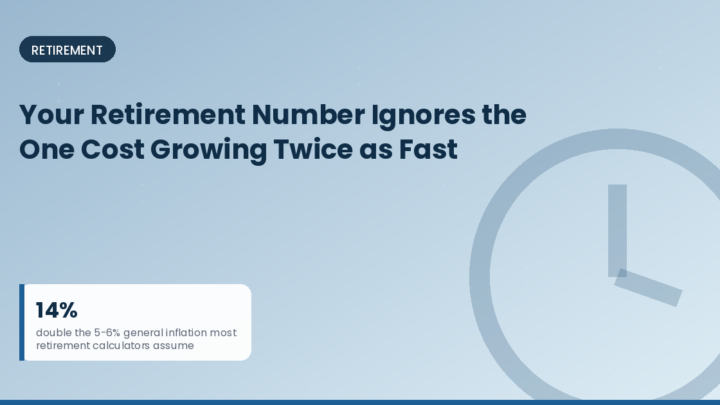
Medical inflation runs 10-14% a year in India, nearly double the 5-6% general inflation most retirement calculators assume.
India has 967 SEBI-registered fiduciary advisers against over 1,33,000 commission-paid distributors.