
Rent in the City, Buy Farmland, Pay No Tax: The Advice That Raises Your Tax Bill
Agricultural income is exempt, but partial integration uses it to pick a higher rate for your salary. The…
 June 19, 2026by cyborg.vaibhav@gmail.com10 min read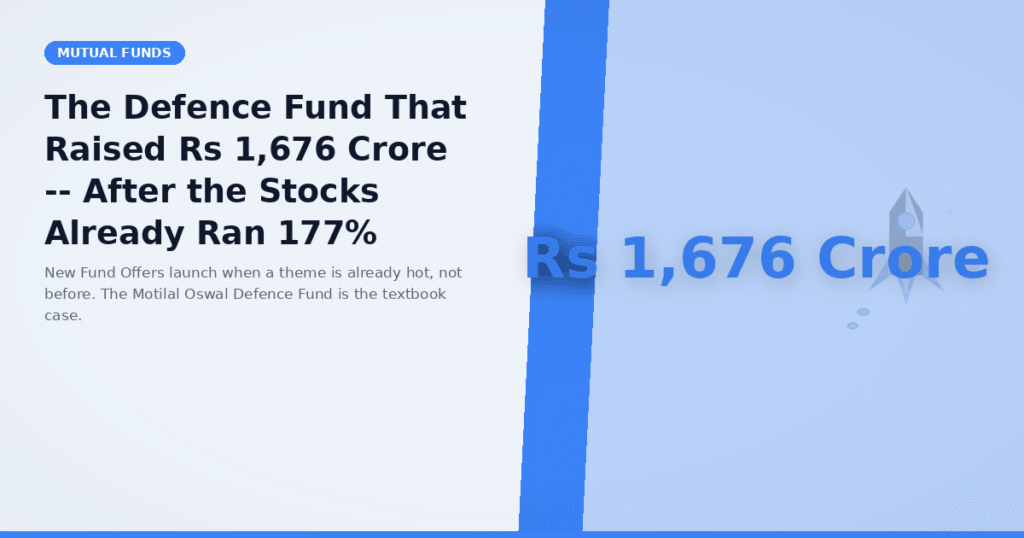
In June 2024, Motilal Oswal launched India’s first passive defence-sector index fund. The New Fund Offer raised ₹1,676 crore in two weeks — the highest-ever collection by an equity index fund in Indian history, from over 248,000 investors. The index it tracks had already delivered a 177% one-year return and an 89.5% three-year CAGR by the time the NFO closed. Read that sequence again: the fund launched after the run-up, not before it, and retail money poured in at the moment a brokerage house’s own research was warning about “the risk of entering the market at lifetime highs.”
Ganesh Warrier felt exactly the pull that’s built into every NFO pitch. He’s a civil engineer in Thrissur, forty-one, with a decade of steady site-supervision income and a habit of checking his portfolio app most evenings. When the defence fund NFO opened, the pitch he saw wasn’t “here is a concentrated, high-risk sector bet” — it was “India’s first defence fund, at just ₹10 a unit, don’t miss it.” He put in ₹3,00,000 of his savings, money he now says he’d normally have parked in an index fund he actually understood. Ganesh is a composite investor, built from patterns common among that NFO’s buyers — not a real individual — but every number in his arithmetic below tracks the index’s actual, publicly recorded movement.
New Fund Offers are, structurally, the moment an AMC can raise the most money with the least resistance: a marketing push, a “limited period” NFO discount narrative, and a theme that’s already in the news because its stocks have been running. A fund house has every incentive to launch a themed or sectoral fund exactly when that sector is hot, because that’s when the story sells — not necessarily when the sector’s valuations still have room to run. SEBI itself has grown concerned enough about this dynamic that a July 2025 consultation paper proposed capping stock overlap between thematic/sectoral schemes at 50% within the same fund house, specifically to curb AMCs launching a wave of similar “hot theme” products.
NFO marketing frequently leans on the idea that buying at ₹10 NAV is “cheaper” than an existing fund trading at a higher NAV. It isn’t — NAV is just units outstanding divided by fund assets; a ₹10 NAV fund and a ₹100 NAV fund holding the same portfolio at the same value grow identically in percentage terms. The only real difference an NFO buyer takes on is an unproven fund with no track record, often launched specifically because the theme is already popular — the worst combination of “new and unproven” plus “already expensive.”
Brokerage research on defence-sector funds itself flagged the relevant risks plainly: sector concentration (“a white-knuckle ride” of boom and bust cycles), frothy valuations after a sustained rally, dependency on government policy priorities that can shift, and lower liquidity in many of the underlying stocks compared to diversified large-cap names. None of these risks are hidden — they’re usually in the fine print of the same NFO’s own risk disclosures — but they rarely make it into the marketing headline the way “India’s first defence fund!” does.
Here is the detail Ganesh says nobody walked him through. Under SEBI’s mutual fund product-labelling framework, every scheme carries a riskometer — a six-level scale running from Low to Very High — and asset managers are required to recompute and publish it every single month, not just at launch, and to notify investors specifically when a scheme’s level changes. Sectoral and thematic equity schemes, by the nature of their concentrated exposure to one industry, are placed in the “Very High” band as a matter of course. That placement doesn’t wait for a correction to arrive — it is disclosed from the day the NFO opens, printed on the same factsheet as the “India’s first” headline.
SEBI’s own investor-facing guidance describes the riskometer’s purpose as letting an investor know the level of risk associated with their investments, on a scale that’s comparable across every scheme in the country — not as a footnote to be buried under a launch narrative. The Motilal Oswal defence fund’s riskometer was never going to say anything except Very High, on day one, because that’s what its category requires by rule, regardless of how the NFO was marketed.
This part doesn’t require assuming anything, because the index’s own price history is public record. The Nifty India Defence Index kept climbing after the NFO closed in June 2024, peaking in July 2024 after more than doubling over the preceding nine months. Then the kind of correction that single-sector concentration makes possible actually arrived: the index fell more than 38% from that peak by mid-February 2025. A fund that had just collected a record ₹1,676 crore at the top of a run doesn’t get to sidestep a fall in the index it exists to track — by construction, it moves with it, rupee for rupee.
Run that against Ganesh’s ₹3,00,000. If his units tracked the index’s 38% drawdown, his holding was worth roughly ₹1,86,000 by February 2025 — a paper loss of about ₹1,14,000 on money he’d parked eight months earlier expecting a defence-sector tailwind, not a correction of that size. The index did claw back a large share of that ground through the first half of 2025 before correcting again later in the year. That round trip is exactly the point: swings of 30-40% in either direction are the normal behaviour of a “Very High” rated, single-sector index, not a malfunction. Ganesh’s mistake wasn’t choosing defence as a theme. It was buying the concentrated, undiversified version of that bet at the exact moment the marketing volume was loudest — which, structurally, tends to be close to the moment the risk is highest too.
Ask two questions: has this sector or theme already had a large run-up in the last 12-24 months (check the index’s own trailing returns, not the fund’s, since the fund has none yet), and would I still want this exposure if it had launched two years ago at a much lower valuation? If a sector fund only sounds appealing because of a recent rally, that rally is precisely the risk, not the reason to buy.
It doesn’t mean every sectoral or thematic NFO is a trap, or that defence as a sector was a poor long-term call — it may well turn out to be a fine one over a full decade. It doesn’t mean a Very High riskometer rating is a signal to avoid a fund entirely; plenty of deliberate, well-sized allocations carry that rating on purpose, as part of a wider diversified portfolio. And it doesn’t mean Ganesh behaved recklessly in some unusual way — buying a concentrated bet at the top of a rally because the marketing made it feel urgent is close to the median pattern among NFO investors in a hot theme, not an outlier one.
What it does mean is narrower: the riskometer had already told him what he was buying, in a government-mandated disclosure format, on day one — and the marketing simply competed for his attention against that disclosure, and won.
Not inherently — some investors have deliberate, informed conviction in a specific sector’s long-term prospects. The concern is buying into a hot theme reactively, right after a rally, rather than as part of a considered allocation decided in advance.
Only in the sense of lower minimum investment amounts some NFOs offer — never in the sense of the ₹10 NAV itself representing better value, since NAV alone says nothing about a fund’s valuation or future returns.
No — plenty of experienced investors deliberately choose Very High-rated sectoral or thematic funds as a small, sized-down slice of a wider portfolio. The rating discloses risk level, it isn’t a verdict on whether the fund suits you; sizing the position correctly matters more than avoiding the category outright.
No — a correction of 30-40% from a peak is well within the normal range for a concentrated, single-sector equity index after a rapid run-up, which is exactly why SEBI’s framework requires the Very High label in the first place. The surprise wasn’t the size of the swing; it was that the marketing around the NFO never mentioned swings of that size are normal for the category.
Regulatory source: SEBI‘s mutual fund product-labelling and riskometer framework requires every scheme’s risk level to be disclosed and republished monthly, with sectoral and thematic equity schemes placed in the Very High band because of their concentrated exposure. The reconstruction of Ganesh’s arithmetic and the entry-timing analysis built around it are this article’s own.
Disclaimer: This article is for general information only and is not financial or investment advice. Past index performance does not indicate future returns; sectoral and thematic funds carry higher concentration risk than diversified funds. “Ganesh Warrier” is a composite character built from patterns common among NFO investors, not a real individual.
Agricultural income is exempt, but partial integration uses it to pick a higher rate for your salary. The…
Deferring tax is an interest-free loan from the government. Growth vs IDCW, employer NPS, gain harvesting, CGAS, section…
EPF and NPS both carry real equity exposure, while EPF-VPF tax thresholds are twice as generous for government…
Medical inflation runs 10-14% a year in India, nearly double the 5-6% general inflation most retirement calculators assume.
India has 967 SEBI-registered fiduciary advisers against over 1,33,000 commission-paid distributors.
5% minimum due, 36-42% annual interest, and a lost grace period on every new purchase.