
Target-Date Funds: A Fund Inside a Fund Inside a Fee
The default fund stacks a wrapper fee on underlying fees -- $118,000 over a career for a rebalancing…
 April 23, 2026by cyborg.vaibhav@gmail.com8 min read
Sofia switched jobs in July, and both her old startup and her new employer’s payroll systems did exactly what they were built to do: let her contribute all the way up to the IRS’s annual 401(k) limit, tracked entirely within each company’s own plan. Neither system had any way of knowing about the other. By December, Sofia had deposited close to double the actual annual limit the IRS allows any one person to contribute across every 401(k) they hold in a calendar year — a mistake with a hard, specific deadline attached to fixing it, and one that neither employer’s HR department was ever going to catch on her behalf.
Sofia is a composite character — a stand-in for a pattern that shows up constantly among people who change jobs mid-year, not a real payroll record. Her numbers are invented. The IRS rule that caught up with her is not.
How this article was checked. The excess-deferral mechanics and correction deadline below are described directly from the IRS’s own published guidance as reviewed in July 2026. The annual elective deferral limit is adjusted every year — check irs.gov for the current-year figure before relying on any specific number.
Almost every 401(k) explainer, including the common “contribute up to the match, then max it out if you can” advice, quietly assumes one employer, one plan, tracking your contributions against the IRS’s annual elective deferral limit all year. Every individual payroll system is genuinely good at this within its own walls — it will not let your per-paycheck contributions push you over the annual limit, calculated against what it itself has withheld. What it cannot see is any other employer’s plan, because the limit is set by law on the person, not on any single plan.
Sofia contributed enough at her startup, before leaving in July, to hit close to the full annual elective deferral limit through that plan alone. Her new employer’s 401(k) enrollment, a few weeks later, started from zero on its own books and let her contribute up to the same full annual limit all over again through its own plan, with no way of knowing she’d already hit that ceiling somewhere else. By year-end, her combined elective deferrals across both plans sat well above the single limit the IRS allows per person, per year — an excess deferral that exists purely because two independently correct systems never talked to each other.
The IRS’s own guidance is direct about this: when elective deferrals across multiple plans exceed the annual limit, it is up to the individual to identify the excess and request a corrective distribution from one or more of the plans before the April 15 deadline following the year of the deferral. If that deadline passes without a correction, the excess amount is taxed twice — once as income in the year it was contributed, and again as income in the year it’s eventually distributed, since the plan doesn’t automatically remove it once the calendar year has closed.
If you change employers during a calendar year and contribute to a 401(k) at more than one, add up your elective deferrals across every W-2 for that year yourself — your final pay stub from each employer shows the total. If the combined figure exceeds the annual limit, contact the plan administrator for one of the plans and request a corrective distribution of the excess before April 15 of the following year. This is squarely your responsibility to catch; no single employer’s payroll system is built to see the other one.
This same gap applies, for a different reason, to anyone holding two jobs simultaneously rather than switching between them — a full-time role with a 401(k) alongside a part-time or contract position that also offers one. Each employer’s plan is, again, entirely correct on its own terms and entirely blind to the other. The check is identical either way: total every elective deferral across every plan for the calendar year, not per employer, before assuming you’re within the limit. W-2 Box 12 codes D and AA (and related codes for other deferral types) show exactly what each employer reported, which makes this a five-minute check once tax documents arrive, well before the April 15 deadline for the prior year’s excess.
This is not a reason to avoid maxing out a 401(k), and it doesn’t affect the ordinary case of contributing to a single employer’s plan for the entire year, where the payroll system’s own tracking is completely sufficient. It also doesn’t apply to employer matching contributions, which follow separate limits and aren’t part of the elective deferral total the IRS is tracking here. The point is narrower: changing jobs mid-year, or holding two jobs with 401(k) plans simultaneously, removes the safety net that a single payroll system otherwise provides, and checking the combined total yourself is the only thing standing between a routine job change and a double-taxed mistake.
Yes — the annual elective deferral limit applies to your combined traditional and Roth 401(k) contributions across every employer in a calendar year, not just traditional contributions alone.
Then your employer’s payroll system tracking is sufficient on its own, since it has full visibility into all of your contributions to that single plan for the entire year. This issue is specific to holding contributions at more than one employer’s plan in the same calendar year.
The plan administrator for whichever plan you want the excess withdrawn from, before the April 15 deadline following the year the excess was contributed. Acting early in the year gives the administrator more time to process the correction.
It’s less common, but possible if payroll miscalculates or a mid-year raise isn’t reflected quickly enough in the plan’s own cap logic. The same corrective-distribution process and April 15 deadline apply regardless of how the excess happened.
Match formulas are typically calculated per plan and per employer, so switching jobs doesn’t create the same combined-limit problem for matching contributions that it does for your own elective deferrals. It can, however, mean a shorter window at each employer to capture a full year’s worth of match, which is a separate planning question worth checking with each employer’s specific plan documents.
Statutory sources, all official: IRS, Retirement Topics: Elective Deferrals in Excess of the Limits; IRS, 401(k) Plan Fix-It Guide, Section 402(g) Excess Deferrals. The framing of this as a specific job-change trap is Linqz’s own analysis, not stated as such by the IRS.
Disclaimer: General information, not tax or financial advice, and Linqz is not a CPA firm or a registered investment adviser. “Sofia” is a composite character with invented finances, not a real person. Elective deferral limits and correction procedures are set by federal law and adjusted annually — verify current-year figures on irs.gov before acting, and consult a qualified tax professional about your own contributions.
The default fund stacks a wrapper fee on underlying fees -- $118,000 over a career for a rebalancing…
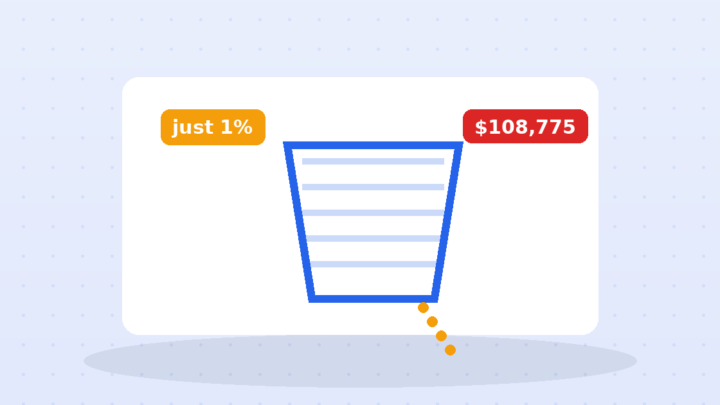
On $500 a month for 30 years, 'just one percent' is $108,775. The invoice never comes; the money…
If your employer matches 401(k) contributions and you're not contributing enough to get the full match, stop reading…
Claiming at 62 vs 70 can change your monthly benefit by more than 50%. See your own numbers…
Same contribution, two tax treatments, very different after-tax outcomes depending on one bet: your future tax bracket.
Skip the scary generic headline number. Work backward from your own real spending to find what you actually…