The 1% Fee Dressed as Professional Management
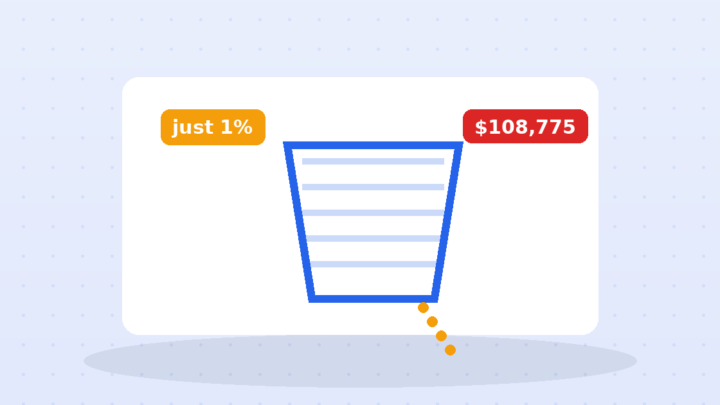
On $500 a month for 30 years, 'just one percent' is $108,775. The invoice never comes; the money…
 March 28, 2026by cyborg.vaibhav@gmail.com7 min read
Erin Castellano, a dental hygienist in Boise ID, did the responsible thing. No stock-picking, no timing — she put her whole 401(k) into the target-date fund with her retirement year on the label. “Set it and forget it.” What the label omits: her fund is a wrapper holding other funds, and the fees stack like nesting dolls — a wrapper fee on top of each underlying fund’s fee, all charged on the same dollars, all invisible on every statement she will ever receive. It also omits something else Erin assumed the label meant: that her money gets safer, not just cheaper to hold, the moment her named year arrives.
A target-date fund is mostly plumbing: it owns a handful of the provider’s own stock and bond funds and glides the mix as you age. Useful. But in the expensive versions, you pay twice for the privilege — the underlying funds’ expense ratios plus a management layer on the wrapper, totaling 0.7–1% or more, for what is functionally a rebalancing spreadsheet. The identical service exists at 0.1% from low-cost providers. The gap is not service; it is the provider’s choice of which of its own funds to stuff inside — frequently the pricier, actively-managed shelf, because the wrapper’s captive dollars have nowhere else to go.
$500 a month for 30 years at 7% net grows to about $613,500. Drag it to 5.9% net — a 1.1% stacked-fee version of the very same market exposure — and it reaches about $495,200. The dolls ate $118,000, one basis point at a time, from a person who did everything the enrollment brochure said.
Default funds receive default dollars: target-date funds are where auto-enrolled contributions land, which makes them the least price-sensitive shelf in American finance. Plan providers negotiate revenue sharing with fund managers; expensive share classes appear on menus for reasons that have nothing to do with Erin. Regulation forces fee disclosure — in documents engineered to be technically available and practically unread.
Simplified: assumes your contribution percentage and salary stay level (real paychecks usually get raises, which this does not model) and applies the employer match every month with no cap modeled -- check your plan document for the exact match formula and any vesting schedule, since unvested employer contributions are not really yours until vested.
Find your target-date fund’s total expense ratio (the fee disclosure or any fund-research site; check the ticker’s share class). Under ~0.2%: relax, you own the good kind. Above 0.5%: rebuild the same recipe yourself from the menu’s cheap ingredients — a total-market index fund and a bond index fund, rebalanced yearly, replicates the glide path for a tenth of the toll. Keep the simplicity; fire the markup.
The SEC’s own investor bulletin on target-date funds draws a distinction most enrollment brochures never mention: some funds use a “to” glide path, which shifts the investment mix to become more conservative only until the target date and largely holds steady after; others use a “through” glide path, which keeps shifting the mix for years or decades past the named date, since the fund assumes the money will stay invested through retirement rather than being withdrawn all at once the year it’s reached. Erin’s plan enrollment materials never specified which type her fund uses — that detail lives in the fund’s prospectus, not the one-page summary most participants actually read.
The SEC’s bulletin is explicit about why this matters: reaching the target date does not mean an investor has saved enough to meet their goal, and investment risk exists throughout the fund’s life regardless of glide path type — the year in the fund’s name describes an approximate retirement date, not a safety guarantee, and definitely not a promise about how much equity exposure remains at that date. A “through” fund can still hold a meaningful stock allocation well past its named year, by design, which is either exactly right for someone planning a decades-long retirement or a genuine surprise for someone who assumed “2030” meant “conservative starting in 2030.”
What the calculator settles for Erin, whatever her fee is and whatever glide path her specific fund follows: enter your balance and your fund’s actual expense ratio, and it tells you the dollar cost of the wrapper over the years remaining — the glide-path question is one to answer by reading the prospectus, but the fee question is one this calculator answers immediately, no reading required.
Something, yes — about what a calendar reminder costs. It is not worth $118,000, which is what the expensive wrappers charge for it over a career.
This is not an argument that target-date funds are a bad default — they remain a genuinely reasonable choice for someone who wants a single, professionally allocated fund and doesn’t want to manage rebalancing themselves, and the DOL specifically encourages plan sponsors to offer them as a Qualified Default Investment Alternative for exactly that reason. It is also not a claim that every target-date fund is overpriced, or that a “through” glide path is worse than a “to” glide path in some universal sense — which is better depends entirely on whether the money will be withdrawn as a lump sum near the target date or drawn down gradually over a long retirement, and reasonable target-date fund families make different, defensible design choices on that question. And it is not a suggestion that Erin should abandon the fund and build her own three-fund portfolio out of general principle; that’s the right move for someone who wants the fee savings and is willing to do the annual rebalancing herself, and the wrong move for someone who would otherwise let the account drift unmanaged for a decade.
The two things worth actually verifying, separately and on their own timelines, are the fee and the glide path type — and they are found in entirely different places within the same fund’s disclosure paperwork. The expense ratio is on the fund’s fact sheet, one clearly labeled number, easy to compare directly against a low-cost alternative fund. The “to” versus “through” distinction is buried in the prospectus’s glide path description, sometimes summarized in the fund’s own marketing materials if the family is being unusually transparent about how the fund actually behaves near and after the label date, and it is genuinely worth reading once regardless of what doing so costs in time, since it describes how much market risk the money will still carry in the exact years withdrawals are most likely to begin — a fact Erin’s enrollment paperwork never once surfaced and that her plan’s own fund-menu one-pager never mentioned at all.
Share classes: identical portfolio, different fee, depending on your plan’s negotiated menu. If your plan carries the expensive class, that is worth a polite, documented question to HR — plans have fiduciary duties, and employees asking about share classes is how menus improve.
Disclaimer: Erin Castellano is a composite character based on common target-date-fund participant patterns, not a real person. This article is for general information only and is not financial or tax advice. Consult a qualified advisor before making investment or tax decisions.
On $500 a month for 30 years, 'just one percent' is $108,775. The invoice never comes; the money…
If your employer matches 401(k) contributions and you're not contributing enough to get the full match, stop reading…
An employer match is close to free money. See what your salary, contribution rate, and match actually project…
The HSA shoebox strategy, 457(b) stacking, asset location, 0% capital gains harvesting, NUA and the mega-backdoor Roth, plus…
Each refi resets the interest-heavy years and rolls in fresh costs. Keep the rate; keep the clock honest.
Fear sells early claiming -- a permanent 30% cut to dodge a hypothetical 20% one. Run the break-even…