Post Office MIS Calculator: Monthly Income from Your Savings
The Post Office Monthly Income Scheme pays a fixed monthly income on a lump sum. This calculator shows…
 August 20, 2025by cyborg.vaibhav@gmail.com8 min read
Kusum Bairagi runs a small tailoring shop off a side lane near Udaipur’s Hathi Pol, stitching blouses and school uniforms on a machine that was her mother-in-law’s. Her income most years sits comfortably below the basic income tax exemption limit. And yet, one year, her bank quietly deducted ₹5,600 from an FD she holds — money that was never hers to owe as tax, taken automatically, without her signing anything or being asked. It happened because of one missing piece of paper she had submitted the year before and simply forgot to submit again.
Section 194A of the Income Tax Act requires a bank to deduct TDS on the interest it pays you once that interest crosses a threshold in a financial year, currently ₹40,000 for those under 60 and ₹50,000 for senior citizens — and crucially, once interest crosses that line, the bank deducts TDS on the entire interest amount, not just the portion above the threshold. But the same framework carves out an exception for people whose total income is genuinely below the taxable threshold: Form 15G, for anyone under 60, and Form 15H, for senior citizens, is a self-declaration you can submit to your bank stating that your estimated total income for the year will not be taxable. A validly accepted form instructs the bank not to deduct any TDS at all on that account, regardless of how much interest it earns.
Kusum submitted Form 15G the first year she opened her larger FD, on the advice of a helpful bank clerk who filled it in for her at the counter. What neither the clerk nor the bank’s process reminded her of the following year is that Form 15G and Form 15H are not permanent instructions. They are declarations tied to a specific financial year’s estimated income, and they must be submitted afresh at the start of every single financial year for the exemption to keep applying. Nothing about the account, the FD, or the bank’s records carries the exemption forward automatically. When the new financial year began and she did not walk into the branch again, the bank’s system defaulted to treating her as a normal depositor without a valid declaration on file — and began deducting TDS the moment her cumulative interest crossed the threshold.
Kusum’s FD of ₹8,00,000 earning around 7% a year generates roughly ₹56,000 in annual interest — comfortably over the ₹40,000 threshold. With no Form 15G on file that year, the bank deducted TDS at 10% on the full ₹56,000, not merely on the amount above the threshold, which came to ₹5,600. Her actual tax liability for the year, given her modest shop income and no other significant earnings, was zero — her total income sat below the basic exemption limit entirely. The ₹5,600 was never a tax she owed. It was a tax the bank was legally required to withhold in the absence of a valid declaration, refundable only by her filing an income tax return for that year and waiting for the refund to process.
Anyone whose total estimated income for a financial year is below the taxable threshold and expects interest income above the TDS threshold should submit Form 15G (or Form 15H, if 60 or older) at every bank branch holding an interest-earning account, at the start of every single financial year — not once, and not only at the branch that opened the account, since multiple branches or banks each require their own submission. Set a personal reminder for the start of April each year, since no bank sends a proactive nudge before defaulting to TDS. If TDS has already been deducted despite your income being non-taxable, the only way to recover it is to file an income tax return for that year and claim it as a refund; there is no shortcut through the bank itself once the deduction has already happened.
The calculator settles the one question Kusum’s bank never asked her: given her actual amount, rate, and income, does her interest cross the threshold this specific year — and therefore, does she need a fresh Form 15G in the branch before the interest starts accruing, or can she skip the trip entirely because she is genuinely under the line anyway.
None of this changes what a fixed deposit fundamentally does: you deposit a lump sum for a fixed term at a fixed rate, and the bank owes you exactly that rate regardless of what markets do afterward, usually compounding quarterly. A ₹5 lakh deposit at 7% for five years, compounded quarterly, matures to roughly ₹7.07 lakh — about ₹2.07 lakh in interest for doing nothing but waiting. That certainty is the entire appeal of an FD, and TDS or no TDS, the underlying interest calculation does not change. What changes is only whether the bank hands you all of that interest as it is credited, or withholds a slice of it pending a form that has to be filed every year without fail.
This does not mean TDS on FD interest is unfair or a bank error — it is the correct, legally required default in the absence of a valid declaration, and it exists precisely because the tax department cannot otherwise track interest income earned across thousands of small depositors. It also does not mean Form 15G is only for people with zero income; anyone whose total estimated income for the year, from all sources combined, will remain below the basic exemption threshold can submit it, self-employed shop owners like Kusum included. And withheld TDS is never lost money — it is fully recoverable through a return, just recoverable late, and only if you actually file rather than assume the bank will sort it out on its own.
At every bank and effectively every branch where you hold an interest-earning deposit above the TDS threshold — the declaration is specific to that deposit relationship, and one bank has no visibility into what you filed at another.
Submitting a false declaration when you know your income will exceed the taxable threshold carries its own penal consequences under the Income Tax Act, so only file it if your estimated total income genuinely will not be taxable that year — do not use it as a routine way to avoid TDS regardless of your actual income.
Yes — without a PAN on file, banks are required to deduct TDS at a higher rate than the standard 10%, so ensuring your PAN is correctly linked to the account is a separate, equally important step alongside filing Form 15G or 15H.
Yes, by filing an income tax return for that specific financial year and claiming the deducted amount as a refund; there is a time limit for filing returns for past years, so do not leave it indefinitely once you realise TDS was deducted despite your income being non-taxable.
Regulatory source: Section 194A of the Income Tax Act governs TDS on interest income, and Form 15G/Form 15H are the prescribed self-declarations for avoiding it when total income is below the taxable threshold; verify the current threshold amounts and form validity requirements directly on incometaxindia.gov.in before relying on any figure above. The reconstruction of Kusum Bairagi’s deposit, the missed refiling and the resulting arithmetic is this article’s own.
Disclaimer: This article is for general information only and is not financial or tax advice. “Kusum Bairagi” is a composite character built for illustration and not a real individual. Consult a qualified tax advisor before making investment or tax filing decisions, and verify current TDS thresholds and rates before relying on any figure above.
The Post Office Monthly Income Scheme pays a fixed monthly income on a lump sum. This calculator shows…
DICGC covers bank and cooperative bank deposits up to Rs 5 lakh -- NBFC deposits are not covered…
Banks often re-rate your FD to a lower tenure rate before applying the penalty, not just deduct 1%.
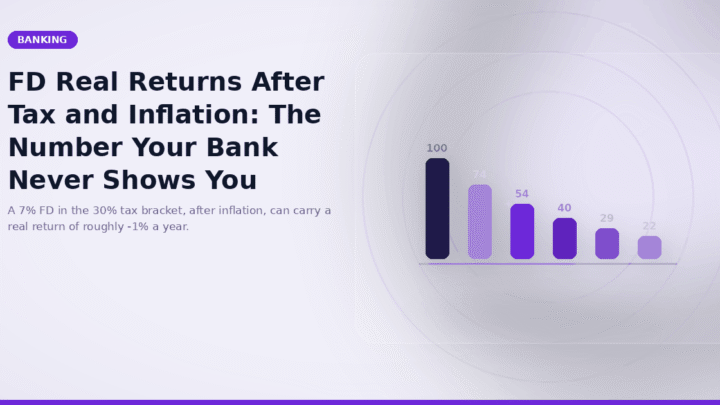
A 7% FD in the 30% tax bracket, after inflation, can carry a real return of roughly -1%…
Idle balances are banking's favourite raw material. Rs 3 lakh loses Rs 78,000 in five years to the…
The premium over a bank FD is the market pricing your chance of not getting it back. Rs…