
Your NBFC Fixed Deposit Has Zero Government Insurance — Unlike a Bank FD
DICGC covers bank and cooperative bank deposits up to Rs 5 lakh -- NBFC deposits are not covered…
 March 7, 2026by cyborg.vaibhav@gmail.com7 min read
Divya, 29, a product manager in Bengaluru earning ₹95,000 a month, is proud of the ₹3 lakh sitting in her savings account. “Liquid,” she says. “Safe.” Her bank agrees enthusiastically, pays her 2.7%, and lends that same money out at 9% and up — pocketing the spread. Divya’s money is not sleeping. It is working the night shift; the salary just goes to someone else. Over five years, the gap between her 2.7% and a simple 7% FD ladder is ₹78,000 — the cost of confusing liquid with idle. And that is only the first way her caution is quietly taxed. The second way, which almost nobody explains correctly, is what happens when she tries to get clever about the tax on that FD interest.
Retail savings-account balances are among the cheapest funding a bank has — lakhs and crores parked at rates that barely register, not because savers compared and chose it, but because the account is where salary lands and attention doesn’t follow it there. Banks price this precisely: the gap between what they pay depositors and what they charge borrowers is the business model, and the marketing term for encouraging large idle balances is “relationship.” The interest you forgo never shows up as a line-item fee anywhere — which is exactly what makes it the most successful charge in Indian retail banking.
The same inattention gets harvested again at FD renewal: deposits auto-roll at whatever the counter rate happens to be that morning — often below the best advertised rate on the bank’s own website — and “sweep-in” facilities are configured with thresholds that keep more money idle in the linked savings account than you would ever choose deliberately. Every default in the system is set to the bank’s favourite answer; your only defence is turning each default into an active decision, once, and then checking it once a year.
Here is where Divya, and most of the internet, gets clever in exactly the wrong direction. Under Section 194A of the Income Tax Act, a bank must deduct TDS at 10% on FD interest once it crosses Rs 40,000 in a financial year for a non-senior depositor (Rs 50,000 for a senior citizen), per bank, per PAN. The common piece of advice — split Rs 12 lakh across four banks at Rs 3 lakh each, so no single bank crosses the threshold and deducts TDS — sounds like a real optimisation. It used to functionally keep the interest out of routine scrutiny. It does not do that anymore, and treating it as a way to reduce tax owed rather than just deferring when it gets collected is the exact mistake.
Since 2021, the Income Tax Department’s Annual Information Statement (AIS) aggregates financial-transaction data reported by every bank against a single depositor’s PAN, FD interest included, regardless of how many banks are involved. By the time Divya opens her AIS before filing her return, all four banks’ interest is sitting in one statement, added together, whether or not any single bank deducted TDS. Splitting deposits changes nothing about the tax owed on total interest — interest income is fully taxable at her slab rate no matter which bank paid it or how small each piece was kept. What splitting actually changes is cash flow: no TDS deducted means no tax was paid in advance on that interest, and if Divya’s total tax liability including that untaxed interest crosses Rs 10,000 for the year, she owes advance tax in quarterly instalments — and interest under Sections 234B and 234C if she pays it all at return-filing time instead. The “trick” doesn’t lower her tax. It just moves a bill she didn’t know was coming to a later date, with a penalty attached for being late.
YOU ENTER your deposit amount and the rate you’re actually being offered today, not the rate you remember from three years ago. IT TELLS YOU the five-year value at that rate versus a savings account, in rupees, so the Rs 78,000 gap stops being an abstract “difference” and becomes the specific number sitting in Divya’s account right now, unclaimed.
Assumes a cumulative FD (interest reinvested and paid out only at maturity), compounded at the frequency you choose. A non-cumulative FD instead pays the interest out on that schedule and returns only the principal at maturity — the total interest earned is the same either way, but a cumulative FD's payout is larger since it also earns interest on interest.
Tax: FD interest is fully taxable at your slab rate as "income from other sources" — there is no special rate. Banks deduct 10% TDS (20% without PAN) once your interest at that bank crosses ₹50,000 in a financial year (₹1,00,000 for senior citizens). TDS is only an advance — your final tax is at your slab, which is what the post-tax figure above uses. If your total income is below the taxable limit, submit Form 15G (15H for seniors) to stop TDS; seniors can also deduct up to ₹50,000 of deposit interest under 80TTB in the old regime.
Define your true liquidity need first — for most households, one to two months of expenses sitting in savings is genuinely enough, with the rest of the emergency fund in instantly-breakable FDs (breaking one costs a small penalty, not a tragedy). Ladder the remainder: three or four FDs at staggered maturities give you both rate and access without one giant lump sum locked away. Check the renewal instructions on every deposit today — change “auto-renew” to “credit to account” and renew deliberately each time. And if you do split deposits across banks, do it for deposit-insurance diversification of counterparty risk, not to dodge TDS — because since AIS started matching interest to PAN, the tax office already knows what your total looks like even if no single bank told them individually. Five minutes a quarter is the entire discipline, and it pays better per minute than most careers. If you know in January that your FD interest for the year will clear the taxable threshold, the fix is simple: estimate the tax on it and pay advance tax in the same quarter the interest is credited, rather than waiting for a bank to deduct TDS on your behalf. That single habit removes both the surprise and the 234B/234C interest in one step, and it costs nothing beyond doing the arithmetic once.
Premature FD closure typically costs about 1% of interest — on Divya’s Rs 3 lakh example, a few thousand rupees against Rs 78,000 of upside. That is a small, known cost for a convenience she will rarely actually invoke.
Yes, but for the right reason: deposit insurance is capped per depositor per bank, so spreading a large sum across institutions genuinely reduces your exposure if a bank runs into trouble. What it does not do, since AIS started aggregating interest by PAN in 2021, is hide any of that interest from the tax department or reduce what you actually owe on it.
The interest is still fully taxable income even with zero TDS deducted, and it will already be sitting in your pre-filled AIS and Form 26AS-linked return by the time you file. If your total advance-tax shortfall for the year is large enough, Sections 234B and 234C add interest for underpayment and for paying late, on top of the tax itself — a cost that exists purely because the tax wasn’t set aside as it was earned.
Statutory sources, all official: Income Tax Department, Section 194A TDS on interest other than interest on securities, and the Annual Information Statement (AIS) FAQs describing PAN-level aggregation of interest reported by financial institutions, both at incometax.gov.in.
Disclaimer: This article is for general information only and is not financial or tax advice. “Divya” is a composite character with invented finances, not a real person. Consult a qualified advisor before making investment or tax decisions.
DICGC covers bank and cooperative bank deposits up to Rs 5 lakh -- NBFC deposits are not covered…
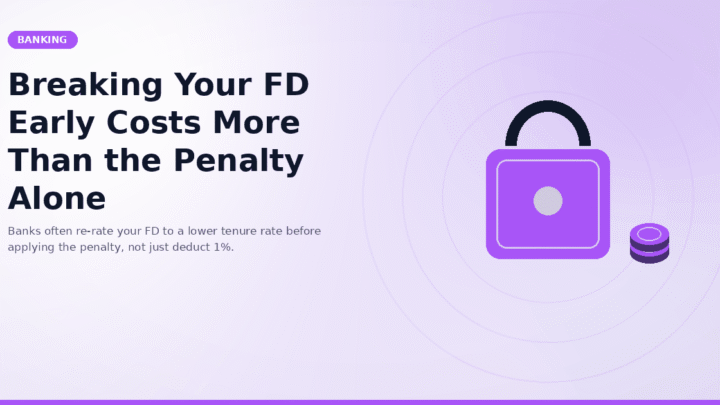
Banks often re-rate your FD to a lower tenure rate before applying the penalty, not just deduct 1%.
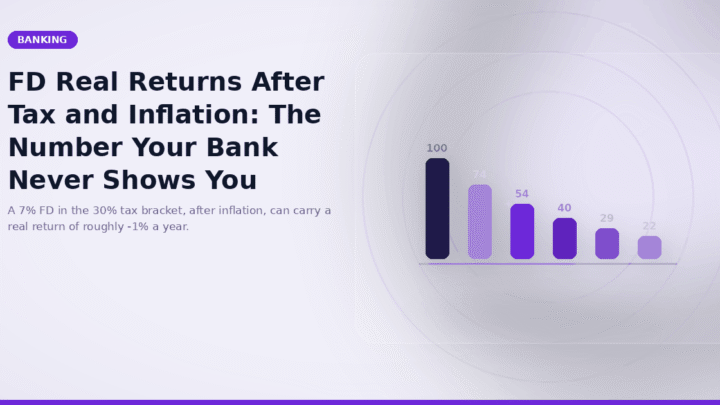
A 7% FD in the 30% tax bracket, after inflation, can carry a real return of roughly -1%…
The premium over a bank FD is the market pricing your chance of not getting it back. Rs…
Up to 65% first-year commission explains every 'special FD' at the branch. The maths of the trap, and…
The Post Office Monthly Income Scheme pays a fixed monthly income on a lump sum. This calculator shows…