
FD Calculator: Fixed Deposit Maturity Amount
An FD is a popular, safe way to save. This calculator shows what your deposit will grow to…
 September 27, 2025by cyborg.vaibhav@gmail.com7 min read
The Post Office Monthly Income Scheme does exactly what its name promises: hand over a lump sum, and it pays you a fixed amount every month for five years, then returns your original deposit in full at the end. No compounding, no market swings, no surprises — just a steady monthly cheque, which is precisely why it’s a staple for retirees who want predictable cash flow over growth.
Kamlesh Solanki retired from the Railways as a guard after thirty-two years of service and moved back to Bhuj — a composite standing in for the pensioners who treat POMIS as the safest possible parking spot for a retirement lump sum. Kamlesh put his full gratuity and leave encashment into a single POMIS account, reasoning that a post-office scheme couldn’t possibly carry the tax and exit complications of a bank product. Eighteen months later, a medical emergency forced him to break the account early, and the same year’s income tax return forced him to confront the second surprise: none of the interest he’d already spent was actually tax-free.
POMIS pays simple, non-compounding interest: Monthly income = P × r ÷ 12, where P is your deposit and r is the annual interest rate, currently around 7.4% and reviewed by the government each quarter. Because it’s simple interest paid out monthly rather than reinvested, your deposit never grows — you’re paid the interest in cash each month, and the original principal just sits there earning the same fixed amount every month until maturity.
Put ₹9 lakh in — the maximum allowed on a single account — at 7.4%, and you’d receive a little over ₹5,500 a month for the full five years, with the entire ₹9 lakh handed back at maturity. A joint account can hold up to ₹15 lakh, roughly proportionally raising the monthly payout.
POMIS is built for people who need income now, not growth later — classically, retirees living off interest income, or anyone who wants a guaranteed monthly amount to cover a fixed set of expenses without touching the principal. It’s a poor fit for anyone still in the wealth-building phase of life, since simple interest with no compounding and no tax benefit is a weak way to grow money over time — the whole design trades growth for certainty and liquidity of income.
People sometimes assume POMIS carries an 80C tax benefit because it’s a post-office scheme, the same family as PPF and NSC — it doesn’t. There’s no deduction on the deposit, and the monthly interest is fully taxable at your slab rate under the Income Tax Act’s normal “income from other sources” treatment, with no Section 80C or equivalent shelter anywhere in the structure. No TDS is deducted at source on POMIS interest, which sounds like a relief but is actually the opposite kind of trap: nothing is withheld, so nothing reminds you a tax bill exists, and the full liability lands on you at return-filing time, calculated at your slab rate, not a flat concessional rate.
Exiting before maturity is possible, and the penalty is tiered rather than a single flat number. No withdrawal at all is allowed in the first year. Between one and three years, closing the account means a deduction of 2% of the deposit amount from the principal you get back. After three years but before the five-year maturity, that deduction drops to 1% of the principal. Kamlesh’s emergency withdrawal fell in the second bracket — an 18-month-old account — so he lost 2% of his principal on top of forfeiting every future month’s interest, at the exact moment he most needed both.
Is the monthly income truly fixed for the full term? Yes — once you deposit, the rate is locked for that account’s entire five-year term, unaffected by later changes to the scheme’s rate for new depositors.
What are the deposit limits? ₹9 lakh for a single account, ₹15 lakh for a joint account — you can also hold multiple accounts as long as your total deposits across all POMIS accounts stay within these caps.
The Post Office MIS queue is retirement money standing in a line — and every product-pusher knows it. The classic swap: an agent ‘helpfully’ redirecting an MIS-bound senior into an insurance annuity or ULIP (“same monthly income, better returns, sir”) that pays him 20–40× the commission. MIS pays agents almost nothing, which is exactly why it is under-recommended and exactly why it deserves the benefit of the doubt.
MIS’s own honest limits: the caps (₹9 lakh single / ₹15 lakh joint), interest taxable at slab with no TDS courtesy, and a flat payout that inflation erodes — the monthly cheque never grows. It is a fine income floor for 5-year windows, not a full retirement plan; pair it with SCSS and something that rises.
SCSS first (higher rate, senior-only, 80TTB-friendly), then MIS for amounts above SCSS limits, then FDs. That ordering is nearly always right and nearly never pitched, because it pays no one.
‘Like MIS but better’ translates to ‘pays me better’. MIS needs no intermediary; income products with commissions attached should be compared IRR-to-IRR in writing.
The number Kamlesh actually needed before depositing his gratuity wasn’t the advertised ₹5,550 a month — it was that figure after his 20% slab rate, and the exact rupee amount he’d forfeit if year one turned into an emergency exit at month eighteen. YOU ENTER the deposit and his slab; IT TELLS YOU the after-tax monthly income and the early-exit penalty in rupees, not a vague “small deduction” warning. The calculator settles both numbers before the money is locked in, which is exactly when they’re useful.
This is not an argument that POMIS is a bad scheme or that Kamlesh made an error by choosing it — for a retiree who genuinely will not need to touch the principal for five years, POMIS remains one of the safest, simplest ways to convert a lump sum into monthly cash flow, government-guaranteed, with no market risk at all. It is also not a claim that the exit penalty is unusually harsh compared to other fixed-term instruments; premature-exit costs exist precisely so accounts aren’t gamed as short-term parking. What it does mean is narrower: “safe” and “tax-free” are not the same word, and a scheme can be entirely safe on principal while still handing you a real, uncushioned tax bill and a real, tiered exit cost — both of which are worth pricing in before signing, not after the emergency.
No — he is a composite drawn from common patterns among retirees who park a lump-sum retirement payout into POMIS without checking its tax treatment or exit terms first, used here to make the arithmetic concrete.
Disclaimer: This article is for general information only and is not financial or tax advice. Consult a qualified advisor before making investment or tax decisions. Kamlesh Solanki is a composite character, not a real person, used to illustrate a common pattern.
An FD is a popular, safe way to save. This calculator shows what your deposit will grow to…
DICGC covers bank and cooperative bank deposits up to Rs 5 lakh -- NBFC deposits are not covered…
Banks often re-rate your FD to a lower tenure rate before applying the penalty, not just deduct 1%.
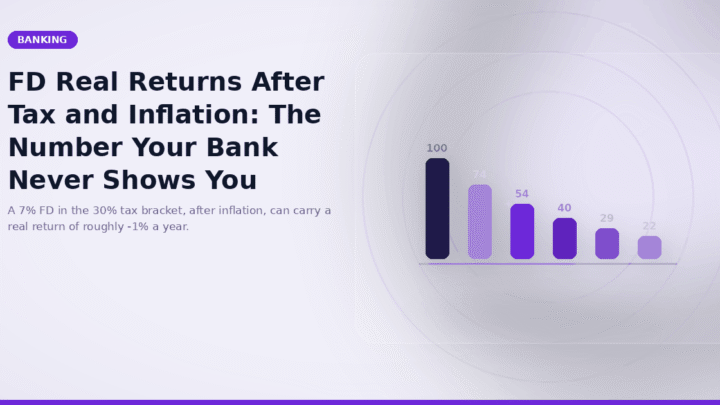
A 7% FD in the 30% tax bracket, after inflation, can carry a real return of roughly -1%…
Idle balances are banking's favourite raw material. Rs 3 lakh loses Rs 78,000 in five years to the…
The premium over a bank FD is the market pricing your chance of not getting it back. Rs…