
The Refinance Treadmill: Lower Payment, Longer Sentence
Each refi resets the interest-heavy years and rolls in fresh costs. Keep the rate; keep the clock honest.
 December 9, 2025by cyborg.vaibhav@gmail.com7 min read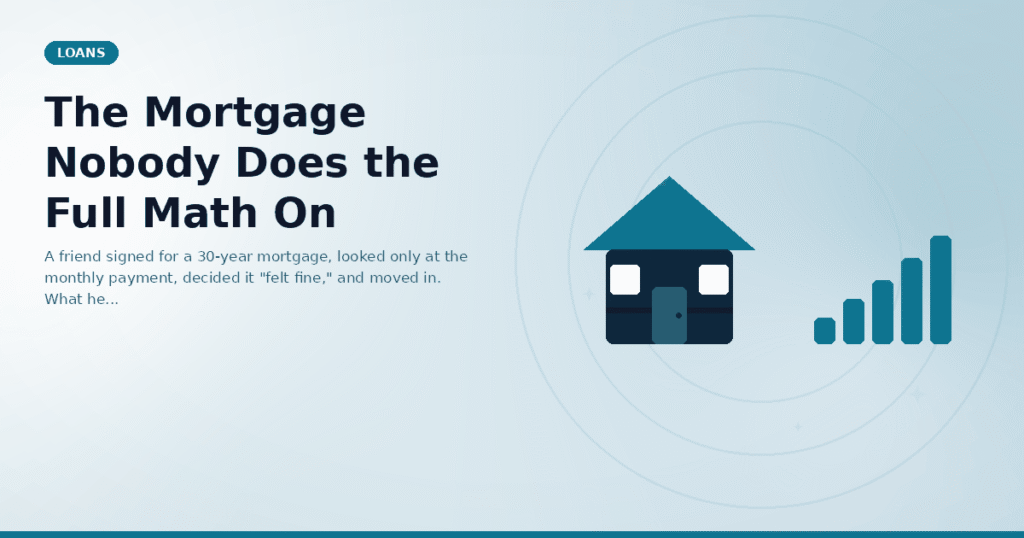
Derek Alvarado, 36, an IT project manager in Phoenix, AZ, signed for a 30-year mortgage, looked only at the monthly payment, decided it “felt fine,” and moved in. What he never added up was that across those thirty years he’d repay nearly double what he borrowed once interest was counted. When a friend showed him the total, he went quiet and said, “Nobody walks you through that part.” Six years later, his loan balance had actually crossed the point where a federal law said his PMI should have vanished automatically — and it hadn’t, because nobody at his servicer was tracking it for him.
They don’t. The monthly payment is the only number anyone discusses. The total interest is the honest one, and it hides at the bottom of paperwork nobody rereads.
The calculator above splits the payment into principal and interest and shows the balance falling over time. Two things tend to surprise people. First, on a 30-year loan the total interest can rival the price of the house itself. Second — look at the balance curve — in the early years almost your entire payment is interest; the loan barely shrinks.
Switch on the extra-payment view and the effect is almost rude. A modest extra each month can shave years off the loan and save tens of thousands in interest, because every early dollar attacks the part of the schedule where interest piles up.
A few honest pointers beyond the calculator’s own numbers. A 15-year mortgage costs meaningfully more per month but far less in total interest paid across the life of the loan. There’s no federal prepayment penalty on most residential mortgages, so extra principal paid down early functions as a guaranteed return exactly equal to your interest rate. And don’t be seduced by the lowest monthly payment on the longest available term — that kind of “affordability” is simply interest stretched thin across more years, not genuine savings.
Derek put down 10% and, like most borrowers below 20% equity, paid private mortgage insurance every month — a protection for the lender, not for him, priced into his payment from day one. What he didn’t know is that the Homeowners Protection Act of 1998 sets two specific, federally mandated exit points from that cost. At 80% loan-to-value based on the original property value, a borrower with a good payment history can request cancellation in writing. At 78% LTV, calculated on the loan’s original amortization schedule, the servicer is legally required to terminate the coverage automatically, without any request from the borrower at all — except this automatic trigger is based on the scheduled balance, not any extra payments made, so a borrower who prepaid principal can cross 80% or even 78% years before the servicer’s own scheduled-balance tracking catches up, and nobody proactively tells them to check.
The mortgage industry’s levers all pull the same direction: bigger loan, longer clock. “You’re approved for $650k” is a risk-model output marketed as a compliment — payment-to-income ratios that assume no childcare, no retirement saving, no life. Points and lender credits shuffle the same money across time in whichever direction confuses comparison. And the 30-year default exists because it maximizes both affordability theater and lifetime interest — a 30-year at 6.5% costs roughly twice the house’s price in total payments.
Escrow padding, rate-lock expiration games during slow processing, and “affiliated” title/insurance referrals each clip their basis points too. The loan estimate form is standardized precisely because the industry’s creativity needed a cage; read yours line by line, twice.
YOU ENTER your loan amount, rate and any extra monthly payment; IT TELLS YOU exactly when your balance crosses 80% and 78% of the home’s original value, so you know the date to request PMI cancellation rather than waiting for a servicer’s scheduled-balance trigger that may lag your real progress by years. What the calculator settles is the exact month you should be picking up the phone.
Derek’s extra payments over six years meant his actual balance crossed 80% of the home’s original value nearly two years before the servicer’s scheduled-balance math would have reached 78% on its own. Because he’d never requested cancellation in writing, he kept paying PMI every month during that entire gap — money that bought him nothing extra, since the legal requirement to remove it (upon his request) had already been satisfied. Nobody at the servicer flagged it, because the law only obligates them to act automatically at the scheduled 78% mark, not to notice when a borrower’s real progress has outpaced the schedule.
PMI premiums typically run somewhere between 0.5% and 1.5% of the original loan amount annually, depending on down payment size and credit profile, which on Derek’s loan worked out to a meaningful monthly cost that simply kept renewing month after month with no expiration date attached to it beyond the ones he had to actively trigger himself. Two years of a cost that was already legally eligible for removal is not a rounding error; on a loan of Derek’s size, it is thousands of dollars paid for a protection he no longer owed anyone, purely because the paperwork to end it was never filed.
None of this means PMI is unfair or that lenders requiring it are acting improperly — it genuinely protects the lender against default risk on a loan with less than 20% equity behind it, and it also lets many buyers enter the market years earlier than saving to a full 20% down payment would allow. The point is narrower: the law sets a clear expiration mechanism for that cost, tied to your loan-to-value ratio rather than to some open-ended judgment call, and the responsibility for triggering the earlier of the two thresholds sits with the borrower, not the servicer, unless your balance happens to match the original schedule exactly.
Divide the points’ cost by the monthly saving: that’s your break-even in months. Beyond your realistic holding period, points are a donation; before it, a discount. Sellers know most people move sooner than they think.
PMI isn’t the moral failure it’s marketed as — sometimes entering years earlier beats saving to 20% in a rising market. Compute PMI’s actual monthly cost against waiting; then request cancellation the moment your real balance, extra payments included, reaches 80% of the original value.
Ask for the denial in writing citing the Homeowners Protection Act, and confirm they’re calculating LTV against the original property value, not a re-appraised or current value, unless you specifically requested a new appraisal. A written paper trail is what resolves this kind of dispute fastest.
Disclaimer: Derek Alvarado is a composite character based on common mortgage and PMI patterns, not a real person. This article is for general information only and is not financial advice. Consult a qualified advisor before making mortgage decisions.
Each refi resets the interest-heavy years and rolls in fresh costs. Keep the rate; keep the clock honest.
Student loans are the debt that shapes a decade of a lot of lives -- big balances, long…
A personal loan is the financial equivalent of fast food: fast, everywhere, and quietly expensive. Unsecured, quick to…
Rates tick down and your inbox fills with offers: refinance your mortgage and save thousands. It's a real…
After years of mortgage payments and rising prices, a lot of homeowners are sitting on real equity. A…
See how much of your payment is interest vs principal, and why extra payments made early save far…