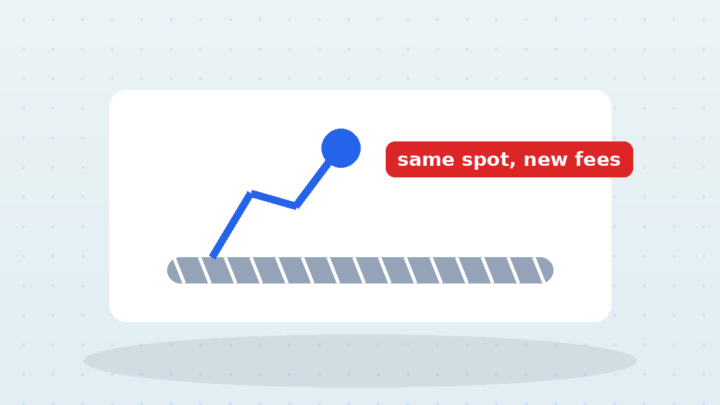
The Refinance Treadmill: Lower Payment, Longer Sentence
Each refi resets the interest-heavy years and rolls in fresh costs. Keep the rate; keep the clock honest.
 December 31, 2025by cyborg.vaibhav@gmail.com7 min read
Danielle Osei, 29, a physical therapist in Columbus, OH, signed her federal student loan paperwork at seventeen, the summer before her freshman year, guided mostly by a financial aid letter and her own optimism about a future salary. Student loans are unusual debt: taken on before most people have full-time income, for an asset (an education) whose payoff arrives years later and isn’t guaranteed to match the size of the debt. What Danielle didn’t expect, a decade later, was that the repayment plan she’d carefully enrolled in could be reshaped by litigation and legislation she’d never followed — twice, in the same two-year stretch.
Example: $30,000 in federal loans at 6% over the standard 10-year term runs a monthly payment in the low-to-mid $300s, with total interest around $10,000 over the life of the loan. Stretch the same balance to 20 or 25 years through an income-driven plan and the monthly payment drops noticeably, but total interest paid can roughly double or more.
Federal loans carry protections private loans don’t: income-driven repayment plans that cap your payment as a percentage of income, deferment and forbearance options if you lose your job, and in narrow cases, forgiveness programs for qualifying public-service work. An income-driven plan can be a genuine lifeline in a lean year, but it isn’t free — stretching the amortization schedule this way usually means paying meaningfully more in total interest for the flexibility.
Danielle enrolled in an income-driven repayment plan expecting the rules of that plan — her payment formula, her forgiveness timeline — to stay put for the life of the loan. In practice, federal IDR plans have been reshaped repeatedly by litigation and legislation, sometimes within the same year: a 2025 federal reconciliation law is phasing out several existing income-driven plans and consolidating IDR options on a set legislative timeline running through 2028, while separate ongoing court cases have, at different points, paused, restarted, and altered interest accrual for borrowers enrolled in plans caught up in the litigation. Because the details genuinely change month to month depending on the latest ruling, this article won’t quote a specific plan name or interest-accrual status as if it’s fixed — the only reliable move is checking your loan servicer or studentaid.gov directly, since the plan you enrolled in years ago may not exist in its original form by the time you actually need it.
Student lending is the only mass credit market whose customers sign at seventeen, guided by an industry with zero underwriting discipline — because the loans are largely non-dischargeable and government-backed, the lender’s risk conversation never needed to happen. The grey machinery since: servicers with documented histories of steering borrowers into forbearance (interest capitalizing all the while) instead of income-driven plans, payment-count errors that stalled forgiveness for years, and refinancing pitches that quietly strip federal protections in exchange for a rate.
The defense is paperwork literacy: income-driven plans compute payments from your life, not your balance; forgiveness tracks require exact payment counts you must audit yourself; and refinancing federal loans into private ones is irreversible — the rate discount prices the safety net you’re surrendering. Every servicer call ends with “get it in writing”; their record is the reason.
YOU ENTER your loan balance, rate and repayment term; IT TELLS YOU the monthly payment and total interest at that term, so you can compare a standard schedule against a stretched one before deciding which trade-off actually fits your situation. What the calculator settles is the arithmetic your servicer’s call center won’t walk you through unprompted.
Danielle didn’t check her plan’s status for nearly two years, assuming the enrollment paperwork she’d filed once was still accurate. In that window, the plan she’d enrolled in shifted status more than once, and by the time she called her servicer to ask a routine question, she learned her payment count toward forgiveness had been affected by the changes and needed to be manually reconciled — a process that took several months and required her own saved records as evidence, since the servicer’s own internal count didn’t initially match what she had documented herself. Nothing about that mismatch was malicious; it was simply a system trying to keep up with rules that had changed underneath it more than once.
Check your loan status directly on studentaid.gov and with your servicer at least once a year, and immediately after any news of student-loan litigation or legislation, rather than assuming your enrollment is static. Keep your own record of payment counts and plan enrollment dates independent of the servicer’s system — it is the evidence you’ll need if their count and yours ever disagree. Refinancing into a private loan can lower your rate if your credit and income are strong, but it permanently gives up every federal protection listed above, and that trade is only worth making with eyes fully open to what you’re giving up. The single highest-leverage move for anyone with federal loans and extra cash: pay above the minimum specifically toward the highest-rate loan first, the same logic as any other debt-avalanche approach, since federal student loans rarely carry prepayment penalties.
None of this means federal student loans are a bad choice or that the protections attached to them are worthless — income-driven repayment, deferment, and forgiveness paths remain genuinely valuable, and most borrowers are better served staying federal than refinancing away those protections. The point is narrower: “enrolled and done” is not a safe assumption for a program this politically and legally contested, and the borrowers most protected are the ones who check in periodically rather than the ones who file the paperwork once and never look again.
Only with stable, genuinely high income, no forgiveness path needed, and eyes wide open: you’re selling income-driven plans, deferment rights and forgiveness eligibility for basis points. Private-loan refis of already-private loans are the safer version of the trade.
Above roughly 6% rates, guaranteed payoff competes quite well with markets; below roughly 4%, investing usually wins out. In between: split the difference, and never skip an employer 401(k) match to prepay a loan — that’s simply donating a 100% return.
Log into studentaid.gov directly and check your account status, and separately call your loan servicer to confirm your current plan and exact payment count — don’t ever rely on old enrollment confirmation emails, since plan status can change without any new email ever being sent to you.
Disclaimer: Danielle Osei is a composite character based on common federal student loan repayment patterns, not a real person. This article is for general information only and is not financial advice. Consult a qualified advisor or your loan servicer for guidance specific to your situation.
Each refi resets the interest-heavy years and rolls in fresh costs. Keep the rate; keep the clock honest.
A personal loan is the financial equivalent of fast food: fast, everywhere, and quietly expensive. Unsecured, quick to…
A friend signed for a 30-year mortgage, looked only at the monthly payment, decided it "felt fine," and…
Rates tick down and your inbox fills with offers: refinance your mortgage and save thousands. It's a real…
After years of mortgage payments and rising prices, a lot of homeowners are sitting on real equity. A…
See how much of your payment is interest vs principal, and why extra payments made early save far…