
Your NBFC Fixed Deposit Has Zero Government Insurance — Unlike a Bank FD
DICGC covers bank and cooperative bank deposits up to Rs 5 lakh -- NBFC deposits are not covered…
 January 11, 2026by cyborg.vaibhav@gmail.com7 min read
Sunita Rao, a 61-year-old homemaker in Mangaluru, walked into her bank three months after her husband died, to renew his FD. She walked out having signed for a “special FD with insurance benefits and higher returns”. It was a 15-year traditional insurance policy with a ₹2 lakh annual premium. She learned the truth a year later, when the “renewal” notice came — and that surrendering early would eat a third of what she had paid. This exact story, with different names, fills banking-ombudsman files; the Economic Survey itself has called insurance the most mis-sold product at Indian banks. (Sunita is a composite character built from that recurring complaint pattern, not one branch’s mistake — the regulatory detail is below.)
Why would a bank sell you insurance when you asked for an FD? Because an FD pays the bank almost nothing — while a traditional insurance policy can pay the distributing bank up to 65% of your first-year premium as commission. On Sunita’s ₹2 lakh premium, that is potentially over a lakh of rupees, booked the day she signed. Her relationship manager has a monthly insurance target and a dashboard; her FD renewal moves no needle. Every “special FD”, “FD plus” and “guaranteed income plan” pitched at the deposit counter is that 65-versus-zero arithmetic wearing a smile.
Strip the packaging off a typical endowment or money-back policy and the internal rate of return is 4–6% — often below the FD the customer originally asked for, with the money locked for 10–20 years and brutal surrender penalties guarding the exit. The “insurance benefit” is usually a sum assured too small to protect anyone, bolted on to justify the wrapper.
Insurance is for protection. Investment is for growth. Any product claiming to do both does neither — it exists because bundling hides the fee. Buy a pure term plan for protection (a fraction of the premium), and invest the rest where you can see it: an FD, SCSS for seniors, or an index fund.
Sunita’s relationship manager never used the word “insurance” until the form was already in front of her. That is not just poor manners — it runs against a specific regulatory requirement built precisely to stop this branch-counter substitution.
Under IRDAI’s regulations governing banks acting as corporate agents for insurance, a bank must disclose plainly that it is selling insurance as an agent — a distinct product, from a distinct company, entirely separate from the deposit relationship the customer walked in for. No prospect is to be compelled to buy an insurance product bundled with a bank product, and banks are directed to take active steps to avoid forced or high-pressure selling. RBI’s own fair-conduct guidance to banks points the same direction: a deposit customer’s banking relationship is not supposed to become leverage for an unrelated insurance sale.
None of this requires Sunita to become a regulatory expert. It requires one habit: whenever a bank employee begins describing a “special” version of a deposit product, ask the two-part question the regulation is actually designed to force into the open — “Is this still a deposit, or has it become an insurance policy? And if it’s insurance, who is the insurer, separate from this bank?” A compliant employee answers instantly, because the disclosure is a legal obligation, not a courtesy. One who hesitates, or keeps steering back to “same as an FD, just better,” has already told you which product actually pays their target sheet.
What the calculator settles for Sunita: enter the annual premium and the number of years quoted, and it tells you the honest annual rate hiding inside the “maturity amount” — the figure no glossy brochure states directly.
Assumes a cumulative FD (interest reinvested and paid out only at maturity), compounded at the frequency you choose. A non-cumulative FD instead pays the interest out on that schedule and returns only the principal at maturity — the total interest earned is the same either way, but a cumulative FD's payout is larger since it also earns interest on interest.
Tax: FD interest is fully taxable at your slab rate as "income from other sources" — there is no special rate. Banks deduct 10% TDS (20% without PAN) once your interest at that bank crosses ₹50,000 in a financial year (₹1,00,000 for senior citizens). TDS is only an advance — your final tax is at your slab, which is what the post-tax figure above uses. If your total income is below the taxable limit, submit Form 15G (15H for seniors) to stop TDS; seniors can also deduct up to ₹50,000 of deposit interest under 80TTB in the old regime.
At the bank, the word “guaranteed” should raise your pulse, not lower it. Ask three questions and watch the pitch collapse: Is this a fixed deposit — yes or no? What is the surrender value if I exit in year two? What is the annual rate — not the “maturity amount”, the rate? Then ask the disclosure question directly — whether the bank is acting as a corporate agent for a separate insurer, and ask to see that in writing, because IRDAI’s rules say that disclosure is not optional. If a policy has already been sold, the 15-day free-look period (30 days for electronic policies) allows cancellation for a near-full refund — the clock starts when the policy document arrives, so open the envelope that day. Set a reminder for whenever a parent visits a branch alone.
It does not mean every bank employee selling insurance is acting in bad faith, or that traditional insurance-cum-investment plans are always wrong. For someone who genuinely wants forced savings discipline alongside a small protection cover, and who understands the trade-off going in, that combination can be a deliberate, informed choice. It does not mean bancassurance itself is improper either — banks are permitted to sell insurance as corporate agents, and the arrangement is legal and regulated.
What it does mean is narrower: the sale becomes a problem the moment the disclosure the regulation requires goes missing — when a deposit renewal quietly becomes an insurance sale without the words “insurance,” “separate insurer,” or “optional” ever being said. Sunita eventually exercised her free-look cancellation and moved the money into an actual FD and a small term policy bought separately. She says the worst part was not the money; it was realising the conversation had been designed so she would never think to ask the question that would have stopped it.
Twenty years of compounding makes even 5% look big in absolute rupees. Always convert to an annual rate — the FD calculator above does it in seconds — and compare against plain instruments.
Yes, and it works. Insurers process free-look cancellations because the alternative is an ombudsman complaint they lose. Act within the window.
Ask for the disclosure and needs-analysis document IRDAI’s corporate-agent regulations require before any insurance sale by a bank. If it does not exist, was not offered, or was signed after the fact, that gap itself is the substance of a banking-ombudsman or IRDAI grievance — you are not required to prove intent, only that the required disclosure did not happen.
Regulatory source: IRDAI’s regulations governing banks acting as corporate agents for insurance, which require clear disclosure that insurance is a distinct, optional product sold on an insurer’s behalf, together with RBI’s fair-conduct guidance directing banks to avoid forced or bundled selling. The rate reconstruction, the disclosure-gap framing and Sunita’s story are this article’s own.
Disclaimer: This article is for general information only and is not financial or tax advice. Consult a qualified advisor before making investment or tax decisions. Sunita Rao is a composite character based on common bank bancassurance mis-selling patterns, not a real person.
DICGC covers bank and cooperative bank deposits up to Rs 5 lakh -- NBFC deposits are not covered…
Banks often re-rate your FD to a lower tenure rate before applying the penalty, not just deduct 1%.
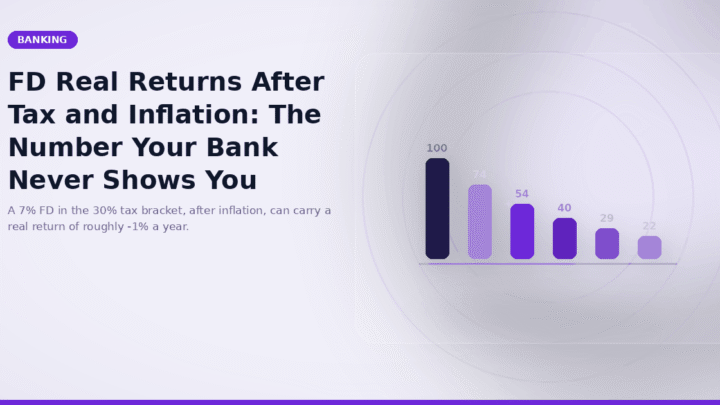
A 7% FD in the 30% tax bracket, after inflation, can carry a real return of roughly -1%…
Idle balances are banking's favourite raw material. Rs 3 lakh loses Rs 78,000 in five years to the…
The premium over a bank FD is the market pricing your chance of not getting it back. Rs…
The Post Office Monthly Income Scheme pays a fixed monthly income on a lump sum. This calculator shows…