
Your NBFC Fixed Deposit Has Zero Government Insurance — Unlike a Bank FD
DICGC covers bank and cooperative bank deposits up to Rs 5 lakh -- NBFC deposits are not covered…
 February 21, 2026by cyborg.vaibhav@gmail.com7 min read
The leaflet at Girish Nadkarni‘s bank branch in Belagavi — placed, note, inside a bank — offered a “corporate FD” at 9.1% when the bank’s own board said 7%. Same word, FD. Same-looking form. Girish, who runs a hardware shop two streets from the branch, moved ₹10 lakh for the extra 2%, because 2% is 2%. What he actually did was exit a government-insured deposit and lend his retirement money, unsecured, to a private company — for the price of a restaurant bill a month. (Girish is a composite character built from a pattern that repeats across corporate-FD complaints, not one shop owner’s mistake.)
Companies borrow from the public at 8.5–10% for one reason: banks would charge them more, or lend them less. The extra yield is not generosity; it is the market’s written estimate of the chance you do not get everything back. Bank FDs carry DICGC insurance up to ₹5 lakh and a regulator that shuts banks slowly and mergers them loudly. Corporate FDs carry a credit rating — an opinion, revisable in one press release — and a queue: in a collapse, secured lenders eat first, and “fixed deposit holders” discover what unsecured means. DHFL’s depositors, many of them retirees who chose it for exactly this extra 2%, learned the vocabulary in court.
On ₹10 lakh for 3 years, 8.5% instead of 7% earns you about ₹52,000 extra — before slab tax shaves it to ₹35-odd thousand. Against that: a single default can impair lakhs, with recovery measured in years and paise-per-rupee. You are selling insurance on a company’s solvency for ₹1,000 a month, without reading the policy.
Distributors earn commission on corporate FDs — often meaningfully more than on bank deposits, which is why the leaflet found its way to the branch counter and why the word “FD” is doing the costume work. Ratings in the brochure may be for a different instrument of the same group; “AAA” on the cover can be “AA-” on your specific deposit. And the highest rates cluster, always, in the companies that need your money most.
Girish assumed DICGC insurance — the same cover that protects his savings account — simply followed the word “FD” wherever it appeared. It does not, and the gap between the two is written into law, not just fine print.
Separately, company law does not leave this entirely to chance either. Under Section 73 of the Companies Act, 2013, a company is generally barred from accepting deposits from the public at all unless it meets specific conditions; the Companies (Acceptance of Deposits) Rules, 2014 add a concrete one — an eligible company must obtain, at least once a year, a credit rating that is not below the minimum investment-grade level, from an approved rating agency, and file it with the Registrar of Companies. The rating exists precisely so a depositor has something to check before handing over money — and almost nobody ever asks to see it.
That rating is the one document that actually tells Girish what the 2% extra is buying him. A company rated comfortably investment-grade and a company scraping the bottom of that same grade can both advertise “9.1%, AAA-linked group” on the same leaflet, and the difference between them is exactly the difference DHFL’s depositors discovered the hard way. Asking to see the current rating certificate, not the brochure’s summary of it, takes two minutes and would have told Girish more than the leaflet’s font size ever could.
What the calculator settles for Girish: enter the amount, the bank rate and the corporate rate on offer, and it tells you the actual after-tax rupee gain — the number that should be sitting next to the credit rating before anyone signs anything.
Assumes a cumulative FD (interest reinvested and paid out only at maturity), compounded at the frequency you choose. A non-cumulative FD instead pays the interest out on that schedule and returns only the principal at maturity — the total interest earned is the same either way, but a cumulative FD's payout is larger since it also earns interest on interest.
Tax: FD interest is fully taxable at your slab rate as "income from other sources" — there is no special rate. Banks deduct 10% TDS (20% without PAN) once your interest at that bank crosses ₹50,000 in a financial year (₹1,00,000 for senior citizens). TDS is only an advance — your final tax is at your slab, which is what the post-tax figure above uses. If your total income is below the taxable limit, submit Form 15G (15H for seniors) to stop TDS; seniors can also deduct up to ₹50,000 of deposit interest under 80TTB in the old regime.
Rule one: money whose loss you cannot absorb does not chase yield — it stays within insured limits, laddered across banks if needed. If you do lend to companies, ask for the current annual credit rating certificate required under the Companies (Acceptance of Deposits) Rules, 2014 — not the brochure’s summary of it — and confirm the rating applies to the specific deposit on offer, not a different instrument from the same group. Cap it at a small slice of your fixed-income money, only investment-grade or better from boring, systemically-watched issuers, spread across names, with maturities you can outwait. And always compute the actual rupee difference first, after tax, in the calculator above — the “extra 2%” usually shrinks to a number too small to be worth meeting a lawyer over.
It does not mean corporate FDs are always a mistake, or that every company accepting public deposits is a DHFL waiting to happen. A well-rated, well-known manufacturer with a long, boring history of paying depositors on time is a legitimate, if genuinely riskier, place for a small slice of fixed-income money. It does not mean bank FDs are risk-free either — they carry inflation risk and a real, if low, cap on insured amount — only that the specific risk being taken with a corporate FD is a different and larger one than the word “FD” suggests.
What it does mean is narrower: the extra 2% is a price for a risk that is real, uninsured and legally disclosed if you know where to look. Girish kept a smaller portion in the corporate FD after checking the rating certificate himself, moved the rest back to insured bank deposits, and now asks every leaflet the same first question: show me the rating, not the rate.
Advertising budgets are not collateral. Several of India’s loudest borrowers defaulted with their hoardings still lit. Fame is a marketing metric, not a credit rating.
Better than unrated — and still unsecured, still uninsured, still an opinion. The rating agencies’ record on downgrading in time is, being generous, mixed. Size your exposure to the worst quarter, not the brochure.
Companies accepting public deposits must file their annual credit rating with the Registrar of Companies alongside their deposit return, and the rating is also meant to be stated in the deposit application form and advertisement itself. If a leaflet quotes a rating without naming the specific rating agency and the date it was issued, ask for both before treating the number as current.
Regulatory source: DICGC’s deposit insurance, which covers bank deposits only up to the prescribed limit and never extends to company deposits, and Section 73 of the Companies Act, 2013 together with the Companies (Acceptance of Deposits) Rules, 2014, which require companies accepting public deposits to carry and disclose a minimum investment-grade credit rating. The after-tax rate comparison and Girish’s story are this article’s own.
Disclaimer: This article is for general information only and is not financial or tax advice. Consult a qualified advisor before making investment or tax decisions. Girish Nadkarni is a composite character based on common corporate-FD mis-selling patterns, not a real person.
DICGC covers bank and cooperative bank deposits up to Rs 5 lakh -- NBFC deposits are not covered…
Banks often re-rate your FD to a lower tenure rate before applying the penalty, not just deduct 1%.
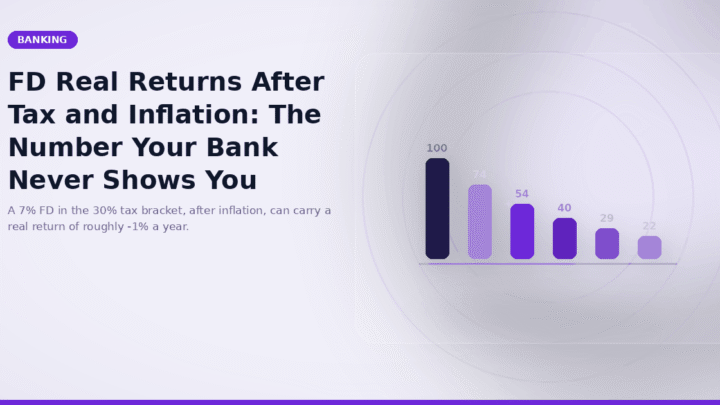
A 7% FD in the 30% tax bracket, after inflation, can carry a real return of roughly -1%…
Idle balances are banking's favourite raw material. Rs 3 lakh loses Rs 78,000 in five years to the…
Up to 65% first-year commission explains every 'special FD' at the branch. The maths of the trap, and…
The Post Office Monthly Income Scheme pays a fixed monthly income on a lump sum. This calculator shows…