
Your NBFC Fixed Deposit Has Zero Government Insurance — Unlike a Bank FD
DICGC covers bank and cooperative bank deposits up to Rs 5 lakh -- NBFC deposits are not covered…
 July 8, 2026by cyborg.vaibhav@gmail.com8 min read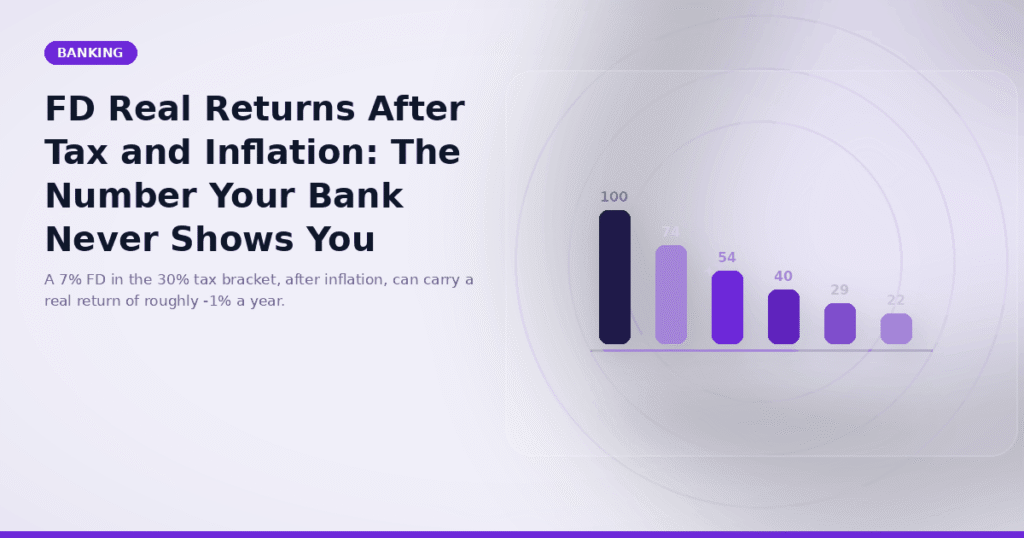
Manisha Konde runs a small hardware and paints business in Nagpur, and every March she does the same small calculation: check the TDS certificate from her bank, see that 10% was already deducted from her FD interest, and file it away as “tax settled.” It never occurred to her to check whether 10% was actually her tax rate. It wasn’t. Her business income puts her in the 30% slab, and the gap between what her bank withheld and what she actually owed showed up eighteen months later as an intimation under Section 143(1), with interest added on top.
Take a typical 7% FD. If you’re in the 30% tax slab, TDS and tax together take roughly 30% of the interest, leaving an effective post-tax return of about 4.9%. Against CPI inflation running around 6% in a normal year, your real (inflation-adjusted) return works out to roughly -1% a year. You are not preserving your money’s value — you are losing about 1% of real purchasing power annually, guaranteed, while the account statement shows a number quietly climbing.
Under Section 194A, banks and post offices deduct 10% TDS the moment your annual FD interest crosses ₹50,000 — ₹1,00,000 for senior citizens, following the threshold increase effective from April 1, 2025 — and 20% if you haven’t submitted PAN. These specific rupee figures move when the Finance Act changes them, so check the current threshold rather than trusting last year’s number; what does not move is the mechanism itself: TDS is a flat-rate estimate withheld at source, not a computation of your actual liability, and if your actual slab rate is higher than 10%, you owe the difference at filing.
This is the part Manisha Konde’s TDS certificate never told her: 10% withheld is not the same statement as “10% owed.” Form 15G or 15H lets someone below the taxable threshold stop the deduction entirely and is the mechanism designed for that end of the income scale. There is no equivalent form at the other end — nothing tells a depositor in the 30% bracket that the bank’s 10% is an under-withholding, not a completed transaction. The default in the system is a flat rate calibrated for nobody’s actual bracket in particular, and the burden of noticing the shortfall sits entirely on the depositor.
Manisha Konde’s FDs earned ₹2,40,000 in interest for the year. Her bank withheld 10% — ₹24,000 — and issued the Form 16A she treated as a closed matter. Her actual liability at her 30% slab, before cess, was ₹72,000 on that interest. The shortfall of ₹48,000 sat unpaid through the year, because nothing in the TDS process flagged it. Since her total tax liability for the year, after accounting for FD interest, exceeded the threshold for advance tax, the shortfall also triggered interest under Section 234B for not paying advance tax during the year, and Section 234C for not paying it in the right quarterly instalments — interest charged at 1% per month on the unpaid portion, compounding a mistake she did not know she was making until the assessment year’s intimation arrived.
Run a -1% real return out over 20 years on a ₹10 lakh deposit: the nominal number on your statement can grow to roughly ₹38-39 lakh, which feels like a win. But measured in today’s purchasing power, that same corpus is worth only around ₹12 lakh — a real gain of just ₹2 lakh over two decades of “safe” saving. The FD did exactly what it promised: it didn’t lose your principal. It just didn’t grow your wealth either, once you measure in the only currency that actually matters — what the money can buy. And that is before layering in Manisha Konde’s separate problem: a 30% earner who spends years assuming a 10% TDS deduction was the whole story is not just losing to inflation, but quietly under-paying tax on top of it, year after year, until the interest and the intimation notice both arrive at once.
This isn’t an argument to abandon FDs — they remain genuinely useful for emergency funds and short-term goals where capital safety matters more than growth. It is a reason to stop treating a 10% TDS deduction as proof that your FD tax is settled, to compute your actual liability against your real slab rate every year regardless of what got withheld, and to pay advance tax in quarterly instalments if the shortfall is meaningful, rather than discovering it as a lump sum with interest attached at filing time.
YOU ENTER your FD interest for the year and your actual income tax slab, and the calculator settles whether the 10% already withheld covers your real liability or leaves a balance — plus roughly how much 234B/234C interest that gap would add if left unpaid through the year.
This does not mean the bank made an error, or that TDS at 10% is some kind of shortcut being pulled on depositors — it is a flat statutory withholding rate applied uniformly, and it was never designed to match every depositor’s individual slab. It also does not mean every FD holder has this problem: for a genuine 10% bracket earner, the TDS deducted is close to correct, and for someone below the taxable threshold, Form 15G or 15H largely solves it.
It means something narrower, and specific to higher earners like Manisha Konde: a flat-rate TDS certificate is evidence of what was withheld, not proof of what is owed, and the gap between those two numbers is the depositor’s responsibility to close, not the bank’s.
Tax-saver FDs (5-year lock-in) give you a Section 80C deduction upfront, which improves the effective first-year return, but the interest earned is still fully taxable every year at your slab rate — the real-return problem described here still applies to the interest itself, and so does the TDS-versus-actual-liability gap if your slab is above 10%.
Not necessarily — a small finance bank offering 8-8.5% carries different (usually higher) credit risk than a large scheduled bank offering 7%, and the same tax, inflation, and TDS-shortfall dynamics apply to both. A higher rate should be evaluated against the issuer’s safety, not just compared as a bigger number.
You can still claim credit for the full 20% against your actual liability when you file your return — it isn’t lost, but it also isn’t a substitute for filing, since only your return reconciles what was withheld against what your slab actually requires, in either direction.
Regulatory source: Section 194A of the Income Tax Act on TDS on interest other than interest on securities, and Sections 234B and 234C on interest for default in payment and deferment of advance tax, are administered under rules published at incometaxindia.gov.in. The TDS rate and threshold figures cited here move with each Finance Act — verify the current figures before relying on them. The reconstruction of Manisha Konde’s shortfall and its interest cost is this article’s own.
Disclaimer: This article is for general information only and is not financial or tax advice. “Manisha Konde” is a composite character, not a real individual. Actual TDS, tax slab, and inflation figures vary by individual and year — compute your own real return and true liability before making decisions.
DICGC covers bank and cooperative bank deposits up to Rs 5 lakh -- NBFC deposits are not covered…
Banks often re-rate your FD to a lower tenure rate before applying the penalty, not just deduct 1%.
Idle balances are banking's favourite raw material. Rs 3 lakh loses Rs 78,000 in five years to the…
The premium over a bank FD is the market pricing your chance of not getting it back. Rs…
Up to 65% first-year commission explains every 'special FD' at the branch. The maths of the trap, and…
The Post Office Monthly Income Scheme pays a fixed monthly income on a lump sum. This calculator shows…