
Your NBFC Fixed Deposit Has Zero Government Insurance — Unlike a Bank FD
DICGC covers bank and cooperative bank deposits up to Rs 5 lakh -- NBFC deposits are not covered…
 July 10, 2026by cyborg.vaibhav@gmail.com8 min read
Sunita’s father was admitted on a Thursday. By Saturday she needed ₹4 lakh, and the only place it existed was a five-year fixed deposit she had opened eleven months earlier at 7.4%.
She broke it. She expected to lose “a bit of interest” — the branch manager had once mentioned a 1% penalty, and 1% of anything did not sound frightening in the middle of a hospital week.
She received almost nothing. Not because the bank cheated her, and not because of the penalty she had been told about. Because of a second mechanism nobody had mentioned at all, which does most of the damage and is not called a penalty.
Almost every explanation of premature withdrawal describes the penalty and stops. The penalty is the smaller half of the story. What actually empties the return is repricing, and because it is arithmetic rather than a fee, it never appears as a line item anywhere.
When you break an FD early, the bank does not calculate your interest at the rate on your receipt and then deduct a charge. It does something else first.
Step one: the contract is rewritten backwards. Your 7.4% was the price of a five-year commitment. You did not keep it for five years; you kept it for eleven months. So the bank recalculates the entire holding period at the rate it was offering for an eleven-month deposit on the day you originally booked — not 7.4%, but whatever the shorter-tenure card rate was. Say 6.5%.
Step two: the penalty comes off that lower number. Typically 0.5% to 1%. So 6.5% becomes roughly 5.5%.
Notice what this means: the penalty you were told about is not the main event. The silent repricing is comparable in size, and on long deposits broken early it is usually larger. Sunita was braced for one of these. She got both.
There is a second-order trap that surprises even people who understand the first part.
TDS has probably already been deducted. Banks deduct tax on FD interest as it accrues each year, above the applicable threshold, at the rate you were originally earning. When the deposit is broken and the interest is recalculated downwards, you may have had tax deducted on interest you are no longer being credited with.
You do not lose that money permanently — it is adjusted when you file — but you lose the use of it for months, which is precisely the thing you were short of on the day you broke the deposit. This is why people report that breaking an FD “felt worse than the numbers said”. The cash actually reaching your account is smaller again than the recalculated interest suggests.
Here is the part most articles miss entirely, and it is where the real money is.
Sunita needed ₹4 lakh. Her deposit was ₹4 lakh. She broke all of it — and that is the expensive instinct, because most banks permit partial premature withdrawal. Had she taken only what she needed, the penalty and repricing would have applied to the withdrawn portion, and the remainder would have continued undisturbed at the original 7.4% to full maturity.
And there is a third option almost nobody is offered at the counter: a loan against the deposit. Banks lend against your own FD at roughly the deposit rate plus one or two points, while the deposit keeps running at its contracted rate. If the money is needed for three months rather than three years, borrowing against it frequently costs less than breaking it — because you keep the 7.4% and pay perhaps 9% on a smaller sum for a short window.
The comparison is straightforward arithmetic, and it is the sort of thing worth doing at the counter rather than afterwards.
Run it twice — once at your contracted rate to maturity, once at the shorter-tenure rate minus the penalty for the months held. The difference is what breaking costs. Then compare that against a few months of interest on a loan against the deposit. Ten minutes, at the counter, before anything is signed.
It does not mean FDs are a bad product or that you should never break one. A fixed deposit did exactly what Sunita needed on the worst week of her year: it turned into cash, in a day, without a market price or a lock-in negotiation. That is precisely what an emergency reserve is for, and a mutual fund on a falling day would not necessarily have been kinder.
It also does not mean you should structure your life to avoid ever breaking one. It means two smaller things. Ladder deposits across several smaller amounts and staggered tenures rather than one large one, so an emergency breaks a fragment instead of the whole. And keep genuine emergency money somewhere with no exit cost at all, so the FD is the second line of defence rather than the first.
Sunita’s father recovered. She reopened a deposit four months later, this time as three smaller ones maturing in different years, which is the only sentence in this article that came from experience rather than arithmetic.
Typically 0.5% to 1% of the applicable rate, though it varies by bank and by deposit and some banks waive it on very short original tenures or for senior citizens. Read your own deposit’s terms — but remember the penalty is only the second of the two reductions, and often the smaller one.
Because it is not a charge. The bank recalculates your interest at the rate that applied to the tenure you actually completed, since the higher rate was the price of a commitment you did not keep. No fee is deducted; the rate itself is replaced. That is why it never appears as a line item and why so few people know to expect it.
Usually yes, and this is the single most useful thing to ask at the counter. Penalty and repricing then apply only to the amount withdrawn, while the balance continues at the original contracted rate to maturity. Some deposits, particularly tax-saving five-year FDs, do not permit any premature withdrawal at all.
Often, for short gaps. You typically borrow at the deposit rate plus one or two points while the deposit continues earning its contracted rate. For a few months that arithmetic usually beats breaking; for a need lasting years it usually does not. Compare the two directly rather than assuming either.
Disclaimer: General information, not financial advice. “Sunita” is a composite character with invented figures, not a real person. Premature withdrawal penalties, repricing practice, partial-withdrawal rules and loan-against-deposit terms vary by bank and by deposit type — the rates used here are illustrative. Check your own deposit’s terms and confirm the applicable figures with your bank before closing anything.
DICGC covers bank and cooperative bank deposits up to Rs 5 lakh -- NBFC deposits are not covered…
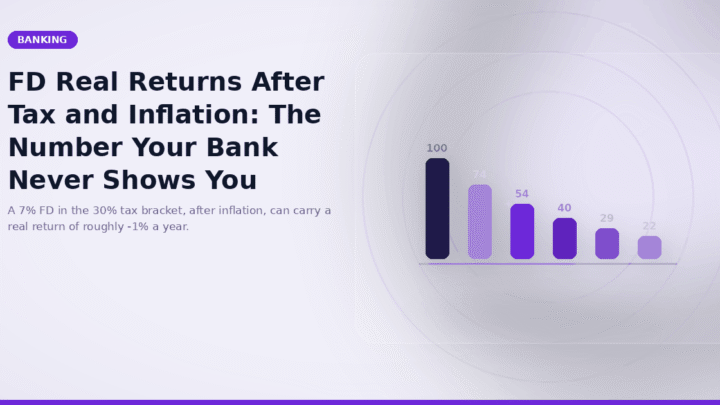
A 7% FD in the 30% tax bracket, after inflation, can carry a real return of roughly -1%…
Idle balances are banking's favourite raw material. Rs 3 lakh loses Rs 78,000 in five years to the…
The premium over a bank FD is the market pricing your chance of not getting it back. Rs…
Up to 65% first-year commission explains every 'special FD' at the branch. The maths of the trap, and…
The Post Office Monthly Income Scheme pays a fixed monthly income on a lump sum. This calculator shows…