
Breaking Your FD Early Costs More Than the Penalty Alone
Banks often re-rate your FD to a lower tenure rate before applying the penalty, not just deduct 1%.
 July 12, 2026by cyborg.vaibhav@gmail.com7 min read
Punjab and Maharashtra Co-operative Bank collapsed in September 2019, and thousands of depositors — ordinary people who’d trusted a “bank” with their savings — found their own money frozen, in some tragic cases for years, with withdrawal limits that left people unable to pay for medical treatment. The word “bank” in the name did nothing to protect them the way most depositors assumed it would.
Vasant Deshmukh, a retired shop clerk in Nashik, is a composite standing in for the thousands of PMC-style depositors who learned the hard way what “insured” actually means. His version of the story: a fixed deposit at a cooperative bank, opened because a neighbour vouched for it and the rate beat the nationalised banks by half a percent. When the bank was placed under RBI restrictions, Vasant discovered two things in the same week — that his deposit was insured by DICGC after all, and that “insured” in 2019 still meant “eventually, after the bank’s liquidation, on nobody’s fixed timeline.”
The Deposit Insurance and Credit Guarantee Corporation insures deposits up to ₹5 lakh per depositor, per bank, covering both principal and interest — and this ₹5 lakh cover genuinely does extend to cooperative banks, not just large commercial banks, small finance banks, and regional rural banks. That’s the good news the PMC crisis eventually forced into wider awareness. The bad news, still not widely understood: NBFCs, primary cooperative societies, chit funds, and other non-bank finance companies are explicitly NOT covered by DICGC at all — a fixed deposit with an NBFC carries zero government-backed insurance, regardless of how “safe” or “bank-like” its marketing sounds.
DICGC coverage is per depositor, per institution — spreading Rs 5L+ across multiple insured banks (not multiple branches of the same bank) restores full coverage.
Before 2021, if RBI placed a bank under moratorium, depositors could be locked out indefinitely with no defined timeline for even the insured portion of their money — exactly what happened to PMC Bank customers. Parliament passed the DICGC (Amendment) Act, 2021 specifically in response: it now guarantees depositors of a bank under RBI restrictions receive an interim payment of up to ₹5 lakh within 90 days of the moratorium starting — 45 days for the bank to submit claim data, 45 more for DICGC to process and pay. This is a genuine, meaningful improvement, but note precisely what it fixes: the timeline for the INSURED ₹5 lakh. Anything above that limit is still subject to the bank’s resolution process, with no guaranteed timeline at all.
Two separate blind spots persist. First, anyone with more than ₹5 lakh in a single bank has genuine uninsured exposure above that limit — splitting large deposits across multiple insured institutions is the only real mitigation. Second, and less understood: co-operative credit societies (distinct from cooperative banks) and NBFC fixed deposits, however attractive their advertised rates, carry no DICGC safety net whatsoever — a default there means depositors stand in line with other creditors, with no automatic government-backed payout at all.
Confirm whether the institution is a DICGC-insured bank (commercial, cooperative, or small finance) or an NBFC/credit society — these look similar in marketing but sit in entirely different risk categories. If you’re holding more than ₹5 lakh anywhere, consider whether splitting it across separately-insured institutions is worth the minor inconvenience, given what PMC Bank depositors went through when they didn’t.
In practice this means asking the branch a blunt question before you sign anything: “Is this deposit covered by DICGC, and up to what amount?” A commercial bank, a cooperative bank, and a small finance bank will all answer yes, up to ₹5 lakh. An NBFC — even one carrying a household name, a high credit rating, or a rate that beats every bank around it by a full percentage point — will not be able to say that, because it legally cannot be. Vasant’s neighbour who recommended the cooperative bank wasn’t wrong about DICGC cover; he simply never mentioned the ₹5 lakh ceiling or the fact that above it, Vasant’s money would sit in the same queue as everyone else waiting for the bank’s resolution to conclude, insured or not. That distinction — covered-with-a-ceiling versus not-covered-at-all — is the one piece of information an advertised interest rate never carries with it.
Deposits held in the same right and capacity are aggregated for the ₹5 lakh limit — simply splitting money across multiple accounts at the SAME bank does not multiply your coverage. Different capacities (individual vs joint vs a business account) may be treated separately; check DICGC’s official guidance for your specific structure.
No — NBFC deposits carry no DICGC cover. Your only protection is the NBFC’s own credit rating and RBI’s regulatory oversight of that specific NBFC, which is a fundamentally different (and generally weaker) safety net than deposit insurance.
If Vasant had run his ₹7 lakh deposit through this before choosing a single cooperative bank, the calculator settles the question immediately: ₹5 lakh insured, ₹2 lakh exposed to the bank’s resolution timeline with no guarantee at all. YOU ENTER the amount and the institution type; IT TELLS YOU the insured-versus-exposed split, and what moving the excess to a second insured bank would have covered instead. That is a five-minute check most depositors never make before signing a deposit form.
This is not a claim that cooperative banks are inherently unsafe, or that Vasant made a foolish choice by using one — DICGC covers cooperative banks exactly as it covers commercial banks, and most cooperative banks never see a moratorium. It is also not a claim that the 2021 reform was cosmetic; a guaranteed 90-day payout for the insured portion is a genuine improvement over an open-ended wait. What it does not mean is that the reform closed the NBFC gap or removed all risk above ₹5 lakh — both of those exposures are exactly as real today as they were in 2019, and no amount of “the government fixed deposit insurance” headline changes that arithmetic for money above the limit or money outside a bank altogether.
No — he is a composite drawn from common patterns among retired depositors who learned about DICGC’s actual scope only after a bank they trusted ran into trouble, used here to make the mechanism concrete.
Disclaimer: This article is for general information only and is not financial advice. Deposit insurance rules and limits can change — verify current DICGC coverage terms before making large deposit decisions. Vasant Deshmukh is a composite character, not a real person, used to illustrate a common pattern.
Banks often re-rate your FD to a lower tenure rate before applying the penalty, not just deduct 1%.
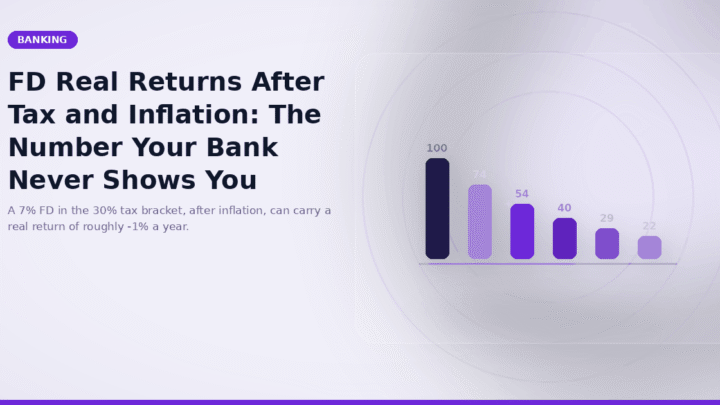
A 7% FD in the 30% tax bracket, after inflation, can carry a real return of roughly -1%…
Idle balances are banking's favourite raw material. Rs 3 lakh loses Rs 78,000 in five years to the…
The premium over a bank FD is the market pricing your chance of not getting it back. Rs…
Up to 65% first-year commission explains every 'special FD' at the branch. The maths of the trap, and…
The Post Office Monthly Income Scheme pays a fixed monthly income on a lump sum. This calculator shows…