The Boring Years Are Where the Money Gets Made
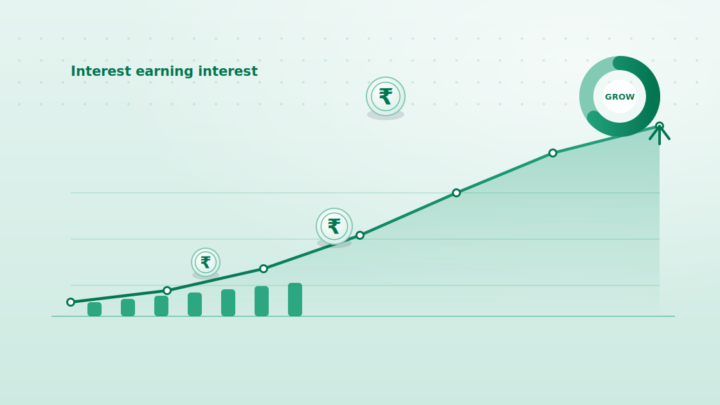
Compound interest gets quoted to death and somehow stays misunderstood. People nod at "interest earning interest," then bail…
 May 5, 2026by cyborg.vaibhav@gmail.com7 min read
Derek got a $20,000 inheritance at 35 and did what his grandfather always did: he built a CD ladder, locked in a solid rate, and let it compound quietly for fifteen years, untouched. His coworker Tanya put the same $20,000 into an S&P 500 index fund the same month and never sold a share. Both accounts averaged remarkably similar headline returns over that stretch. Tanya’s balance still finished meaningfully ahead. Derek assumed compounding worked the same way everywhere once the rate was locked in. It doesn’t — because every single year, the IRS quietly reached into his account and took a bite that never touched hers at all, right up until the day she finally sold.
Derek and Tanya are composite characters — stand-ins for a pattern that shows up constantly between savers who favor CDs and savings accounts and those who favor index funds, not real account records. Their numbers are invented. The tax mechanic that separated their outcomes is not.
How this article was checked. The interest and dividend taxation rules below are described directly from IRS Publication 550 as reviewed in July 2026. Specific rates and thresholds change periodically — check current IRS guidance before relying on an exact figure.
A standard compound-interest projection takes a rate and lets it run, uninterrupted, for however many years you enter. $10,000 at 7% for 10 years grows to roughly $19,700, and more than half of that growth happens in the second half of the period — the well-known “slow start, steep finish” curve. That math is correct as a description of what happens inside the account. It quietly assumes every dollar of growth stays fully invested and untouched the whole time. In a taxable account, that assumption is false for one kind of asset and true for another — and which one you’re holding changes how fast the account actually compounds in practice, not just on paper.
IRS Publication 550 is explicit that interest credited to an account — including a CD’s interest, even interest you never withdraw and never touch — must generally be included in taxable income for the year it’s credited. Derek’s bank sends a 1099-INT every January whether or not he took a single dollar out, and that interest is taxed as ordinary income at his regular bracket the same year it’s earned. Every year, before the next year’s compounding even starts, the base it compounds from has already been shrunk by whatever he owed the IRS on the interest just credited.
Tanya’s index fund also distributes some taxable dividends along the way, but the bulk of her return — the share price appreciation itself — is an unrealized gain, and unrealized gains are not taxed at all until the position is actually sold. For fifteen years, the part of her return that came from the fund simply being worth more was invisible to the IRS. Only when she eventually sells does that portion get taxed at all, and at that point it qualifies for the long-term capital gains rate rather than her ordinary bracket — a lower rate, paid once, fifteen years later, instead of a smaller bite paid every single year along the way.
If Derek and Tanya’s accounts had earned identical headline rates, a naive comparison would expect identical ending balances. They didn’t get identical balances, because Derek’s account never actually compounded at the full headline rate in any single year — a chunk of interest was removed as tax before the next year’s base was set, every year, for fifteen consecutive years. Tanya’s account, by contrast, was allowed to compound at something very close to its full headline rate for the entire period, because nothing was removed until the very end. The published rate on each account was the same. The rate that actually compounded, year over year, was not.
Interest-bearing holdings — CDs, high-yield savings, most bonds — compound most efficiently inside a tax-deferred or tax-free account like a 401(k), traditional IRA or Roth IRA, where the annual tax bite doesn’t happen at all. Equity holdings whose return comes mostly from price appreciation lose comparatively little by sitting in a regular taxable brokerage account, because the realization principle already defers their tax the same way a retirement account would, at least until you sell. Matching each asset type to the account where its specific tax treatment does the least damage to the compounding curve is worth more, over a long horizon, than chasing a slightly higher headline rate on the wrong account.
This is not an argument against CDs, high-yield savings, or bonds — they serve a role that equities don’t, particularly for money you need with certainty on a known date, and that stability is worth something a pure growth comparison doesn’t capture. It’s also not a claim that Tanya’s approach is risk-free; equity values can and do fall, sometimes for years, in a way a CD’s principal never does. The point is narrower: the “compound interest” math taught in every explainer describes the account’s own growth correctly, but which account you put a given asset in changes how much of that growth you actually keep, and that gap compounds too.
Time, generally — a modest rate given enough years often beats a higher rate given only a few, since compounding needs time to reach its steepest part of the curve. But which account holds the money changes how much of that time-driven growth survives taxation along the way.
Partly — qualified dividends are taxed annually like interest, but usually at the lower long-term capital gains rate rather than ordinary income, and the price-appreciation portion of a stock’s return still isn’t taxed until sold. It sits between Derek’s and Tanya’s situations, not fully like either one.
Yes, separately from tax — the nominal ending balance overstates real purchasing power either way. Subtracting an assumed inflation rate on top of the tax adjustment gives the most honest picture of what either account is actually worth in today’s terms.
Yes, substantially — a CD held inside a traditional or Roth IRA is not subject to the annual interest-taxation rule described above, since the account itself is tax-deferred or tax-free. The compounding drag described in this article applies specifically to interest-bearing assets sitting in an ordinary taxable brokerage or savings account, not to the same asset held inside a retirement wrapper.
Statutory sources, all official: IRS Publication 550, Investment Income and Expenses, on when interest and dividends must be reported and how capital gains are taxed only upon realization. The framing of this as a “compounding tax drag” that varies by asset and account type is Linqz’s own analysis, not stated as such by the IRS.
Disclaimer: General information, not tax or financial advice, and Linqz is not a CPA firm or a registered investment adviser. “Derek” and “Tanya” are composite characters with invented finances, not real people. Interest and dividend tax treatment is set by federal law and reviewed periodically — verify current-year rules on irs.gov before acting, and consult a qualified professional about your own accounts.
Compound interest gets quoted to death and somehow stays misunderstood. People nod at "interest earning interest," then bail…
Claiming at 62 vs 70 can change your monthly benefit by more than 50%. See your own numbers…
Same contribution, two tax treatments, very different after-tax outcomes depending on one bet: your future tax bracket.
Skip the scary generic headline number. Work backward from your own real spending to find what you actually…
Salary isn't take-home pay. See what federal tax, payroll taxes, and deductions actually leave you with.
Income doesn't measure progress - assets minus liabilities does. Add up your own numbers and track the trend…