Compound Interest Calculator: How a Lump Sum Actually Grows
Interest earning interest on interest - see why the growth curve looks slow at first and steep later,…
 August 8, 2025by cyborg.vaibhav@gmail.com7 min read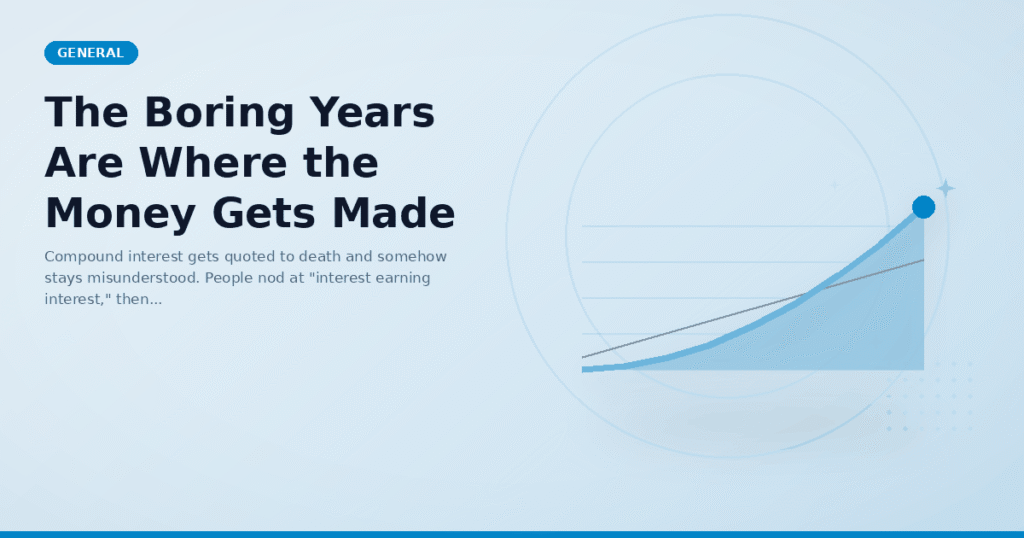
Compound interest gets quoted to death and somehow stays misunderstood. People nod along at “interest earning interest,” then bail on a perfectly good investment in year four because “nothing’s happening.” Nothing happening is exactly what’s supposed to happen — that’s the part nobody warns you about.
The mechanics are simple even if the outcome feels like magic. Simple interest pays you a flat amount each year on your original deposit. Compound interest pays you on your original deposit plus every dollar of interest you’ve already earned, so the base you’re earning on keeps growing. The formula is A = P(1 + r/n)^(nt) — starting amount, rate, how often it compounds, and time — but the intuition matters more than the algebra: your money starts earning money on its money.
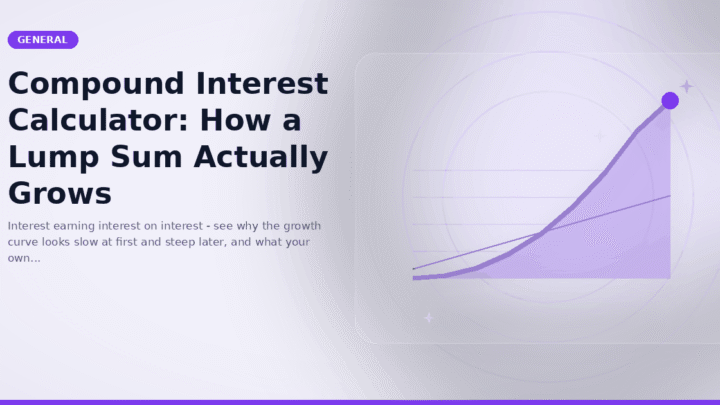
Example: put $10,000 into an account earning 7% a year and never touch it. After 10 years it’s roughly $19,700. After 20 years, about $38,700 — not quite double the 10-year figure, even though the rate never changed and only ten more years passed. After 30 years it’s around $76,100. Notice the shape: the growth in the last decade dwarfs the growth in the first. That’s compounding being back-loaded, and it’s the whole secret.
A cleaner way to feel it: money growing around 10% a year roughly doubles every seven years, a rule of thumb (72 divided by the rate) worth keeping in your head. So $10,000 becomes $20,000, then $40,000, then $80,000 — and the jumps get bigger each time even though the rate is constant. The fourth doubling adds far more dollars than the first. That’s why starting young beats investing more later, and why cashing out and restarting resets you to the flat, boring part of the curve every single time.
Who this matters for most: anyone investing for a goal decades away, and anyone carrying debt that compounds against them. Those are the same math running in opposite directions. A 401(k) balance and a credit-card balance both compound — one quietly builds your future, the other quietly demolishes it. The common mistake is treating early, unglamorous years as proof something isn’t working, then quitting right before the curve does its real work.
A genuine caveat: none of this assumes a smooth, guaranteed 7% every year. Real markets are lumpy — some years up 20%, some years down 15% — and the compounding math above describes the long-run average, not a promise. Compound interest is also not a strategy on its own; it’s a description of what happens once you’ve picked a reasonable rate of return and left the money alone. The strategy is the leaving-alone part.
The takeaways are unglamorous, which is why so few people act on them. Start early, even small. Leave it alone. Kill high-interest debt before it compounds against you. The magic isn’t a clever product or a hot stock — it’s time, plus the patience to do nothing while it works.
Compounding is neutral machinery, and two industries depend on you misreading it. Industry one hides that costs compound: a 1% fee ‘is nothing’ each year and a fifth of your wealth over a career — $108,775 on a $500/mo habit. Industry two hides that debt compounds: minimum payments, deferred-interest promotions and ‘small’ monthly carrying costs are compound interest running in reverse, at triple the rate your savings earn.
The literacy that defends you fits on a card: every percentage is annual, every percentage compounds, and every percentage applies to a growing base. Ask of any product — savings, loan, fee — what does the rate compound on, in whose favor, for how long? The answers sort the shelf faster than any review site.
Divide 72 by any rate to get doubling years — 7% doubles in ~10 years, 24% card debt doubles what you owe in 3. It works on both sides of the ledger; use it on both.
Less than marketed: 5% compounded daily vs annually differs by ~0.13%. The frequency flex in savings ads is decoration; the rate and the fees are the substance.
Deandre Wallace, a composite forklift operator in Toledo, Ohio built from a pattern common among first-time bond buyers, put $8,000 into a 15-year zero-coupon municipal-adjacent corporate bond through his brokerage, expecting to owe nothing until it matured and paid out the full face value. Zero-coupon bonds don’t pay periodic interest — they’re sold at a discount to face value, and the “interest” is simply the gap between what you pay and what you collect at maturity, compounding invisibly the whole time you hold it.
What caught Deandre off guard the following tax season was a Form 1099-OID in the mail. Under IRS rules for Original Issue Discount instruments, the imputed interest that accrues and compounds each year on a zero-coupon bond counts as taxable income annually — even though Deandre received zero actual cash and wouldn’t see a dollar until the bond matured 15 years later. The IRS treats the compounding itself as “phantom income,” taxable in the year it accrues, not the year it’s paid out.
YOU ENTER the purchase price and the years to maturity, and What the calculator shows you is the same curve driving Deandre’s OID income — a bond compounding toward face value while its owner owes real tax, out of pocket, on money that’s still locked up. For someone in a 22% federal bracket, that can mean writing a check from other income every single year for a decade and a half, just to hold an investment that never once puts cash in their hand until it matures.
The instrument isn’t a trap on its own — OID bonds are a legitimate, sometimes tax-efficient tool inside a retirement account, where the annual accrual isn’t taxed at all until withdrawal. The mistake is buying one in a regular taxable brokerage account without knowing that compound interest you never touch can still generate a real, annual tax bill. Deandre’s fix going forward was straightforward: hold future OID purchases inside his IRA, where the same compounding curve runs without an annual tax event attached to it.
Yes, for OID instruments like zero-coupon bonds — the IRS taxes the imputed annual accrual, not just cash actually paid out. Check any bond’s issue documents for OID treatment before assuming “no coupon” means “no tax until maturity.”
The location of the account, not the bond itself, is what decides whether OID becomes an annual paperwork headache or a non-issue — the exact same zero-coupon bond behaves completely differently depending on which wrapper holds it. Deandre’s broker offered to move his remaining OID holdings into his Roth IRA the following year, and from that point forward the same compounding curve ran without a single 1099-OID landing in his mailbox.
Deandre Wallace is a composite character built from a pattern common among first-time bond buyers, not a real person. General information, not financial advice.
Interest earning interest on interest - see why the growth curve looks slow at first and steep later,…
The HSA shoebox strategy, 457(b) stacking, asset location, 0% capital gains harvesting, NUA and the mega-backdoor Roth, plus…
Each refi resets the interest-heavy years and rolls in fresh costs. Keep the rate; keep the clock honest.
Fear sells early claiming -- a permanent 30% cut to dodge a hypothetical 20% one. Run the break-even…
The default fund stacks a wrapper fee on underlying fees -- $118,000 over a career for a rebalancing…
Interest plus 1%: enough to keep you current, never enough to free you. $5,000 becomes 19 years and…