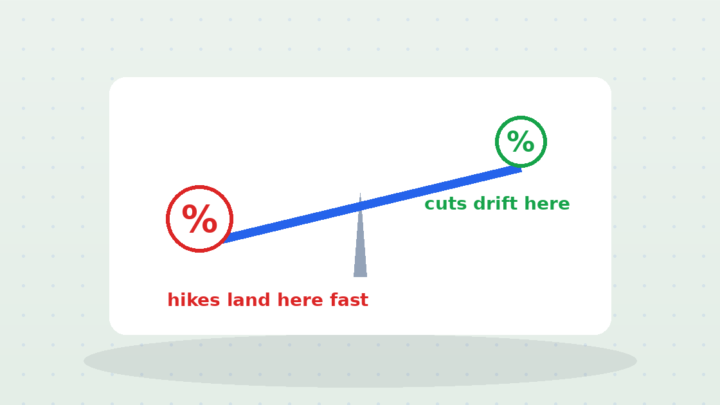
Rate Hikes Travel First Class, Rate Cuts Walk
Hikes reach your EMI in one reset; cuts take scenic routes. Know your reset date, or fund the…
 February 23, 2026by cyborg.vaibhav@gmail.com8 min read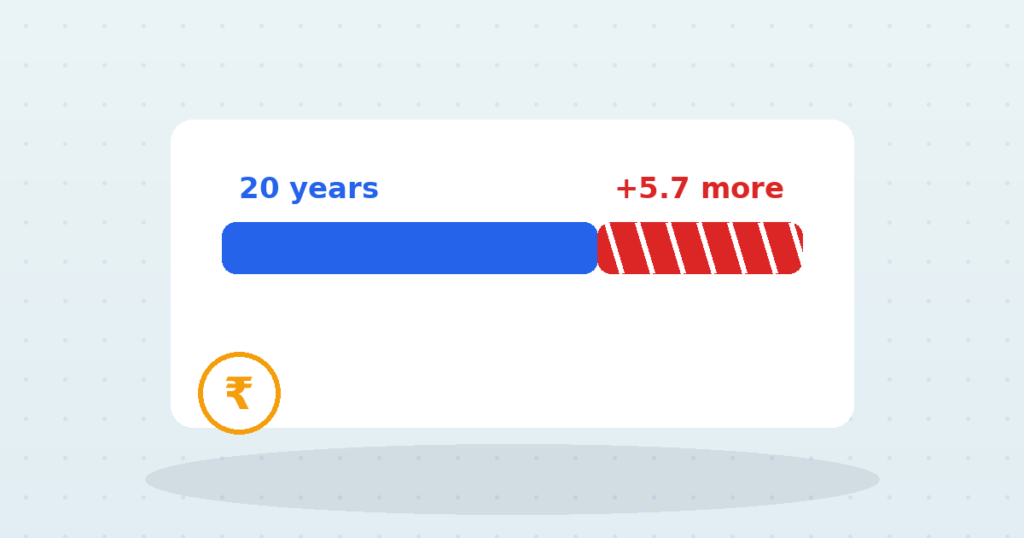
Nobody called Ajay Kher, an IT support engineer in Jabalpur, when it happened. Rates rose through 2022–23, and his bank did what banks quietly prefer: kept his EMI identical and stretched his 20-year home loan to something longer. He found out two years later, on a bored Sunday inside the netbanking portal: outstanding tenure, 309 months. He had signed for 240. His loan had grown by nearly six years, and the only notification was a line item he was never meant to read. (Ajay is a composite character built from common floating-rate home loan patterns, not a real person — more on that at the end.)
A floating-rate loan must absorb rate hikes somewhere: a higher EMI, or a longer tenure. A higher EMI triggers phone calls, complaints, maybe defaults. A longer tenure triggers nothing — the account debits the same number every month, and the borrower’s life continues undisturbed. So tenure extension became the silent default across the industry, to the point that RBI in 2023 had to direct lenders to actually offer borrowers the choice and spell out the consequences. The bank was not doing you a kindness by “protecting your EMI”. It was choosing the option that maximises its interest income while minimising its phone calls.
Ajay’s ₹50 lakh at 8.5% for 20 years meant an EMI of ₹43,391. When the rate moved to 9.5%, accepting a higher EMI (₹46,607) would have kept the loan at 20 years. Keeping the old EMI stretched it to 25.7 years — and the total interest difference between those two paths is about ₹22 lakh. That is the price of not receiving one honest phone call.
Tenure extension is uniquely vicious because the added years land at the loan’s end — the phase that is nearly all interest was already behind you, and the extension appends fresh interest-heavy years to a balance that should have been dying. Multiple hikes across a cycle can stretch a 20-year loan towards 30 without a single decision you remember making.
Here is the part that goes missing even in coverage of RBI’s own 2023 intervention: tenure extension is not allowed to run forever. Buried inside the same circular that most articles reduce to “banks must disclose and offer a switch option” is a specific, narrower prohibition — regulated entities must ensure that the elongation of tenor on a floating-rate loan does not result in negative amortisation, meaning the EMI can never be allowed to fall below what is needed to cover that month’s interest in full. If it did, the unpaid interest would get added to the principal, and the loan balance would grow even while Ajay kept paying every EMI on time.
Run Ajay’s own numbers against that ceiling. His flat EMI of ₹43,391 was still comfortably above the monthly interest owed on his outstanding balance even after the rate moved to 9.5% — roughly ₹39,600 a month in interest against his ₹43,391 EMI, which is precisely why the bank could keep stretching tenure instead of raising his payment. But that gap is not permanent. Illustratively, one or two further rate resets from here — into the 10.8–11% band on his remaining balance — would push the monthly interest above ₹43,391 itself. At that point, RBI’s rule stops the bank from simply adding another year to the tenure sheet; it obligates the lender to either raise the EMI or actively offer Ajay a switch, because letting the loan balance itself grow is the one outcome the circular explicitly forbids.
What nobody tells you: the fact that your tenure “only” grew, rather than your loan balance actually rising month over month, is not the bank being kind — it is the regulator’s floor doing its job. That also means the silence Ajay experienced has a legal limit most borrowers never learn about, and checking how close your own EMI sits to your own monthly interest is a five-minute exercise that tells you exactly how much further silent stretching your particular loan has left before the law forces the bank to speak up. What the calculator settles for Ajay: enter his current balance, rate and EMI, and it tells you the exact rate at which his flat payment would cross into the territory RBI’s circular does not allow — the number his bank is quietly watching so it never has to.
Indicative only. On a floating-rate loan, a rate change here recomputes the EMI for the remaining balance and term. Prepayments have no penalty on floating-rate home loans in India. Confirm exact figures with your lender.
Tax: home-loan tax breaks exist only in the old regime for a self-occupied house — up to ₹2L/yr of interest under §24(b) and up to ₹1.5L/yr of principal within the shared 80C bucket (the 80C limit is shared with PPF, ELSS, insurance etc., so the principal benefit is often already used up). The new regime gives no deduction for a self-occupied home. A let-out property is different: the full interest is deductible against rent in both regimes, with loss set-off against other income capped at ₹2L/yr (old regime only; excess carries forward). The tax-benefit box uses year-1 figures — interest falls each year, so the §24(b) benefit shrinks over the tenure. Prepaying reduces interest, which also reduces this deduction: the savings box above is the gross figure, and your net saving is a little lower if you were claiming 24(b).
Log in today and read three numbers: current rate, current EMI, remaining tenure. If the tenure is longer than your original schedule minus years elapsed, you have been stretched. The fixes, in order of power: ask the bank to raise your EMI back to the original-tenure figure (a form, not a negotiation); prepay a lump sum with tenure — not EMI — reduction; and at every future rate hike, reply to the silence with instructions. Run your loan in the calculator above both ways; the ₹22 lakh class of difference tends to end the indecision.
It does not mean Ajay’s bank broke the law. Keeping his loan balance itself from rising — not just his tenure — is exactly what the negative-amortisation rule requires, and by that narrow measure his bank stayed compliant throughout. The complaint against tenure-stretching is about silence and disclosure, not about this specific safeguard failing.
It also does not mean every borrower is close to the negative-amortisation ceiling the way Ajay’s illustrative numbers are. A borrower who took a loan at a lower loan-to-income ratio, or whose EMI has real headroom above current interest, can absorb several more rate resets through tenure alone before the rule would ever force the bank’s hand.
And it does not mean the current setup is fine simply because the loan balance isn’t rising. Nearly six extra years of interest, at a flat EMI that was never revisited, is a real cost even when it stays on the right side of the negative-amortisation line — compliance with the floor is not the same as a good outcome for the borrower.
More months of interest on a slowly-dying balance is simply more revenue, and the borrower who never notices never refinances. Inertia is the most profitable customer segment in lending.
If cash flow allows — almost always, and by a wide margin. If it genuinely doesn’t, split the difference: partial EMI increase, or an annual prepayment that claws the tenure back. The only wrong answer is the default one.
Multiply your outstanding balance by your current annual rate and divide by twelve — that is your monthly interest. If it sits close to your EMI, you have little room left before the next rate hike forces your bank to raise your payment rather than quietly extend your tenure further. The wider the gap, the more silent stretching your loan can still absorb.
Regulatory source: RBI (rbi.org.in) issued the August 2023 circular on Reset of Floating Interest Rate on Equated Monthly Instalments, which requires that tenor elongation on a floating-rate loan must not result in negative amortisation and that lenders offer borrowers a choice between a higher EMI and a longer tenor. The application of that specific safeguard to Ajay’s own numbers, and the illustrative ceiling calculation, are this article’s own.
Disclaimer: This article is for general information only and is not financial or tax advice. Consult a qualified advisor before making investment or tax decisions. “Ajay Kher” is a composite character based on common floating-rate home loan patterns, not a real person.
Hikes reach your EMI in one reset; cuts take scenic routes. Know your reset date, or fund the…
New borrowers get 8.5%; your loyalty pays 9.4%. One written request -- and a few thousand in 'fees'…
Personal loans are quick but expensive. This calculator shows the EMI and total interest so you borrow with…
Before applying, find out roughly how large a loan your income can support. This calculator estimates your eligibility.
A loan against property unlocks cash from real estate at lower rates than a personal loan. This calculator…
Buying a home is a big decision. This calculator shows your home-loan EMI, total interest, and the savings…