Rs 21,718 Crore in Unclaimed Insurance Money — Because Families Didn’t Know a Policy Existed
A high claim settlement ratio means nothing if your family never finds out the policy exists. What actually…
 June 5, 2026by cyborg.vaibhav@gmail.com10 min read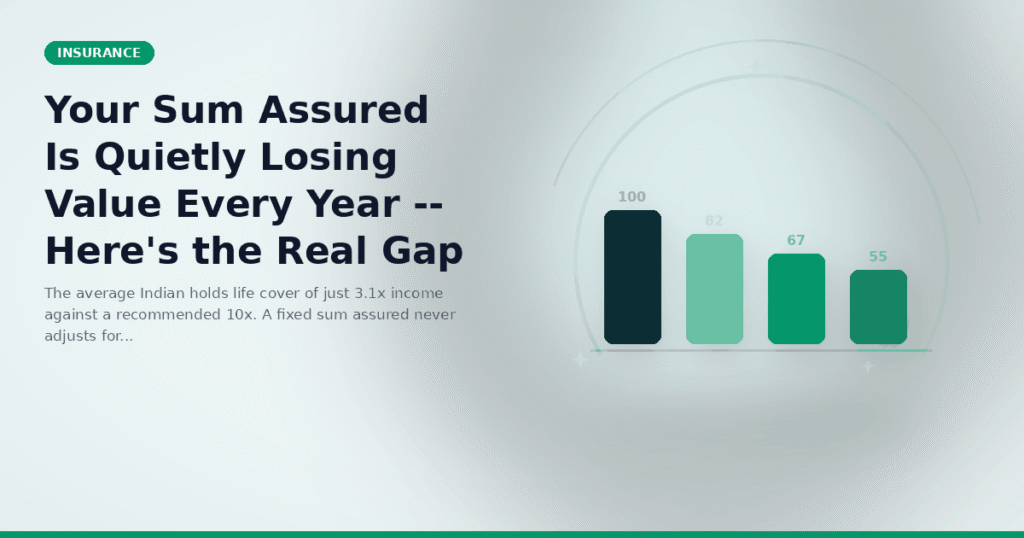
A ₹10 lakh sum assured sounded like serious money when a lot of Indian policies were bought — a decade or two ago, it might genuinely have replaced a family’s income for years. Today, that same ₹10 lakh barely covers a child’s engineering degree, let alone years of household expenses. Nobody’s policy document updates itself for inflation, and almost nobody goes back to check whether the cover they bought years ago still does the job it was bought for.
Anjali Vaidya found this out doing something unrelated to insurance entirely: renewing her father’s health cover. She’s a school administrator in Solapur, forty-six, and while reading through the health policy’s fine print she noticed a clause her own decade-old term life policy didn’t have — a cumulative bonus that increases the health cover automatically every claim-free year. It made her go back and actually reread her own ₹40 lakh term policy, bought when her son was born, for the first time since she’d signed it. Nothing in it increased. Ever. Anjali is a composite character built from a pattern common enough that IRDAI’s own product rules explain exactly why it happens — not a real individual, but the regulatory contrast below is real.
India’s own insurance data shows this isn’t a fringe problem. The average life cover held by Indians is estimated at roughly 3.1 times annual income, against an industry-recommended benchmark of 10 times income — meaning most insured households are covering less than a third of what a genuine income-replacement calculation would call for. At the aggregate level, India’s total sum assured sits at only around 70% of GDP, and industry estimates put the country’s overall life insurance protection gap at roughly $16.5 trillion — money that would be needed to fully replace lost income across the insured and underinsured population if the worst happened today. Insurance penetration (premiums as a share of GDP) has actually been declining in recent years, down to about 2.7% in FY25 from 2.8% the year before, even as incomes and costs of living rise.
A sum assured is a fixed rupee number written on day one of your policy. It never adjusts upward on its own, no matter how much prices rise over the 15-20 years your policy runs. At even a modest 6% average inflation, money halves in real purchasing power roughly every 12 years — so a ₹50 lakh cover bought in your late twenties can feel more like ₹25 lakh in today’s terms by the time you’re in your forties, precisely the years your family may need it most. Insurers rarely proactively contact policyholders to suggest a top-up as their income and responsibilities grow; the sale happens once, and the product it produced is frozen at that day’s numbers forever, or until you notice and act.
This is the asymmetry Anjali actually stumbled onto, and it isn’t accidental — it’s built into how IRDAI regulates the two product categories differently. Health insurance products commonly carry an IRDAI-recognised cumulative bonus feature: for every claim-free policy year, the insured’s cover increases by a set percentage (commonly around 5% per claim-free year, compounding as long as claims stay clear, sometimes with a restoration benefit on top if a claim is made), with no fresh underwriting and no extra premium beyond the base renewal. Term life insurance has no equivalent regulatory mandate. Nothing in IRDAI’s framework requires a term policy’s sum assured to move at all, ever, in either direction.
What term insurance does have is an increasing term assurance rider — an optional add-on, available at the time of purchase or in some products at defined intervals, that lifts the sum assured by a pre-set amount or percentage each year. It exists inside IRDAI’s product-approval framework and insurers are permitted to offer it. It is also, by regulation, capped: a rider’s sum assured cannot exceed the base policy’s sum assured, and rider premium is limited to a proportion of the base premium. The practical effect is that it’s a genuine, approved option — but it has to be actively chosen and paid for at purchase, unlike the health insurer’s cumulative bonus, which simply happens in the background as long as no claim is filed. An agent quoting a lower base premium on an unindexed term policy, versus a higher one with the escalation rider built in, has an obvious reason to lead with the cheaper number.
Run Anjali’s number against this. Her ₹40 lakh term policy is ten years old. At a modest 6% average inflation, purchasing power roughly halves every twelve years, so ten years in, that ₹40 lakh cover already carries the real-terms buying power of only about ₹24-25 lakh in today’s rupees — a gap of roughly ₹15 lakh, decided entirely by the calendar, not by anything Anjali did wrong. Had she paid a modestly higher premium for an increasing term rider at purchase, that erosion simply wouldn’t have happened at the same pace; instead, the base policy’s lower quoted premium was what got sold to her, and nobody flagged the trade-off she was making.
The standard approach: total your outstanding liabilities (home loan, other debts) plus a reasonable number of years of household expenses for your dependents, minus existing savings and investments that could be liquidated. If your current sum assured doesn’t cover that number, you have a real gap — and unlike a stock market loss, a life insurance shortfall only becomes visible to your family after it’s too late to fix. The Human Life Value method (income-replacement based, not a flat multiple) is a more rigorous version of this same exercise.
The good news is this doesn’t require starting over. Buying an additional term policy to cover the gap is usually cheaper than most people expect, since term insurance is priced purely on age and health, not on any existing policy you hold. Reviewing your cover every 3-5 years, or after any major life event (marriage, a child, a new loan), costs nothing and takes an hour — it’s simply not a step the industry has much incentive to remind you to take.
A common shortcut is 10-15 times annual income, but the more accurate method adds up actual future obligations — outstanding loans plus years of dependents’ expenses — minus what you’ve already saved, rather than using a flat multiplier.
Most base policies can’t be increased mid-term — the standard fix is a separate, additional term policy to cover the gap, medically underwritten fresh at your current age.
It doesn’t mean IRDAI has done nothing about escalating cover — the increasing term assurance rider is a real, regulator-approved product feature, and health insurance’s automatic cumulative bonus shows the regulator clearly knows how to mandate escalation when it chooses to. It doesn’t mean every agent deliberately hides the rider option; many simply lead with the lowest quoted premium because that’s what closes a sale fastest, which has the same practical effect without requiring any bad intent. And it doesn’t mean a decade-old policy with no escalation is worthless — the original sum assured still pays out in full; it’s simply worth less in real terms than it was on day one, which is a gap to close with a top-up, not a reason to lapse or surrender the existing cover.
What it does mean is narrower: the regulatory tools to prevent this erosion already exist inside IRDAI’s own framework, they’re just opt-in for term life instead of automatic the way they are for health cover — and “opt-in” only protects you if someone tells you to opt in.
A cumulative bonus is a feature common in health insurance where the sum insured increases by a set percentage for every year no claim is made, at no extra premium. It exists because IRDAI’s health insurance product regulations build it in. Term life insurance sits under a different part of IRDAI’s product framework, which has no equivalent automatic-escalation mandate — escalation there is only available through an optional, separately priced rider chosen at purchase.
No — the rider locks in the future escalation at the original underwriting terms and age, priced into the policy from day one. Buying more cover later means fresh medical underwriting at whatever age and health status you have at that time, which can cost more or, if your health has changed, may not be available at all.
Regulatory source: IRDAI‘s product regulations recognise a cumulative bonus / cover-escalation feature as standard in health insurance products, while term life insurance carries no equivalent automatic sum-assured escalation mandate; an increasing term assurance rider exists as an optional, separately priced add-on within IRDAI’s product-approval framework, with rider sum assured capped at the base policy’s sum assured. The reconstruction of Anjali’s arithmetic and the health-versus-term regulatory contrast are this article’s own.
Disclaimer: This article is for general information only and is not financial or insurance advice. Cover adequacy depends on your specific liabilities, dependents, and goals — a qualified advisor can help you run the full calculation. “Anjali Vaidya” is a composite character built from a common pattern of unnoticed sum-assured erosion, not a real individual.
A high claim settlement ratio means nothing if your family never finds out the policy exists. What actually…
Banks drew over 12,000 insurance mis-selling complaints in a single year. The specific phrases that should make you…
IRDAI removed the commission cap in 2023. See exactly what a term plan pays an agent versus a…
Agricultural income is exempt, but partial integration uses it to pick a higher rate for your salary. The…
Deferring tax is an interest-free loan from the government. Growth vs IDCW, employer NPS, gain harvesting, CGAS, section…
EPF and NPS both carry real equity exposure, while EPF-VPF tax thresholds are twice as generous for government…