Rs 1 Crore of Cover for the Same Premium as Rs 10-25 Lakh — Term vs the Endowment You Were Actually Offered
Same monthly outlay, 8-10x less cover through an endowment plan. See the real gap in sum assured, and…
 May 31, 2026by cyborg.vaibhav@gmail.com8 min read
Here’s the number nobody reads out loud during the sales pitch: if you stop paying your endowment or money-back policy’s premium in the very first year, you get back ₹0. Not a partial refund, not your money minus a fee — zero. And even after that, the amount you get back for years is a fraction of what you actually paid in. This isn’t a glitch or an unusual insurer being harsh — it’s the standard structure of how these policies are built, and it’s exactly why so many people who buy one under pressure and can’t keep up the premium end up losing real money.
Pallavi Nikam runs a small tuition class out of her home in Kolhapur — a composite standing in for the self-employed buyers who get sold an endowment plan as “forced savings” precisely because their income is irregular. Pallavi bought a ₹60,000/year money-back policy in 2022, on the promise that even if a lean month made her skip a premium, “the company will adjust it against the surrender value.” Two years later, when tuition enrolments dropped and she genuinely needed to stop, she learned that promise had never applied to her policy at all — because her policy predated a rule that only started protecting buyers from October 2024 onward.
Following IRDAI’s revised surrender value norms (rolled out through late 2024), here is what a policyholder who stops paying premiums actually gets back, as a percentage of total premiums paid — not the sum assured, the premiums:
Guaranteed Surrender Value (GSV) floor under IRDAI’s revised 2024 norms; insurers pay the higher of GSV or their own Special Surrender Value (SSV), so actual payouts can be somewhat better — but GSV is the guaranteed floor you can rely on if you need to exit.
IRDAI’s Master Circular on Life Insurance Products, issued in June 2024, changed exactly the promise Pallavi had been given — but only going forward. For policies issued on or after 1 October 2024, insurers must pay a Special Surrender Value (SSV) once the policyholder has completed one full policy year and paid one full year’s premium; the circular’s own language ties this payment to “completion of the first policy year provided one full year premium has been received.” Before this date, no surrender value of any kind — guaranteed or special — was payable if you stopped after year one. That is the rule Pallavi’s 2022 policy is still governed by, because IRDAI’s reform explicitly applies by policy issue date, not by the date you happen to surrender. Buy in 2022, and October 2024’s improvement simply never attaches to your contract.
It’s worth being precise about what even the new rule delivers: it introduces an SSV in year one, not a guarantee that the SSV is large. The Guaranteed Surrender Value (GSV) floor — the table above — still shows 0% in year one for non-single-premium products; what changed is that insurers must now also calculate and pay whichever is higher between that GSV and their own SSV, and the SSV calculation is now required to kick in a year earlier than before. For a buyer today, that is real progress. For Pallavi, sitting on a 2022 contract, it changes nothing.
An insurer’s own costs — agent commission, underwriting, admin — are heavily front-loaded into the first year or two of your premium. If they refunded you proportionally from day one, they’d be paying out money they’ve already spent on acquiring you as a customer. So the structure is built to punish early exits and reward people who stay the full term, which lines up neatly with insurers’ own persistency targets, not necessarily with your life circumstances changing (job loss, a better use for the money, realizing the product wasn’t right for you).
It’s rarely someone who carefully compared products and chose an endowment plan with eyes open. It’s far more often someone who bought a ₹50,000 or ₹1,00,000/year policy because a relative, bank employee, or agent pushed it — sometimes bundled with a loan approval — and then couldn’t sustain the premium two or three years later. IRDAI’s own annual reports have flagged persistency (the percentage of policyholders still paying premiums in later years) as a chronic industry problem for exactly this reason: a large share of buyers don’t make it to the years where the surrender value stops being a loss.
Before surrendering anything, get the exact current surrender value quote in writing from the insurer — don’t estimate it yourself. Compare that number against what continuing to pay would eventually deliver at maturity, run through an actual XIRR calculation rather than the sales brochure’s headline number. In many cases, especially in years 2-5, the honest answer is that you’ve already taken the loss the moment you signed up for a high-premium bundled plan — the only question left is whether continuing throws good money after bad, or whether the remaining years’ returns actually justify staying in.
Only the “free-look period” — typically 15-30 days from receiving the policy document — lets you cancel for a near-full refund (minus stamp duty and medical exam costs, if any). Once that window closes, the surrender value table above applies.
No — pure term insurance has no surrender value because there’s no savings component to return; you’re only ever paying for the cover, so there’s nothing to “surrender” other than cancelling future premiums. This surrender-value problem is specific to savings-linked products like endowment, money-back, and whole-life plans.
Pallavi’s real decision was never “can I get my money back” — by the time she asked, the GSV table had already answered that. Her real decision was whether continuing to pay a ₹60,000/year premium for the remaining years still beat surrendering now and putting the same money into term cover plus a separate investment. YOU ENTER her issue date, premiums paid, and the insurer’s quoted surrender value; IT TELLS YOU the XIRR on both paths side by side. The calculator settles that comparison in minutes, instead of leaving her to trust a brochure’s maturity illustration.
This is not a claim that IRDAI’s October 2024 reform was meaningless, or that regulators are indifferent to this problem — requiring an SSV a full year earlier than before is a real, measurable improvement for every policy issued after that date. It is also not a claim that Pallavi was cheated by her insurer; the surrender value table her policy follows is the industry-standard structure that predated the reform, not a violation of any rule in force when she bought it. And it is not an argument that endowment plans are always the wrong choice — someone who is certain they can sustain the premium for the full term, and specifically wants the forced-savings discipline, may still find the product reasonable. What it does mean is narrower: a promise made verbally at the point of sale (“we’ll adjust it if you miss a payment”) is worth exactly nothing against the surrender value table that actually governs the contract, and that table is fixed by the policy’s issue date, not by anything said in the sales meeting.
No — she is a composite drawn from common patterns among self-employed buyers sold an endowment policy as flexible forced savings, used here to make the arithmetic and the regulatory timeline concrete.
Disclaimer: This article is for general information only and is not financial or insurance advice. Surrender value depends on your specific policy, insurer, and the exact year of surrender — request a written surrender value quote from your insurer before making any decision. Pallavi Nikam is a composite character, not a real person, used to illustrate a common pattern.
Same monthly outlay, 8-10x less cover through an endowment plan. See the real gap in sum assured, and…
Life insurance replaces income for people who depend on you. Once you've built real savings, the product being…
Agricultural income is exempt, but partial integration uses it to pick a higher rate for your salary. The…
Deferring tax is an interest-free loan from the government. Growth vs IDCW, employer NPS, gain harvesting, CGAS, section…
EPF and NPS both carry real equity exposure, while EPF-VPF tax thresholds are twice as generous for government…
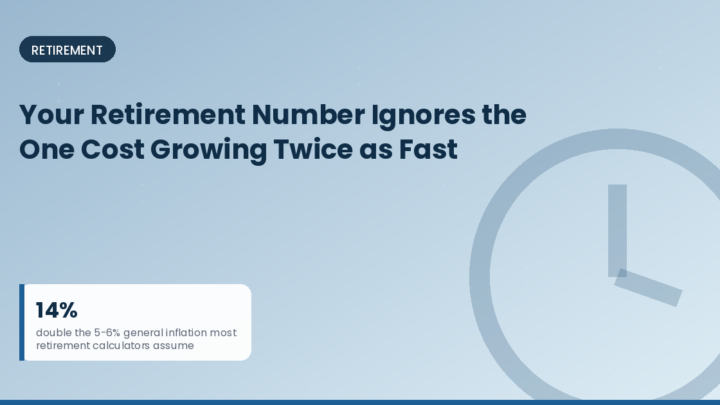
Medical inflation runs 10-14% a year in India, nearly double the 5-6% general inflation most retirement calculators assume.