Stop Paying Your Policy in Year One and You Get Back Rs 0 — The Real Surrender Value Table
IRDAI's actual guaranteed surrender value schedule, year by year, in rupees -- and why so many policyholders lose…
 June 7, 2026by cyborg.vaibhav@gmail.com11 min read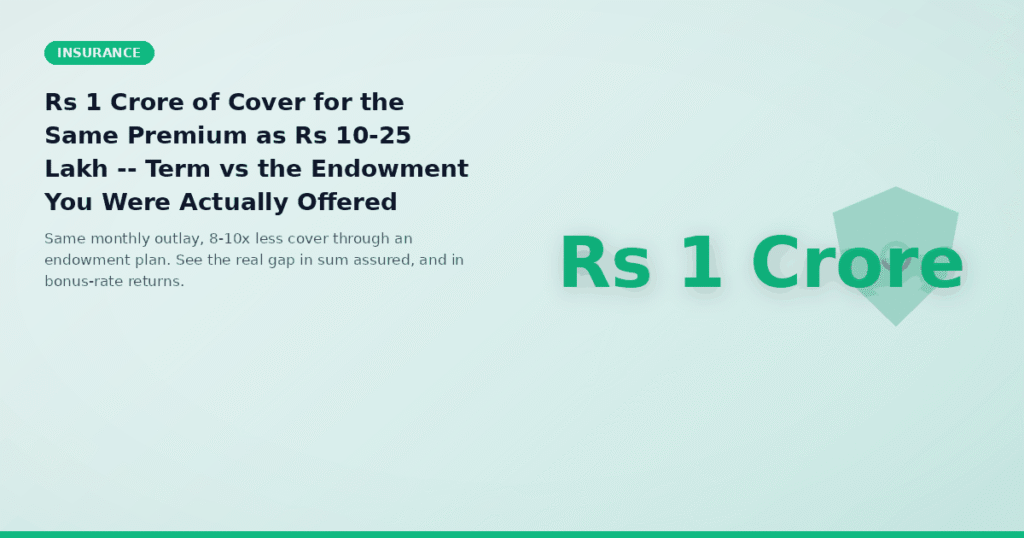
Ask almost any traditional LIC or private insurer agent whether you should buy term insurance, and watch the conversation quietly steer toward an endowment or money-back plan instead. It isn’t that term insurance is a secret — every agent knows it exists and knows it’s cheaper. It’s that a sentence like “term insurance is 8-10 times cheaper for the same cover” is also a sentence that shrinks their own commission by roughly the same factor, and very few salespeople volunteer the version of the pitch that costs them money.
Suresh Bhonsle runs a dairy farm outside Sangli and went to his LIC agent, a family friend of twenty years, wanting cover for his two sons’ education if anything happened to him. He walked out having signed for a money-back policy with a sum assured a fraction of what he’d asked for, paying a premium he’d expected would buy far more protection. It took a cousin who worked in a bank to point out, a year later, what the same premium would have bought as pure term cover. Suresh is a composite built from a pattern that repeats across small-town India, not a real client file, but the commission structure that shaped his agent’s recommendation is real, and it changed shape again in 2023 — in a way that, if anything, gives agents more room to keep doing exactly this.
A healthy 30-year-old buys ₹1 crore of pure term cover for roughly ₹8,000-₹12,000 a year. An LIC-style endowment plan offering a much smaller sum assured — often ₹10-25 lakh — for a comparable annual premium is a common trade retail buyers are offered instead, without the difference in cover being made explicit. On the “investment” side of the endowment, LIC’s own declared simple reversionary bonus rates for popular plans in recent years have run around ₹45-54 per ₹1,000 of sum assured per year. An independent plan-wise XIRR analysis of LIC’s current traditional plans (accounting for the full premium timeline and eventual payout, not just the headline bonus rate) puts most popular endowment and money-back plans at roughly 4.6-5.8% XIRR — with some products as low as 3.0-3.8% — well below what a term-plus-index-fund combination has historically delivered over the same horizon, and often close to or below inflation once the decades of premium outlay are accounted for.
Illustrative — endowment premiums scale roughly linearly with sum assured, which is why retail buyers are typically sold a much smaller sum assured for a “comparable” premium rather than being shown the true cost of matching term-level cover.
The sales conversation is almost always anchored on what premium you can comfortably pay each month, not on what cover that premium actually buys you. That framing works in the endowment’s favour: ₹2,000-3,000/month sounds affordable either way, but it buys roughly 8-10x more life cover through term insurance than through an endowment plan at the same outlay. The follow-up question rarely gets asked out loud: if the cover is 8-10x smaller, why is the premium the same? The honest answer is that a large share of an endowment premium is funding the savings component and the commission, not the insurance risk itself.
Until 2023, IRDAI capped commission on a product-by-product basis — a specific ceiling for term plans, a different one for endowment plans, another for money-back plans, each fixed in the regulations themselves. The IRDAI (Payment of Commission) Regulations, 2023, together with the linked Expenses of Management regulations for life insurers, scrapped that product-wise structure entirely and replaced it with a single overall cap on an insurer’s total “Expenses of Management” (EoM) — the combined commission and operating-expense envelope across its whole book of business. Inside that overall envelope, insurers now have far more freedom to decide how much commission to pay on which product, rather than being bound to a fixed per-product percentage.
This is exactly why the shift matters for someone in Suresh’s position. Removing a hard, product-specific commission ceiling does not automatically shrink the gap between what an agent earns for selling term versus endowment — it hands the insurer discretion to keep that gap wide, or even widen it, as long as the company’s overall EoM stays within its aggregate limit. A term plan remains cheap to insure and thin on commission almost by nature of its arithmetic: the insurer collects a small premium and holds no savings component, so there is little pool to pay a large commission from. An endowment or money-back plan, carrying a much larger premium built partly around a savings component, still has substantially more room inside it to fund a bigger commission — and nothing in the 2023 restructuring forces that room to shrink. The regulatory objective was flexibility and simplified compliance for insurers, not a mandate to narrow the term-versus-traditional commission gap that shapes conversations like the one Suresh had.
Buy the cheap, pure term cover for the protection your family genuinely needs. Take the difference — often 80-90% of what an endowment premium would have been — and invest it yourself in a low-cost index fund or PPF, depending on your risk appetite. Over 20-30 years, the historical gap between equity-linked growth and a 4.5-5.4% simple bonus rate compounds into a very large difference in final wealth, on top of already having larger, more appropriate life cover throughout.
A year in, Suresh’s cousin ran the comparison: the money-back policy Suresh held would have paid roughly ₹12 lakh on death, against the ₹75 lakh of term cover the identical premium could have bought for a healthy man his age. Suresh could not simply cancel the money-back policy without losing most of what he had already paid in — surrender in the early years of a traditional plan typically returns only a fraction of premiums paid. What he actually did was keep the existing policy running rather than take the surrender loss, but buy a separate term policy sized to close the real gap between what he had and what his sons actually needed, and stop adding any new traditional policies going forward. It cost him two premiums for a period instead of one, but it fixed the protection gap immediately rather than waiting years for the money-back policy to mature.
Nothing an agent tells you about an endowment plan’s guaranteed bonus or maturity value is necessarily false — guaranteed additions are genuinely guaranteed, and maturity benefits genuinely do pay out as illustrated. What’s missing is the comparison, not the facts: an agent under no product-wise commission ceiling has every incentive to present the endowment’s numbers in isolation, without placing them next to what the same premium buys as term-plus-investing. The 2023 shift to an overall EoM cap makes this worse in one specific way — it removed the one regulatory feature that at least fixed, in black and white, what a term sale versus an endowment sale was worth to the seller. That number is now an internal insurer decision, not a public ceiling you could look up.
Ask your agent directly what they earn, as a percentage or a rupee figure, on the specific policy they’re recommending versus what they’d earn on a pure term policy for the same premium — this is a fair, factual question, not an accusation. Get a term quote from at least one insurer before agreeing to any traditional plan, so you have a real number to compare against rather than an abstract sense that term is “cheaper.” If you already hold a traditional policy bought this way, don’t surrender it reflexively — work out the surrender value against the cost of closing your actual protection gap with a fresh term policy, the way Suresh did, since the arithmetic of walking away from a policy already several years old is different from the arithmetic of buying one in the first place.
This does not mean every endowment or money-back policy sold is unsuitable, or that every agent recommending one is acting in bad faith — some buyers genuinely want forced savings discipline and a guaranteed, if modest, return, and a traditional plan can serve that goal honestly. It also doesn’t mean the 2023 EoM restructuring was a step backward for policyholders overall — it gave IRDAI a simpler, aggregate lever to control insurer expenses and, according to the regulator, was intended to support new product development and wider insurance penetration. What it does mean is narrower: the removal of product-wise caps did not, on its own, shrink the commission gap between term and traditional products, and a buyer who assumes “the rules must have fixed this by now” is assuming something the 2023 changes were never designed to do.
It’s more stable year to year, yes, but “safer” has to be measured against what you’re trying to achieve. If the goal is real wealth growth over decades, a low, simple-interest bonus rate on a small guaranteed base is a very different risk-return trade than most people assume when they hear the word “guaranteed.”
Not necessarily bad faith — commission incentives shape default recommendations even for well-meaning agents (see how commission structures work). It’s still worth asking directly what they earn on each option before deciding.
Neither cleanly — it simplified compliance for insurers by replacing many product-wise ceilings with one overall expense cap, but it did not specifically target or shrink the commission gap between term and traditional products that drives conversations like Suresh’s. Treat it as a change in regulatory mechanics, not a consumer protection upgrade aimed at this particular problem.
Not automatically. Early surrender of a traditional plan often returns only a fraction of premiums paid, so run the actual surrender value against the cost of buying a fresh term policy to close your real protection gap, the way Suresh did, rather than treating cancellation as the default response.
Regulatory source: IRDAI‘s Payment of Commission Regulations, 2023, replaced product-wise commission caps with an overall Expenses of Management limit for life insurers. The reconstruction of Suresh’s numbers and the surrender-versus-fresh-term arithmetic are this article’s own.
Disclaimer: This article is for general information only and is not financial or insurance advice. Specific premiums and bonus rates vary by insurer, plan, age, and health — always get a personalised quote before deciding. “Suresh Bhonsle” is a composite character built to illustrate the mechanism, not a real individual.
IRDAI's actual guaranteed surrender value schedule, year by year, in rupees -- and why so many policyholders lose…
Life insurance replaces income for people who depend on you. Once you've built real savings, the product being…
Agricultural income is exempt, but partial integration uses it to pick a higher rate for your salary. The…
Deferring tax is an interest-free loan from the government. Growth vs IDCW, employer NPS, gain harvesting, CGAS, section…
EPF and NPS both carry real equity exposure, while EPF-VPF tax thresholds are twice as generous for government…
Medical inflation runs 10-14% a year in India, nearly double the 5-6% general inflation most retirement calculators assume.