Social Security Estimator: Why Claiming Age Changes Everything
Claiming at 62 vs 70 can change your monthly benefit by more than 50%. See your own numbers…
 May 2, 2026by cyborg.vaibhav@gmail.com3 min read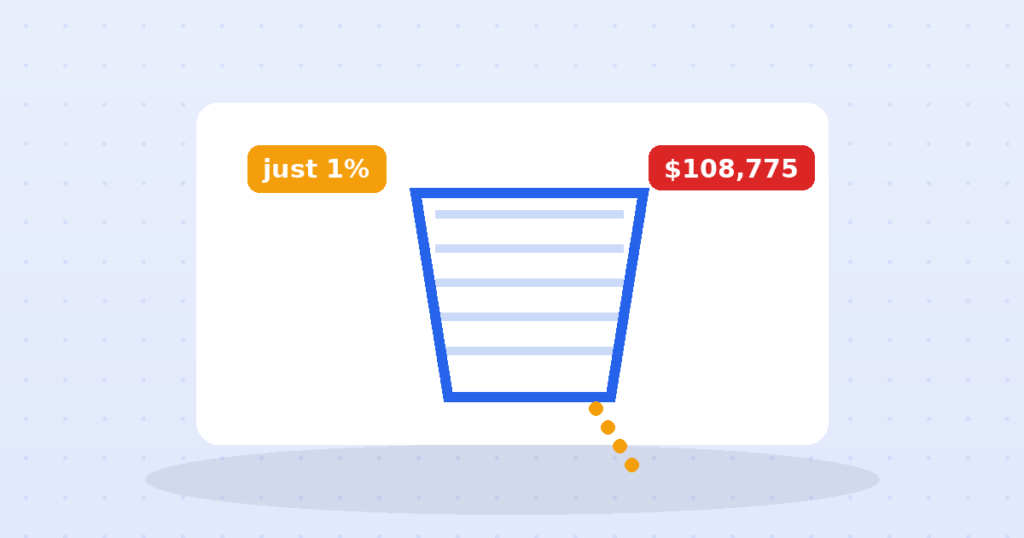
Dana’s 401(k) statement says her fund returned 7% last year, and it is not lying, exactly. It is just quietly leaving out that the market returned 8%, and that the missing point went to a fund company she has never spoken to, for “management” she cannot describe. One percent. Nobody quits a job over one percent. That is precisely why it is one percent.
An expense ratio is charged on your entire balance, every year, forever — not on this year’s contribution, on everything you have ever saved. As your balance grows, the fee’s bite grows with it, and the money removed stops compounding for you permanently. A 1% fee does not cost you 1%. Over a career it costs you closer to a fifth of your final wealth.
$500 a month for 30 years at a 7% net return grows to about $613,500. The identical contributions at 6% net — the same market, minus one point of fees — reach about $504,800. The difference: $108,775. That is not a rounding error; that is several years of retirement, transferred to an intermediary in slices too thin to notice.
Because it is invisible at every moment it is charged. No invoice, no line item on your pay stub — just a net-asset value that grows slightly slower than it should. The fund industry spent decades marketing “professional management” while, over long periods, most actively managed funds trail cheap index funds after fees. The 401(k) menu your employer picked may be stocked with the expensive kind, because plan providers get paid through those funds too — a practice politely called revenue sharing.
Simplified: assumes your contribution percentage and salary stay level (real paychecks usually get raises, which this does not model) and applies the employer match every month with no cap modeled -- check your plan document for the exact match formula and any vesting schedule, since unvested employer contributions are not really yours until vested.
Open your plan menu and find each fund’s expense ratio — it is a single number, and under 0.2% is the modern standard for index options. Move future contributions to the cheapest broad index fund on the menu. If your plan has nothing under 0.5%, contribute to the employer match, then consider an IRA at a low-cost brokerage for the rest. And ignore last year’s star performer; you cannot buy last year, but you will definitely pay this year’s fee.
The manager must beat the index by more than the fee, every year, for decades — a feat few sustain. You are betting six figures of your retirement on it. The index fund does not need the bet.
The fund’s expense ratio is in your plan’s fee disclosure and on any fund-research site. If it takes more than five minutes to find, that is itself information.
Disclaimer: This article is for general information only and is not financial or tax advice. Consult a qualified advisor before making investment or tax decisions.
Claiming at 62 vs 70 can change your monthly benefit by more than 50%. See your own numbers…
Same contribution, two tax treatments, very different after-tax outcomes depending on one bet: your future tax bracket.
Skip the scary generic headline number. Work backward from your own real spending to find what you actually…