Inflation Calculator: What Today’s Dollar Will Buy Later
See what today's amount will actually cost in the future - and why a retirement number that ignores…
 September 6, 2025by cyborg.vaibhav@gmail.com8 min read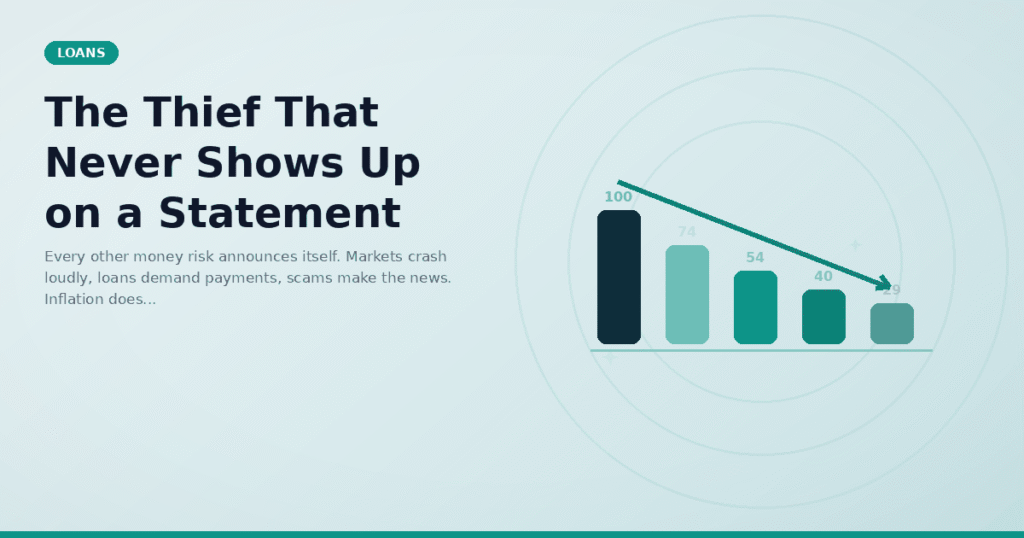
Wanda Pruitt retired from the postal service in Baton Rouge with a pension, a paid-off house, and a Social Security check that goes up almost every January. She did everything right, and she still feels poorer every year — not because her check shrank, but because the number that is supposed to protect her purchasing power is quietly built on an estimate of a rent she has never once paid. (Wanda is a composite character based on common fixed-income retiree patterns, not a real person — more on that at the end.)
Every other money risk announces itself. Markets crash loudly, loans demand payments, scams make the news. Inflation does its damage in total silence — no statement, no alert, no obvious loss — and over a lifetime it quietly steals more from cautious savers than any market crash ever does.
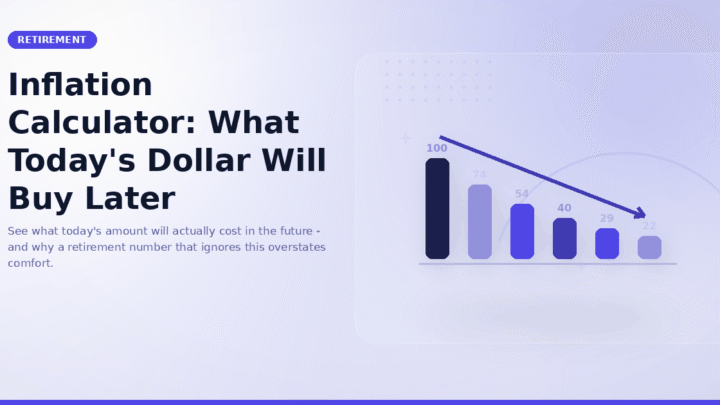
Inflation is simply the slow erosion of what your dollar can buy, measured most commonly through the Consumer Price Index (CPI), which tracks the price of a broad basket of everyday goods and services over time. The comparison below makes it concrete: what costs $100 today might cost $180 or more in twenty years at a typical long-run inflation rate. Your money in the bank didn’t shrink — its purchasing power did, while you weren’t looking.
Example: at 3% average annual inflation — roughly the long-run historical average — something costing $100 today costs about $181 in 20 years. That’s not a market crash or a bad decision; it’s just the ordinary passage of time at a modest, unremarkable inflation rate. Run that same math over a 40-year working life and prices can nearly triple.
This is the hidden flaw in playing it “too safe.” A savings account paying 4%, taxed down to roughly 3% after ordinary income tax, while inflation runs near 3%, is barely holding its ground in real terms. A near-zero big-bank account, meanwhile, is quietly losing you purchasing power every single year.
That’s the whole case for owning growth assets — stocks, primarily — for goals far in the future. Not because they’re exciting, but because over long stretches they’ve reliably outpaced inflation and protected your money’s real worth.
The practical lesson cuts both ways. For short-term money — the emergency fund, next year’s expenses, a house down payment due soon — stay safe; inflation over a year or two is a small thief. For long-term money, “safe” without growth is its own slow risk, just a quieter one. And whenever you set a future goal, inflate it honestly rather than using today’s prices.
Inflation is the one levy that requires no legislation, and every institution has made peace with it at your expense. Banks pay 0.4% on savings during 3%+ inflation — a guaranteed real loss marketed as safety. Wage cycles lag price cycles, and ‘merit increases’ below inflation are pay cuts with congratulations attached. Meanwhile unindexed thresholds across the tax code quietly promote you into higher effective burdens without a single rate ‘rising’.
The sales industry works both sides: fear-selling gold and annuities against hyperinflation that isn’t coming, while under-selling the boring 3% that definitely is — the one that halves purchasing power every 24 years and makes cash-heavy ‘conservative’ portfolios the riskiest thing a retiree can hold over 25 years.
Here is the part almost nobody explains to a retiree like Wanda, and it directly affects the number her COLA is measured against. Shelter makes up close to a third of the entire CPI basket the Bureau of Labor Statistics builds every month — and the largest single slice of that, Owners’ Equivalent Rent (OER), is not a price anyone actually paid. It is an estimate the BLS constructs by asking homeowners a hypothetical question: “If someone were to rent your home today, about how much do you think it would rent for?”
The BLS itself is candid about why it does this: nobody transacts an owner-occupied home’s “rent” every month, so there is no real transaction price to survey. Renters give the BLS an actual rent check; owners give a guess. That guess is then smoothed across a rotating survey panel and updated gradually, which means it structurally lags whatever is happening in the real rental market — understating housing inflation when rents are accelerating, then overstating it a year or two later once rents have already cooled. Either way, the printed CPI and the real cost Wanda’s neighbors are actually paying to rent or maintain a home can disagree for extended stretches, in both directions.
For Wanda specifically this cuts twice. Her Social Security cost-of-living adjustment is set once a year off a CPI measure that embeds this same lagging, estimated shelter figure. And because she owns her home outright, OER does not even describe a bill she pays — her real housing costs are property tax, insurance premiums and maintenance, all of which can rise at a completely different pace than the modeled rental-equivalent number driving her raise. A retiree in her position can end up with a COLA calibrated to a rent nobody billed her, while her actual insurance premium — the bill she does pay — runs hotter than the headline number implies.
What the calculator settles for Wanda: enter her pension and Social Security income alongside a realistic inflation assumption for the specific categories that hit her hardest — insurance, property tax, medical care — rather than the blended headline number, and it tells you how many years before her fixed income falls behind her actual bills, not the modeled ones.
It does not mean the CPI is rigged or that the BLS is hiding something. The OER methodology is published, debated openly in BLS’s own technical notes, and exists because there genuinely is no monthly transaction price for a service — “renting your own house to yourself” — that does not occur. The estimate is a defensible answer to a real measurement problem, not a conspiracy.
It also does not mean Wanda should ignore the headline number entirely, or assume every year will show the same insurance-versus-OER gap. Some years the lag runs the other way, and a homeowner’s specific bills can run cooler than the modeled shelter figure, not hotter. The point is not that CPI is wrong; it is that a national average built substantially from an estimate cannot be assumed to match any one household’s actual bills, and a retiree on a fixed COLA is exactly the household with the least room to absorb the gap when it runs against them.
And it does not mean the fix is panicking into gold or an annuity salesperson’s “inflation-proof” pitch. It means tracking your own real bills against the published number periodically, and building a buffer sized to your own heaviest categories rather than the blended average.
Equity ownership (companies reprice), your own earning power, I-bonds/TIPS for the cash slice, and fixed-rate debt (inflation shrinks it). Gold’s record is romantic and erratic.
Your personal basket differs — healthcare, education and rent bite harder for many — but the conspiracy versions mostly sell newsletters. Plan with 3% general, more for your known heavy categories.
Because there is no transaction to survey. A renter’s rent check is a real price; a homeowner living in their own house generates no equivalent monthly bill for “housing services,” so BLS asks owners to estimate what their home would rent for and uses that as a stand-in. It is a reasonable answer to a genuinely hard measurement problem, but it is still a modeled number, not a receipt.
Regulatory source: the U.S. Bureau of Labor Statistics publishes both the CPI relative-importance weights and its own methodology notes explaining Owners’ Equivalent Rent and why it is estimated rather than transacted. The application of that lag to Wanda’s specific fixed-income situation is this article’s own.
General information, not financial advice. “Wanda Pruitt” is a composite character based on common fixed-income retiree patterns, not a real person.
See what today's amount will actually cost in the future - and why a retirement number that ignores…
The HSA shoebox strategy, 457(b) stacking, asset location, 0% capital gains harvesting, NUA and the mega-backdoor Roth, plus…
Each refi resets the interest-heavy years and rolls in fresh costs. Keep the rate; keep the clock honest.
Fear sells early claiming -- a permanent 30% cut to dodge a hypothetical 20% one. Run the break-even…
The default fund stacks a wrapper fee on underlying fees -- $118,000 over a career for a rebalancing…
Interest plus 1%: enough to keep you current, never enough to free you. $5,000 becomes 19 years and…