The Debt That Compounds Against You — Kill It First
Of all the numbers in personal finance, one deserves genuine urgency: a credit-card balance. At rates often north…
 March 26, 2026by cyborg.vaibhav@gmail.com7 min read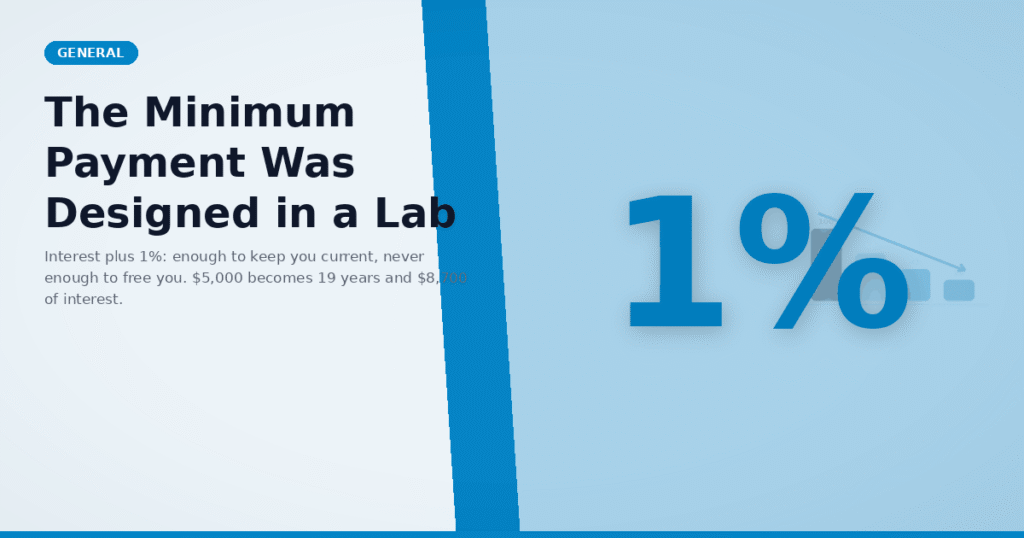
Devon Pruitt, 30, a warehouse operations lead in Memphis, Tennessee, carries two balances on the same card: an old $2,000 balance-transfer promo at 0%, and a newer $3,000 balance from ordinary purchases at 24%. Every month Devon pays a little above the minimum, assuming the extra dollars just chip away at “the balance” generically. They don’t. A federal rule most cardholders have never heard of decides exactly which balance that extra money attacks first — and it happens to work in Devon’s favor, but only above the minimum, never at it.
Most issuers set the minimum at interest plus 1% of the balance. Decode that: the payment covers everything the bank earned this month, plus a token so the balance technically shrinks — at a pace measured in presidential administrations. At 24% APR, month one on $5,000 is $100 of interest; the minimum of $150 retires just $50 of debt. The structure guarantees the bank collects its yield in full every month while your principal ages like a mortgage.
Under the CARD Act’s payment allocation rule, when a cardholder pays more than the minimum on a card carrying balances at different interest rates, the issuer must apply the amount above the minimum to the highest-APR balance first. Before this rule existed, issuers routinely applied extra payments to whichever balance was cheapest for the cardholder but most profitable to keep revolving on the expensive side — typically the low-rate promotional balance — leaving the higher-rate balance untouched and accumulating interest indefinitely. For Devon, this means any dollar paid above the minimum goes straight at the 24% purchase balance, not the 0% promo, without needing to call the issuer or request it specifically. The catch: the minimum payment itself is still allocated proportionally across balances under the issuer’s normal formula, so paying only the minimum gets none of this protection — the favorable allocation rule only activates on money paid above it.
After the CARD Act, statements must disclose the minimum-payment timeline — that grim little box you have trained yourself not to read. Separately, a CFPB rule that would have capped late fees at $8 was vacated by a federal court in 2025 after the agency agreed it had overstepped the CARD Act’s own “reasonable and proportional” standard; issuers can once again charge the pre-rule range of roughly $25-$41, though several who’d already switched systems to $8 haven’t all reverted. Both the payment box and the late-fee ceiling are regulated territory, but “regulated” doesn’t mean “fixed” — the specific dollar amounts move as rules get finalized, challenged, and sometimes struck down.
This matters for Devon’s situation in a very concrete way: a single missed payment doesn’t just cost a fee somewhere between $8 and $41 depending on which issuer and which year — it can also trigger a penalty APR on the account, which then becomes the new highest-rate balance the allocation rule routes extra payments toward. A late payment doesn’t just cost the fee itself; it can restructure which balance the payment-allocation protection is even protecting, turning a card that was working in the cardholder’s favor into one where the “highest-rate balance first” rule is now attacking a penalty rate instead of a purchase rate, which is a worse trade than it sounds.
Every tool in the app orbits the same goal: keep balances revolving. Pre-approved limit increases arrive after you revolve, not before. “Flexible payment options” default the slider to the minimum. Points programs pay you 1% to borrow at 24%. None of it is a conspiracy; all of it is optimization, and you are the metric.
YOU ENTER your real balance, rate, and a monthly payment above the minimum. IT TELLS YOU the payoff date and total interest — and for a card like Devon’s with more than one balance at different rates, remember that only the amount above the minimum gets legally routed to the expensive balance first.
"Minimum only" models a typical 2% of balance payment (floor $25) that shrinks every month as the balance falls - the scenario that keeps a balance alive for years and multiplies the interest paid. Assumes no new charges are added to the card while paying it down.
Pick a fixed payment — the same dollar amount every month, as high as survivable — instead of the shrinking minimum; that single change collapses the timeline from decades to a couple of years. Attack the highest-APR card first. A 0% balance-transfer card or a personal loan at a third of the rate is a legitimate weapon if, and only if, the spending stops. Run the calculator above with your real balance and watch the payoff date move as you change the payment — it is the most motivating slider on this site.
You avoid late marks, but high utilization suppresses your score anyway. On-time minimums are the floor of creditworthiness, not the substance of it.
Keep a small emergency buffer, then yes — no savings account pays anything close to the 24% you are being charged. You cannot out-save a revolving balance.
You don’t need to — the CARD Act’s payment allocation rule already requires the issuer to apply anything above your minimum to the highest-rate balance automatically. What’s worth double-checking on your own statement is simply how much you’re paying above the minimum each month, since that’s the only portion the rule actually protects.
Yes — cash advances typically carry a higher APR than purchases and often start accruing interest immediately with no grace period, which usually makes them the highest-rate balance on the card by default. Under the same allocation rule, any payment above the minimum on a card carrying both a cash advance and a purchase balance goes to the cash advance first, precisely because it’s the most expensive debt sitting on the account.
None of this changes the basic math from the top of this page: the minimum payment, on its own, is built to barely dent a balance while collecting a full month of interest, and no allocation rule fixes that by itself. What the allocation rule does is make sure that once you decide to pay more, that extra effort isn’t wasted on the wrong balance by a system quietly working against you. Devon’s real lesson wasn’t that the 0% promo needed protecting — it was that the law was already protecting it, and the actual decision that mattered was simply choosing to pay more than the minimum in the first place.
Sources: Regulation Z / CARD Act payment allocation rule (12 CFR 1026.53), and the Consumer Financial Protection Bureau’s Credit Card Penalty Fees final rule and its 2025 vacatur, at consumerfinance.gov.
Disclaimer: This article is for general information only and is not financial or tax advice. “Devon Pruitt” is a composite character with invented finances, not a real person. Consult a qualified advisor before making financial decisions.
Of all the numbers in personal finance, one deserves genuine urgency: a credit-card balance. At rates often north…
Minimum payments are designed to keep a balance alive for years. See what a fixed higher payment actually…
The HSA shoebox strategy, 457(b) stacking, asset location, 0% capital gains harvesting, NUA and the mega-backdoor Roth, plus…
Each refi resets the interest-heavy years and rolls in fresh costs. Keep the rate; keep the clock honest.
Fear sells early claiming -- a permanent 30% cut to dodge a hypothetical 20% one. Run the break-even…
The default fund stacks a wrapper fee on underlying fees -- $118,000 over a career for a rebalancing…