The Refinance Treadmill: Lower Payment, Longer Sentence
Each refi resets the interest-heavy years and rolls in fresh costs. Keep the rate; keep the clock honest.
 February 16, 2026by cyborg.vaibhav@gmail.com3 min read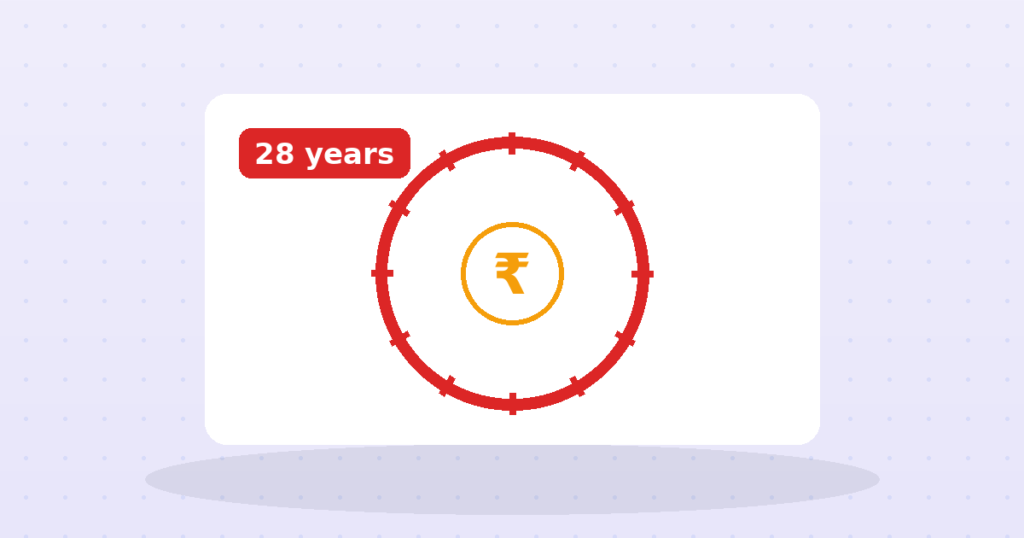
The SMS is gentle: “Minimum amount due: ₹5,000. Pay now to stay stress-free.” Anita pays it, feels responsible, and moves on. Nobody tells her what she just signed up for: at this pace, her ₹1 lakh balance will take 28 years to clear, and she will hand the bank about ₹4.7 lakh — for money she has already spent. The minimum due is not a payment plan. It is a subscription to interest.
Credit card interest runs at 36–48% a year — call it 3.5% a month. The minimum due is typically 5% of the balance. Watch what happens in month one: on ₹1,00,000, interest is ₹3,500. GST at 18% on that interest adds ₹630. So ₹4,130 of Anita’s ₹5,000 payment evaporates into charges, and her balance drops by ₹870. The minimum is not sized to walk you out of debt; it is sized to keep the debt alive while technically not defaulting. That is not an accident of arithmetic. Someone chose 5%.
Notice the second charge: GST on the interest. When a lakh of card debt compounds at 42%, the government collects 18% of every interest charge, month after month, for 28 years. The most punishing consumer interest rate in the mainstream system is also a tax base. Nobody in that chain is in a hurry for Anita to be free.
Card companies have a name for people who pay in full: “transactors” — tolerated, barely profitable. People like Anita are “revolvers”, and they are the profit centre. The reward points, the limit increases that arrive unasked, the EMI-conversion offers on large purchases — all are instruments tuned to one goal: keep the balance revolving. The interest-free period you think you have vanishes entirely the moment you carry any balance; interest then runs from each transaction’s date.
Simulated month by month: interest accrues on the reducing balance at your card's rate, plus 18% GST on that interest — a uniquely Indian cost most payoff calculators quietly skip. At a 42% APR, GST takes the true cost of carrying a balance to over 49% a year. The minimum-payment card assumes the common 5%-of-outstanding (floor ₹200) formula — watch how it stretches the debt for years while barely denting the principal.
Tax: there is no deduction of any kind for credit-card interest on personal spends — every rupee of interest and GST here is paid from post-tax income. At a 30% slab, ₹1 of card interest costs you ₹1.43 of salary. That's why clearing a card balance is the single highest guaranteed "return" available to most people — no investment reliably beats 49% post-tax.
Treat the minimum due as what it is: the bank’s preferred outcome. Pay in full, always; if you cannot, pay the absolute maximum you can and stop using the card until clear. Already deep? A personal loan at 12–16% to retire a 42% balance is not more debt — it is a two-thirds pay cut for your creditor. Run the calculator above with your real balance: seeing “28 years” printed against your own number does more than any lecture.
It avoids a default mark, yes — while your utilisation stays maxed, which itself drags the score down. You are preserving the score’s floor, not its health.
Because your behaviour marks you as profitable. A higher limit for a revolver is not a compliment; it is inventory expansion.
Disclaimer: This article is for general information only and is not financial or tax advice. Consult a qualified advisor before making investment or tax decisions.
Each refi resets the interest-heavy years and rolls in fresh costs. Keep the rate; keep the clock honest.
Fear sells early claiming — a permanent 30% cut to dodge a hypothetical 20% one. Run the break-even…
The default fund stacks a wrapper fee on underlying fees — $118,000 over a career for a rebalancing…