

The Refinance Treadmill: Lower Payment, Longer Sentence
Each refi resets the interest-heavy years and rolls in fresh costs. Keep the rate; keep the clock honest.
 April 6, 2026by cyborg.vaibhav@gmail.com3 min read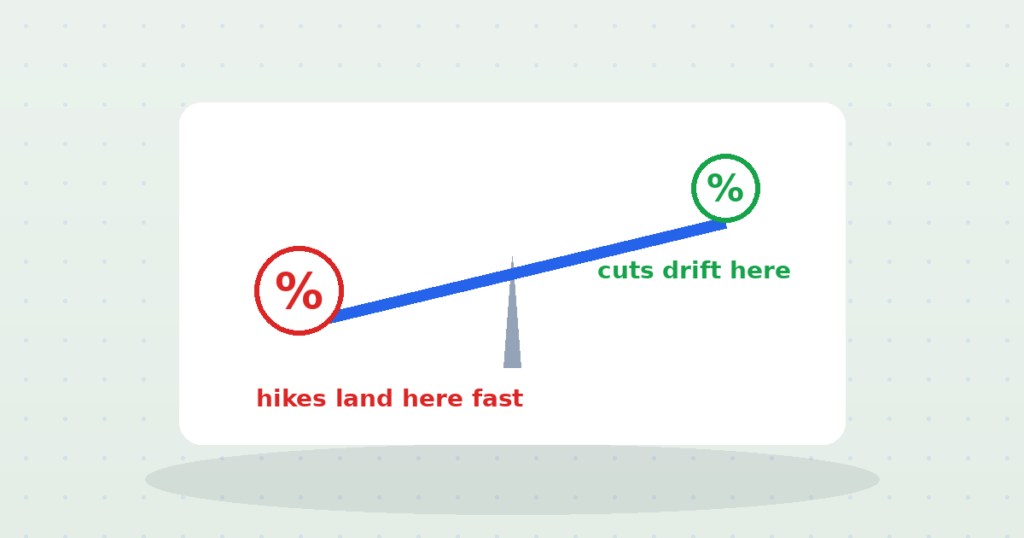
When RBI raised rates in 2022, Nitin’s home-loan EMI adjusted within the quarter — the bank’s SMS was almost proud. When RBI began cutting, Nitin waited. And waited. His deposit rates fell promptly enough, but the loan’s descent was somehow slower, an administrative glacier. Rate hikes, he learned, travel first class. Rate cuts walk, and they stop for tea.
Banks fund loans partly from deposits. When policy rates rise, loan rates (linked to external benchmarks) reprice on schedule — but deposit rates are raised grudgingly, and old fixed-rate deposits keep paying you the old low rate till maturity. When policy rates fall, the mirror image: deposit rates drop with theatrical speed, while loan-side spreads, reset dates, and “policy transmission lags” buy the bank a quarter here, a quarter there. Each lag is small. Multiplied by crores of accounts, the float between fast and slow is a revenue stream with no product behind it — pure timing, engineered.
On a ₹50 lakh loan, a 0.25% cut delayed by six months costs about ₹6,250 — invisible in any single statement. Two or three such episodes per rate cycle, per borrower, across a career of borrowing: the invisible becomes a lakh, collected without ever appearing as a fee. The reset-date fine print (quarterly, from benchmark movement, from the bank’s “review”) decides which class your money travels in.
The same asymmetry meets you as a depositor: rate-cut cycles reach your FD renewals instantly, rate-hike cycles arrive at the counter late. Auto-renewal is the mechanism — deposits rolling over silently at whatever the board says that morning, no negotiation, no comparison. The bank’s timing advantage is bidirectional; your inattention funds both directions.
Indicative only. On a floating-rate loan, a rate change here recomputes the EMI for the remaining balance and term. Prepayments have no penalty on floating-rate home loans in India. Confirm exact figures with your lender.
Tax: home-loan tax breaks exist only in the old regime for a self-occupied house — up to ₹2L/yr of interest under §24(b) and up to ₹1.5L/yr of principal within the shared 80C bucket (the 80C limit is shared with PPF, ELSS, insurance etc., so the principal benefit is often already used up). The new regime gives no deduction for a self-occupied home. A let-out property is different: the full interest is deductible against rent in both regimes, with loss set-off against other income capped at ₹2L/yr (old regime only; excess carries forward). The tax-benefit box uses year-1 figures — interest falls each year, so the §24(b) benefit shrinks over the tenure. Prepaying reduces interest, which also reduces this deduction: the savings box above is the gross figure, and your net saving is a little lower if you were claiming 24(b).
Know your reset date — it is in your loan agreement and your netbanking; diarise it. After every policy cut, check the following reset actually delivered it; if not, a written query citing the external-benchmark guidelines moves files surprisingly fast. On deposits, kill auto-renewal defaults and ladder maturities so renewals are decisions. You cannot change the system’s timing; you can refuse to be its slowest participant.
Mostly no — the lag lives legally inside reset frequencies and spread definitions. That is what makes it grey: each step defensible, the sum extractive.
Floating with vigilance beats fixed for most, since fixed-rate premiums price in the bank’s own rate expectations. The operative word is vigilance — the calculator above, once a quarter, is the whole discipline.
Disclaimer: This article is for general information only and is not financial or tax advice. Consult a qualified advisor before making investment or tax decisions.
Each refi resets the interest-heavy years and rolls in fresh costs. Keep the rate; keep the clock honest.
Fear sells early claiming — a permanent 30% cut to dodge a hypothetical 20% one. Run the break-even…
The default fund stacks a wrapper fee on underlying fees — $118,000 over a career for a rebalancing…