The Refinance Treadmill: Lower Payment, Longer Sentence
Each refi resets the interest-heavy years and rolls in fresh costs. Keep the rate; keep the clock honest.
 February 10, 2026by cyborg.vaibhav@gmail.com3 min read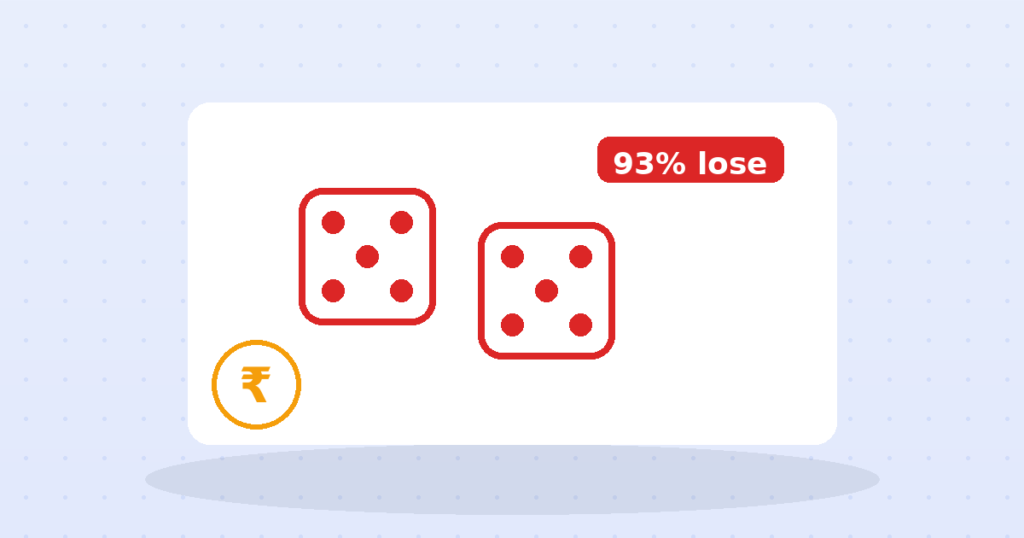
Prakash checks his F&O positions from the office toilet, because that is the only place nobody asks what he is looking at. Eleven lakh people like Prakash lost money in derivatives over three years — and he genuinely believes he is one trade away from getting it back. He is not fighting the market. He is fighting a business model.
This is not a moralising uncle’s opinion. SEBI counted every trader: between FY22 and FY24, 93% of individual F&O traders lost money. The average loser dropped about ₹2 lakh including costs. The total: over ₹1.8 lakh crore transferred out of retail pockets in three years. Only about 1% earned more than ₹1 lakh after costs. A casino with these odds would at least give you a free drink.
Your losses are not vaporised — they are revenue. Proprietary desks and algorithmic traders on the other side of your trades take the spread. Your broker takes brokerage on every leg, win or lose — which is why the app celebrates your order with confetti, not your returns. The exchange takes transaction charges. The government takes STT and GST. Every layer of the pyramid is paid by turnover, and you are the turnover. The “free education” webinars, the Telegram tips channels, the influencers with rented luxury cars — all of it is a funnel built to keep the 93% refilling the pool.
The average loss is not just money gone; it is a future confiscated. ₹2 lakh left alone in a boring index fund for 20 years at 12% becomes about ₹19.3 lakh. Prakash did not lose two lakh. He lost nineteen.
SEBI’s most damning line was not the 93%. It was that three-quarters of the losers kept trading after two straight years of losses. Options are engineered to feel like skill: near-misses, occasional jackpots, a round-the-clock scoreboard. That is not an investment product’s psychology. That is a slot machine’s.
Illustration only. Equity returns are not guaranteed and do not arrive in a straight line. Tax: the post-tax line in the results treats this as an equity fund — units held over 12 months pay 12.5% LTCG on gains beyond ₹1.25L per financial year (units sold within 12 months, e.g. your most recent instalments, pay 20% STCG instead, so the true bill on a one-shot redemption is slightly higher than shown; spreading redemption across years uses the ₹1.25L exemption more than once and lowers it). Debt funds have no LTCG rate at all — their entire gain is taxed at your slab. Start a SIP →
If you trade derivatives with money you cannot lose, stop reading and close the position. If you must scratch the itch, ring-fence it: a fixed small pot, never topped up, never funded by loans or credit cards. And run the SIP calculator above with whatever you lost last year — not to feel bad, but because seeing what it becomes by 60 is the only cure that works.
So does SEBI — about 1 in 100, mostly professionals with speed, data and hedges you do not have. You are not competing against the market; you are competing against them.
No. Owning businesses for years has positive expected returns; leveraged bets on Tuesday’s expiry do not. The industry blurs the two on purpose — “equity market participation” sounds better than what weekly options actually are.
Disclaimer: This article is for general information only and is not financial or tax advice. Consult a qualified advisor before making investment or tax decisions.
Each refi resets the interest-heavy years and rolls in fresh costs. Keep the rate; keep the clock honest.
Fear sells early claiming — a permanent 30% cut to dodge a hypothetical 20% one. Run the break-even…
The default fund stacks a wrapper fee on underlying fees — $118,000 over a career for a rebalancing…